
Impact of ICT on
Motivation and Learning in Primary Education: Towards an exciting school
Impacto de las TIC en la motivación y el
aprendizaje en educación primaria: Hacia una escuela emocionante

 Francisco Ábalos-Aguilera. Universidad Rey Juan Carlos. España.
Dr. Javier Hueso-Romero. Universidad Nacional de Educación a Distancia. España.
Dr. Luis M. Romero-Rodríguez. School of Comunication,
University of Sharjah (UAE) y ESAI Business School,
Universidad Espíritu Santo. Ecuador
Received: 2025/03/13 Reviewed 2025/11/20 Accepted: 2025/11/21 Published: 2026/01/01
How to cite:
Ábalos-Aguilera, F.; Hueso-Romero, J. &
Romero-Rodríguez, L.M. (2026). Impact of ICT on Motivation and Learning in
Primary Education: Towards an exciting school [Impacto de las TIC en la motivación y el aprendizaje en educación primaria:
Hacia una escuela emocionante]. Pixel-Bit,
Revista de Medios y Educación, 75,
Art. 1. https://doi.org/10.12795/pixelbit.114450
ABSTRACT
This study analyzes the impact of Information and Communication
Technologies (ICT) on the motivation and learning of primary education students
through a longitudinal quasi-experimental design that compares a pedagogical
intervention based on ICT, gamification, and Game-Based Learning (GBL) with the
results of a similar study conducted a decade earlier. The intervention was
structured around a gamified interactive digital object and assessed through a
digital questionnaire measuring students’ perceptions of ICT use, motivation,
and academic performance. The results show that, although technological
intermediation continues to have a positive influence on motivation, its
current impact depends more on the methodological and emotional design of the
pedagogical proposal than on the mere presence of digital tools or devices. The
study provides a replicable model of technopedagogical integration and
introduces the concept of affective digital literacy, concluding that ICT is a
valuable tool only when implemented through active, gamified strategies that
are contextually adapted to the characteristics of each school and student
group.
RESUMEN
Este estudio analiza el
impacto de las Tecnologías de la Información y la Comunicación (TIC) en la
motivación y el aprendizaje de estudiantes de educación primaria mediante un
diseño cuasi-experimental
longitudinal que compara una intervención pedagógica basada en TIC,
gamificación y Aprendizaje Basado en Juegos (ABJ) con los resultados de un
estudio similar realizado una década antes. La intervención se articuló en
torno a un objeto digital interactivo gamificado y se
evaluó mediante un cuestionario digital que midió la percepción del uso de las
TIC, la motivación y el rendimiento académico. Los resultados muestran que, si
bien la intermediación tecnológica sigue influyendo positivamente en la
motivación, su impacto actual depende más del diseño metodológico y emocional
de la propuesta que de la mera presencia de dispositivos o recursos digitales.
El estudio aporta un modelo replicable de integración tecnopedagógica
y apunta hacia la noción de alfabetización digital afectiva, concluyendo que
las TIC son una herramienta valiosa solo cuando se incorporan a través de
estrategias activas, gamificadas y contextualizadas a
las características de cada centro y grupo de alumnado.
KEYWORDS· PALABRAS CLAVES
Educational innovation; Technology intermediation;
Educational engagement; Educational achievement; Active learning; Active
learning
Innovación educativa;
Intermediación tecnológica; Compromiso educativo; Rendimiento escolar;
Aprendizaje activo
1. Introduction
Although relatively recent, emotions have gradually
become a central axis in scientific research related to education. For centuries,
they remained relegated to the background in favor of
rationalist and empiricist approaches that dominated scientific inquiry.
However, the term “emotions” has progressively gained relevance in
educational literature, reflecting a growing interest among researchers (e.g.,
Rebollo et al., 2008; Méndez-Aguado et al., 2020; Casanova-Mata, 2023;
Quílez-Robles et al., 2023). Today, the educational field faces a paradox:
despite the increasing attention given to emotions, interdisciplinary studies
remain scarce. Neuroscience, psychology, sociology, communication, and
education each examine emotions from their own epistemological and ontological
frameworks, producing a fragmented analysis that limits a comprehensive
understanding of their role in learning.
The etymological meaning of emotĭo
refers to a “movement toward” or “impulse,” and has been categorized in various
ways. Casassus (2007) proposes a typology based on
the feelings associated with emotions, distinguishing between positive,
negative, and neutral emotions. Positive emotions—such as happiness—are linked
to pleasant sensations that generate beneficial situations. Conversely,
negative emotions—such as anxiety or fear—are associated with discomfort and
perceived threat. Unlike other authors, Casassus
introduces a third category: neutral emotions, including surprise or hope,
which lack a clear emotional valence and align more closely with the original
notion of impulse.
The influence of emotions on behavior
and learning is essential, as they directly shape how knowledge is assimilated.
Studies in neuroscience, psychology, and education demonstrate that learning
depends not only on cognitive ability but also on emotional and motivational
factors (Tyng, 2017; Tan et al., 2021; Gkintoni et
al., 2023; Astleitner, 2000). Camacho-Morles et al.
(2021) argue that interest and the need for information condition the
acquisition of knowledge: enjoyment fosters academic performance, whereas
boredom or frustration have a detrimental effect. This interplay between
emotion and cognition explains how actions, thoughts, and memories rely on the
synchronisation of both systems.
Pekrun et al. (2002) further confirmed this
relationship by challenging the traditional view that educational success
depends solely on intelligence, highlighting instead the importance of
motivation and interest in constructing meaningful learning. Recent research
reinforces this perspective, underscoring that learning extends beyond
memorisation and requires a balance between emotional and cognitive processes
to be effectively consolidated (Camacho-Morles et al., 2021; Tan et al., 2021;
Lozano-Fernández et al., 2000).
1.1.
Emotions and academic
performance
Learning is intrinsically linked to emotions. As Mora
(2013) famously asserts, “one can only learn what one loves.” Goleman
(1996) reinforces this by arguing that life success depends 80% on emotional
intelligence and only 20% on cognitive intelligence—an idea applicable to the
educational domain. Pekrun (1992) identifies emotions
as a core component of student psychology, connecting them to motivation and
cognitive strategies that influence academic performance. Contemporary studies
consolidate this connection (Tyng et al., 2017; Tan et al., 2021; Gkintoni et al., 2023; Astleitner,
2000), while De Sitxe and Sánchez (2014) describe
cognition, motivation, and emotion as interdependent determinants of learning.
1.2.
Motivation in the classroom
Motivation plays a fundamental role in learning, influencing
cognition, memory, and behavior (Roman, 2022;
Sánchez-Sánchez et al., 2020; Polaino-Lorente, 2011).
According to Polaino-Lorente (op. cit.) and Ausubel’s (1960) theory of
meaningful learning, students only feel motivated when they perceive an actual
usefulness in the task they are performing. Although the concept of motivation
is complex, most studies agree in defining it as the set of processes that
activate, direct, and sustain behavior (Bekker et
al., 2023; Feraco et al., 2023).
From an educational perspective, two main types of
motivation are distinguished: intrinsic motivation, linked to personal interest
and self-regulated learning (Howard et al., 2021), and extrinsic motivation,
determined by external factors such as rewards or sanctions (Anaya-Durand &
Anaya-Huertas, 2010; Schunk & Dibenedetto, 2020).
Intrinsic motivation has been shown to promote deeper and more lasting learning
compared to extrinsic motivation (Buzdar et al., 2017; Rinaudo et al., 2006).
Stipek (1988) points out that students’ interest in the task influences the
prevailing type of motivation, highlighting the role of the teacher in planning
instructional strategies that foster enthusiasm and active involvement in the
learning process.
1.3.
The affective role of ICT
in education
Dewey (1995) argued that the school environment should
balance play and work to support children’s development. This idea remains
relevant in educational technology research, which highlights the positive
impact of ICT on motivation and academic performance (Bekker et al., 2023;
Camacho-Morles et al., 2021; Méndez-Aguado, 2020; Muñoz-Millet, 2023).
Victoria-Maldonado (2024) notes that ICT integration in the classroom
encourages dynamic and interactive learning experiences, facilitates access to
information, and generates flexible and adaptive environments (Cabero-Almenara,
2003). Nevertheless, Area (2009) warns that these resources should be
considered as more than simple information transmission tools, while
Siraj-Blatchford and Romero-Tena (2017) emphasize the need to incorporate ICT
progressively to promote playful learning environments.
However, their implementation requires a
methodological shift that fosters active student participation (Moya, 2013).
Requena (2008) and Trujillo-Torres et al. (2020) argue that ICT enrich
educational experiences by involving students meaningfully in their own
learning. Nonetheless, Parra-González et al. (2020) caution that the mere
introduction of technology in the classroom does not guarantee improvements in
learning. Coll (2008) emphasizes that its pedagogical potential lies in the
teacher’s instructional strategy rather than in the technology itself. Thus, it
is necessary to adopt innovative approaches that promote interaction,
creativity, and collaboration. Correct ICT integration will enable new forms of
teaching aligned with the educational demands of the 21st century.
1.4.
Background of the research
The quasi-experimental study carried out in 2014 at
the Tierno Galván Public School in Granada analyzed
the relationship between emotions, ICT use, and academic performance in the
educational context. The sample included 38 students aged 8 and 9 years,
divided into an experimental group of 18 students and a control group of 20
students, selected intentionally to ensure homogeneity in variables such as
socioeconomic level and academic background. The methodology sought to minimize
the influence of external factors and focus on the impact of ICT and emotions
on learning.
To collect the data, a questionnaire with 43 simple
items and Likert-scale questions was designed, evaluating motivation, emotions,
and students’ perception of learning with ICT. Its development included prior
analysis of similar instruments and validation by a panel of experts in
education and psychopedagogy, who made
adjustments to improve clarity and precision.
The results showed significant differences between the
two groups, indicating that integrating digital resources in the classroom,
combined with a methodology focused on motivation and emotions, had a positive
impact on learning and emotional well-being. The experimental group experienced
a reduction in negative emotions such as disappointment and boredom,
accompanied by a considerable increase in motivation. Regarding academic
performance, this group obtained higher results in exams and evaluations, with
an average of 9.33 out of 10, compared to 6.80 for the control group. Table 1
summarizes the main findings, highlighting the influence of ICT on the level of
enjoyment and motivation among students.
Table 1
Results of the
2014 study
|
Variables
|
|
|
||||||
|
Control
Group Results |
Experimental
Group Results |
Control
Group Results |
Experimental
Group Results |
|||||
|
Enjoyment_ICT |
NO – 35,0% |
YES - 65,0% |
NO - 35,0% |
SÍ - 65,0% |
||||
|
NO – 16.7% |
SÍ - 83,3% |
NO - 11,1% |
SÍ - 88,9% |
|||||
|
Variables |
Control
Group |
Experimental
Group |
||||||
|
Motivation_Use_PC |
NO – 45% |
SÍ - 55% |
NO – 16,7% |
SÍ - 83,3% |
||||
|
Academic
performance |
6, 80
point out of 10 |
9,33 point out of 10 |
||||||
Despite the favorable
results, the study presented some limitations, such as the insufficient
availability of technological resources in the school, which hindered optimal
implementation of the methodology. In addition, some students lacked
technological devices at home, generating a digital divide that affected equal
access to educational resources. Despite these difficulties, the findings
indicate that strategic ICT integration, combined with adaptive methodologies,
can be an effective tool to improve motivation and academic performance. Future
research should explore best practices for technology integration in education,
considering not only available resources but also the socioemotional context of
students.
This study differs from previous research by combining
emotional, technological, and pedagogical perspectives in the analysis of
learning in primary education. It offers an innovative view of ICT use by
integrating the affective and motivational variable into a longitudinal
quasi-experimental design, replicating a previous study and updating its
results in a context of consolidated digitalization. Based on this, the present
research adopts a quasi-experimental exploratory approach and seeks to examine
the impact of using technological educational resources in primary classrooms,
within an affective approach based on emotions. From
this framework, three research questions arise:
PI1: Does the use of technology in the classroom
predispose students’ emotional states?
PI2: Does the methodological variant generate
differences in the learning acquired between the groups participating in the
study?
PI3: Is there evidence of changes in the results
throughout the ten years since the implementation of the previous study?
2. Method
This study seeks to evaluate the effectiveness of an
innovative pedagogical proposal that integrates technological resources and
playful strategies to optimize the understanding of scientific concepts in
third-grade primary education students. It analyzes
the impact of this intervention on the learning of theoretical content,
comparing the results with those obtained in a similar study conducted in 2014.
The research examines whether the integration of technology and playful
pedagogical methodologies has fostered more meaningful and lasting learning, in
contrast to traditional approaches, and how its effectiveness has evolved
considering changes in access to and use of ICT in the last decade.
The study was developed in two phases. The first
phase, descriptive in nature and with a qualitative approach, consisted of a
detailed analysis of the attitudes, emotions, and initial perceptions of the
students regarding the subject of Natural Science. For this purpose, a
questionnaire created with Microsoft Forms was used, whose objective was to
evaluate students’ perception of ICT use within the classroom. Specifically,
the questionnaire sought to determine whether students considered that the use
of ICT, especially educational video games, could be useful for their learning
in the Natural Science subject. Additionally, the questionnaire included
questions about the degree of acceptance of ICT and students’ perception of the
subject before and after the technological intervention. The objective was to
measure whether the incorporation of these digital tools, such as educational
video games, increased interest and improved the perception that students had
of the subject.
In the second phase, with a comparative and
quantitative approach, differences between the control group (3ºA) and the
experimental group (3ºB) were evaluated, within an intervention design in which
active methodologies such as gamification and Game-Based Learning (GBL) were
incorporated. In the experimental group, an interactive digital object was
used, designed with tools such as Genially and Canva, which allowed the
integration of different resources such as educational videos, interactive
activities, and games related to the subject and created specifically for this
purpose, all within the same digital object. The interface of this digital
object was structured in the form of a video game, in which students advanced
through levels of learning related to the contents of the Natural Science
subject. This approach allowed students to engage actively in the learning
process, with a playful integration of content that fostered intrinsic
motivation, collaboration, and critical thinking. The use of this interactive
digital object enabled students to visualize complex concepts dynamically and
participate in practical exercises, promoting collaborative learning and deeper
engagement with the content.
To ensure accurate evaluation of the variables, a
detailed or "fine-grained" analysis approach was applied, enabling a
rigorous comparison of the impact of the methodology on learning and
motivation. This included measuring the frequency of ICT use, the types of
activities performed (collaborative work, educational games, online research),
and the results obtained in pre- and post-tests, with special attention to how
these resources supported autonomy and interest in learning.
2.1. Instrument
Two different instruments were used in this study: (1)
an evaluation instrument, consisting of a digital questionnaire designed to
measure the motivation and perception of students regarding the use of ICT in
the classroom; and (2) a pedagogical intervention instrument, represented by an
interactive digital object that was used exclusively with the experimental
group as part of the teaching process.
2.1.1. Evaluation
instrument: digital questionnaire
The first instrument consisted of a questionnaire
administered through Microsoft Forms, designed to evaluate the perception of
students regarding the use of ICT in the classroom, their motivation toward the
Natural Science subject, and their interest in technological resources in
educational contexts. Its structure was based on two main dimensions:
ICT-guided learning and motivation or engagement.
In addition to measuring the general perception of
students regarding ICT, the questionnaire included specific items related to
the resources used in the practice. Specifically, it evaluated the perceived
usefulness of the digital object, the level of enjoyment and concentration
experienced during the interactive activities, and the relevance of educational
video games as a means to learn content from Natural
Science. This direct correspondence between the instrument and the
technological experience made it possible to analyze
accurately how the integration of ICT influenced motivation and learning,
offering a deeper understanding of the pedagogical role of digital resources in
the classroom.
The instrument used in this study was an adaptation of
a questionnaire previously validated in 2014, designed to evaluate the
motivation and attitude of students toward the Natural Science subject, with a
focus on ICT use. The validation process of the adapted instrument was carried
out in various stages, following rigorous procedures to ensure its reliability
and validity in the context of this new study. These stages included validation
by expert judgment, contextual adjustments to the instrument to ensure its
applicability to the new group of students, and construct validation through
Exploratory Factor Analysis (EFA).
In the first stage of the validation process, the
instrument was evaluated by a panel of experts in the field of education and
educational technology. These experts, with extensive experience in the field
of student motivation and ICT implementation in the classroom, were responsible
for reviewing the content of the questionnaire and ensuring that the items were
relevant, clear, and appropriate to measure the constructs of motivation and
attitude in the educational context. This process of expert judgment validation
made it possible to ensure the content validity of the instrument, since the
experts confirmed that the questionnaire items addressed relevant aspects
related to ICT use and student motivation in Natural Science. Additionally,
this step ensured that the items were understandable and appropriate for
third-grade primary education students, which was a fundamental requirement to
ensure that participants could interpret the questions properly.
2.1.2. Adaptation to the educational context and
lexical adjustments
With the aim of optimizing the applicability of the instrument
to the new context, lexical and structural adjustments were made to the
questionnaire. Since the target population of this study consisted of
third-grade primary education students, the wording of the questionnaire was
reformulated to adapt it to the comprehension level of the participants. These
modifications involved simplifying the wording of certain items and eliminating
terms that were complex or technical, which could hinder students’
understanding. Additionally, redundant items that did not contribute
significant additional information were removed, and the five-point Likert
response categories from the original instrument were maintained. This
adjustment was performed to ensure that students could respond accurately and
meaningfully, while preserving consistency with the design of the questionnaire
used in the previous study. Despite the modifications, the general structure of
the questionnaire was preserved, with the aim of maintaining longitudinal
comparability between the results of this study and those obtained in the 2014
study.
To confirm that the instrument adequately measured the
dimensions of motivation and attitude toward the Natural Science subject, a
construct validation was conducted through Exploratory Factor Analysis (EFA).
This statistical technique allowed verification that the questionnaire items
grouped coherently into the predetermined dimensions of motivation and
attitude, as established in the original design of the instrument. The EFA made
it possible to identify underlying dimensions and verify that the items aligned
with the theoretical constructs, providing statistical evidence for the
construct validity of the adapted instrument. The results of the EFA confirmed
that the questionnaire items grouped correctly into the dimensions of
motivation and attitude, supporting the effectiveness of the instrument for
measuring these aspects in the educational context. To ensure that the results
of the present study were comparable to those obtained in the previous study
conducted in 2014, the general structure of the adapted instrument was
preserved. The structure of the questionnaire remained without significant
changes, maintaining the grouping of items into the same dimensions and
response categories. This decision allowed the results of the present study to
be compared longitudinally with the data obtained in the earlier research,
facilitating a deeper understanding of changes over time in relation to ICT use
and student motivation. By preserving the original structure of the instrument,
data consistency was ensured and a valid and meaningful comparison of findings
across the years was made possible.
In summary, the validation process of the adapted
instrument was based on a rigorous approach combining multiple methods,
including expert judgment validation, contextual adjustments, and statistical
construct validation through Exploratory Factor Analysis. These steps ensured
that the adapted instrument was valid, reliable, and appropriate for measuring
the constructs of motivation and attitude toward the Natural Science subject in
the current educational context, while also enabling a valid comparison with
the results obtained in the 2014 study.
2.1.3. Intervention instrument: interactive digital
object
The second instrument[1],,
pedagogical in nature and non-evaluative, consisted of an interactive digital
object designed with Genially and Canva, implemented exclusively with the
experimental group as part of the instructional intervention. This resource
integrated explanatory videos, interactive activities, gamified challenges, and
mini-games within the same environment, all of which
were linked to the curricular contents of the Natural Science subject. Its
structure was organized following a level-based playful narrative, in which
each level corresponded to a thematic block of the curriculum (for example:
ecosystems, animals, or nutrition). It was used during several consecutive
50-minute sessions, within the regular classroom schedule, completely replacing
traditional expository methodology. In each session, students accessed the
digital environment through individual computers and worked autonomously and
under guidance, progressing in the game as they completed the activities. The
explanatory videos introduced the theoretical concepts; the interactive
activities allowed verification of content comprehension; and the challenges or
mini-games reinforced learning through exploration and
problem-solving dynamics.
The teacher acted as mediator and facilitator, guiding
the instructional sequence, resolving questions, and encouraging peer
collaboration. Students’ progress was visually represented through badges,
achievements, and unlocked levels, generating a more motivating and
personalized learning experience. The design of the digital object was based on
the principles of Game-Based Learning (GBL) and educational gamification,
incorporating elements of immediate feedback, visual progression, and symbolic
rewards to foster curiosity, autonomy, and enjoyment during the learning
process. Overall, the incorporation of ICT in this intervention was not limited
to the use of digital tools as a complement; instead, it constituted the
central axis of the methodology, integrating technological resources into the
classroom dynamics to stimulate emotional engagement and enhance students’
intrinsic motivation.
2.2. Sample
The sample consisted of two natural groups of
third-grade primary education students (3A and 3B) belonging to a two-line
public school in the province of Almería. A total of 27 students participated
(14 in the control group and 13 in the experimental group), aged between 8 and
9 years (Table 2). The distribution by sex was balanced: 54.8% male and 45.2%
female.
The selection of the sample was carried out through
non-probabilistic convenience sampling, based on criteria of accessibility to
the educational center, the willingness of the
teaching staff to participate in the research, and the socioeconomic and
academic comparability with the previous study conducted in 2014. This sample
sought to ensure the representativeness of the third-grade groups within the school,
guaranteeing homogeneity of participants regarding cognitive, affective, and
socioeconomic characteristics, which allows longitudinal comparison with the
previous study. Non-probabilistic sampling is justified by the impossibility of
conducting random sampling due to the characteristics of the educational
context, a key aspect in studies like this, which aim to reflect classroom
dynamics naturally. In the case of the primary education sample, two intact
groups of students were selected without making artificial alterations to their
composition. This design, with intact groups, allowed the ecological validity
of the study to be maintained, since the classes were not reorganized and the
students continued with their usual educational dynamics. This made it possible
to ensure longitudinal comparability between both investigations, facilitating
the evaluation of the evolution of the effects of ICT on motivation and
learning.
Table 2
Descriptive
analysis of sex and age of the control and experimental groups
|
Year 2014 |
||||
|
Variable |
Control Grpup N 20 |
Experimental Group N 18 |
Total N 38 |
|
|
Sex |
M = 55% F = 45% |
M = 55.56% F = 44.44% |
M = 55.26% F = 44.74% |
|
|
Age |
8.5 years (±0.7) |
8.6 years (±0.8) |
8.55 years (±0.75) |
|
|
Year 2024 |
||||
|
Variable |
Control Grpup N 14 |
Experimental Group N 13 |
Total N 27 |
|
|
Sex |
M = 50% F = 50% |
M = 60% F = 40% |
M = 54.84% F = 45.16% |
|
|
Age |
8.7 years (±0.6) |
8.8 years (±0.7) |
8.75 years (±0.65) |
|
N = Number of students, M= Male, F= Female
The students were selected according to the following
characteristics and criteria:
·
Age: Participants were between 8 and 9 years old,
corresponding to the age range of the third grade of primary education.
·
Socioeconomic level and educational context: Two
groups were selected with similar characteristics in terms of socioeconomic
environment and academic level of the students, which allows an adequate
comparison of the results.
·
Parental authorization: Students had authorization
from their legal guardians to participate in the study, ensuring compliance
with the established ethical requirements.
·
Curricular adaptations: In the event
that any student presented curricular adaptations or specific
educational needs, the availability of the necessary resources was guaranteed
(adaptations to the questionnaire and additional resources), with the aim of
ensuring that all participants could access the activities and tests with
guarantees of success and equity.
In a quasi-experimental design, such as the present
study, it is essential to control relevant variables that may influence the
results. In this case, several of these variables were controlled to ensure the
internal validity of the study and prevent possible external variables from
affecting data interpretation:
·
Teacher: Both groups were taught by the same teacher
to eliminate any possible effect of variation in pedagogical style or teacher
training, ensuring that the observed results were attributable exclusively to
the pedagogical intervention.
·
Schedule and curricular content: Both groups worked
under the same class schedule and curricular programming for the Natural
Science subject. This helped ensure that the learning content was the same for
both groups, so that any difference in the results could not be explained by
differences in the content taught.
·
Technological resources: Although the experimental
group used an interactive digital object and gamified resources, both groups
had access to the same basic technological resources, such as computers and
projectors, which ensured that the only difference between the groups was the
methodology applied.
·
School context and classroom environment: Both groups
worked under similar classroom conditions, with the same physical environment
and arrangement of material resources, which helped control possible external
influences of the school context on the results obtained.
·
Curricular adaptations and educational needs: In the event that any student had specific educational needs
or curricular adaptations, it was ensured that they had the necessary resources
and supports to participate under equal conditions, ensuring that the sample
was equitable and representative.
The assignment of participants to the control and
experimental conditions was carried out according to the natural organization
of the groups in the educational center, that is,
without modifying the structure of the classroom or performing random
assignments. Group 3A followed a traditional expository methodology, while
group 3B participated in the ICT- and gamification-mediated pedagogical
intervention. Having the same teacher, the same curriculum, and the same
instructional planning minimized the influence of external factors, ensuring
that any difference between the groups was attributable exclusively to the
intervention. Working with intact groups allowed the natural structure of the
classes to be preserved, reducing administrative interference and ensuring that
the results were as representative as possible of the usual educational
environment. This reinforces the ecological validity of the study, since the
results obtained reflect the real effects of the intervention in a typical
school environment, with conditions similar to those
of many primary education classrooms.
To evaluate the influence of the methodology on the
retention and understanding of knowledge, the test included key aspects
regarding the feeding and morphological adaptations of animals, examining the
relationship between dentition, diet, and frequency of intake. Responses from
both groups were compared to analyze whether the
innovative methodology facilitated better assimilation of the content.
Likewise, the impact of ICT on motivation and attitude toward the Natural
Science subject was evaluated, determining whether the use of digital tools and
playful dynamics increased students’ interest.
In conclusion, this study made it possible to assess
the dual influence of ICT on both knowledge acquisition and perception of
learning, providing a reference framework for future research in primary
education.
3. Analysis and
results
This study analyzed the
relationship between the use of ICT and student motivation, evaluating its
impact on academic performance. The results reflect both significant and
non-significant correlations between the variables, offering a nuanced view of
the role of digital resources in learning processes and in the student’s
emotional and cognitive disposition toward school tasks.
One of the most relevant findings is the moderate
positive correlation between motivation to learn with computers before and
after the intervention (r = .385, p = .035). This result indicates a stable and
coherent relationship between both measurements, suggesting that students who
already showed a favorable predisposition toward
ICT-mediated learning maintained or even increased their motivation after the
intervention (Table 3). From a statistical perspective, this correlation
explains approximately 15% of the shared variance, a value which, although
moderate, is significant in the educational context and reinforces the idea
that exposure to structured technological resources can strengthen positive
attitudes toward learning. From a pedagogical standpoint, this significant
association demonstrates that the incorporation of educational technology in
the classroom has a positive effect on student motivation, reinforcing its role
as a catalyst for student engagement and involvement. A higher level of motivation
results in more active participation, greater persistence in the face of
difficulties, and a more favorable emotional
disposition toward learning. Consequently, the results highlight the need to
integrate ICT into teaching methodologies not only as instrumental tools but as
mediators of the motivational process, capable of activating intrinsic
interest, curiosity, and the student’s sense of competence, key factors for the
consolidation of meaningful and sustainable learning.
Table 3
Motivation to
learn with computers – pre and post test
|
|
Motivation_learn_computer_Pre |
Motivation_learn_computer_Post |
|
|
Motivation_learn_computer_Pre |
Pearson
Correlation |
1 |
.385* |
|
Sig.
(two-tailed) |
|
.035 |
|
|
N |
30 |
30 |
|
|
Motivation_learn_computer_Post |
Pearson
Correlation |
.385* |
1 |
|
Sig.
(Two-tailed) |
.035 |
|
|
|
N |
30 |
30 |
|
|
*. Correlation is significant at the 0,05 level (Two-tailed). |
|||
However, the correlation between preference for
classes with computers before and after the intervention did not reach
statistical significance (r = .109, p = .568), although the positive sign of
the coefficient suggests a slight trend toward a more favorable
evaluation of ICT-mediated learning (Table 4). From a statistical perspective,
this weak correlation indicates that the intervention did not generate
consistent changes in students’ overall preference for classes with computers,
which could be due to the stability of prior attitudes or to the existence of
external factors that moderate this relationship. This result can be understood
as evidence of technological saturation: given that students already coexist
daily with digital environments, their predisposition toward using computers in
the classroom may have reached a motivational ceiling. In other words, the use
of ICT ceases to be a novel element and becomes perceived as part of the usual
learning context. This interpretation aligns with the ideas of authors such as Pekrun (2017), who emphasize that the academic emotion
associated with a tool depends on its perceived value and the relevance that
the student attributes to it within their school experience.
Likewise, the lack of statistical significance could
reflect high interindividual variability in the perception of the usefulness of
ICT, modulated by factors such as familiarity with digital resources, learning
style, or the quality of pedagogical implementation. From an educational
perspective, this finding suggests that the mere presence of computers in the
classroom does not guarantee an improvement in students’ motivation or
preference, but rather that their effectiveness depends on how the resources are
integrated into a coherent and emotionally meaningful instructional sequence.
Consequently, the analysis points to the need to deepen studies that consider
individual and contextual differences as mediating variables of the
motivational impact of ICT.
Table 4
Perceived usefulness
of audiovisual material in class (pre and post test)
|
|
|
Videos_help_class_Pre |
Videos_help_class_Post |
|
Videos_help_class_Pre |
Pearson
Correlation |
1 |
-.015 |
|
Sig.
(Two-tailed) |
|
.938 |
|
|
N |
30 |
30 |
|
|
Videos_help_class_Post |
Pearson
Correlation |
-.015 |
1 |
|
Sig.
(Two-tailed) |
.938 |
|
|
|
N |
30 |
30 |
3.1.Perceived usefulness of working with textbooks
The correlation between the perception of the usefulness
of working with textbooks before and after the intervention was moderate (r =
.331, p = .074), without reaching statistical significance (Table 5). This
result suggests a relative stability in the evaluation of traditional
materials, which reflects the persistence of their pedagogical value even in
digital environments. From a didactic perspective, this stability can be
interpreted as evidence of the functional coexistence between analog and technological resources. Students continue to
consider the textbook as a safe and familiar support, associated with
structured learning routines, while ICT are perceived as a playful and
interactive complement. This finding is consistent with recent research
advocating for a model of educational media ecology, in which the effectiveness
of learning does not depend on replacing traditional resources, but rather on
integrating them into hybrid sequences that combine structure, exploration, and
emotion (Coll, 2008; Cabero-Almenara, 2003). In this sense, the lack of
statistical variation does not imply an absence of change, but rather a
balanced adaptation of students to the coexistence of both learning formats.
Table 5
Perceived
usefulness of textbook use (pre and post test)
|
|
Usefulness_textbook_work_Pre |
Usefulness_textbook_work_Post |
|
|
Usefulness_textbook_work_Pre |
Pearson
Correlation |
1 |
.331 |
|
Sig.
(Two-tailed) |
|
.074 |
|
|
N |
30 |
30 |
|
|
Usefulness_textbook_work_Post |
Pearson
Correlation |
.331 |
1 |
|
Sig.
(Two-tailed) |
.074 |
|
|
|
N |
30 |
30 |
|
3.2.Use of audiovisual material in the classroom
The correlation between the perception of the
usefulness of videos in class before and after the intervention was practically
null (r = -.015, p = .938), indicating that their use did not generate changes
in students’ motivation or perception (Table 6). This result may be explained
by a phenomenon of audiovisual saturation, derived from the daily overexposure
to multimedia content outside the classroom. Students, accustomed to a constant
digital consumption environment, may show a weaker emotional response to
traditional audiovisual resources, perceiving them as passive elements within
the learning process. From the perspective of the theory of academic emotions (Pekrun, 2017), positive emotion arises when educational
material is perceived as novel, challenging, and relevant. In this case, the
mere projection of videos does not necessarily meet these conditions if it is
not integrated into an active learning sequence that stimulates reflection or
participation. Therefore, the absence of statistical changes reinforces the
need to design interactive audiovisual strategies, where the student assumes an
active role in the interpretation and application of the content.
Table 6
Usefulness of
videos in class (pre and post test)
|
|
|
|
Videos_help_class_Post |
|
|
Videos_help_class_Pre |
Pearson
Correlation |
1 |
-.015 |
|
|
Sig. (bilateral) |
|
.938 |
||
|
N |
30 |
30 |
||
|
Videos_help_class_Post |
Pearson Correlation |
-.015 |
1 |
|
|
Sig. (Two-tailed) |
.938 |
|
||
|
N |
30 |
30 |
3.3.Fun in class and computer use
The analysis of the relationship between fun in class
and computer use revealed a moderate correlation (r = 0.135, p = 0.478),
although without reaching statistical significance (Table 7). This suggests
that, although some students experienced greater enjoyment in technology-based
classes, this perception was not uniform across the entire sample. Fun is a key
element for academic motivation, as it promotes active engagement in learning.
The lack of a significant effect could be due to individual differences in
students’ experiences or to the way ICT were implemented in teaching. These
findings highlight the importance of designing pedagogical strategies that
integrate technology in a structured and dynamic way, ensuring a positive
impact on students’ motivation and engagement. From the perspective of flow
theory (Csikszentmihalyi, 1990), fun occurs when the challenge and the
student’s skills are balanced; in the absence of this
balance, motivation decreases. This finding reinforces that technology, by
itself, does not guarantee the creation of emotionally stimulating experiences:
its motivational potential materializes only when it is framed within gamified
or active learning environments. Consequently, the low correlation observed
reflects more a diversity of subjective experiences than a failure of the
methodology, pointing to the need to personalize the use of ICT according to
students’ styles, rhythms, and levels of digital competence.
Table 7
Perception of fun
in class with the use of computers (pre and post test)
|
|
Fun_class_teacher_computer_Pre |
Fun_class_teacher_computer_Post |
|
|
Fun_class_teacher_computer_Pre |
Pearson
Correlation |
1 |
.135 |
|
Sig.
(Two-tailed) |
|
.478 |
|
|
N |
30 |
30 |
|
|
Fun_class_teacher_computer_Post |
Pearson
Correlation |
.135 |
1 |
|
Sig. () |
.478 |
|
|
|
N |
30 |
30 |
|
3.4.Correlation
between teaching methodologies and performance (RQ2)
The results show that the application of methodologies
based on ICT, gamification, and GBL favored better
academic performance in the experimental group (3B) compared to the control
group (3A). On average, students in the experimental group obtained a higher
score (M = 5.77, SD = 1.59) compared to the mean of the control group (M =
4.79, SD = 1.89), reflecting a difference of 0.98 points (Table 8).
Furthermore, the lower dispersion in the results of the experimental group
indicates greater uniformity in performance, suggesting that these pedagogical
strategies not only promote learning but may also contribute to reducing
performance inequalities within the classroom.
Table 8
Statistical data
for the control and experimental groups
|
Variable |
Value |
|
Course
attended |
3A |
|
Test taken |
Post-test |
|
Variable |
Valor |
|
Course
attended |
3B |
|
Test taken |
Post-test |
|
Descriptive Statistics |
||||||||||||||||||||||||||||||||||||||||||||||||
|
In order to determine whether
the implementation of ICT in the teaching–learning process has a significant
impact on students’ academic performance, the Student’s
t-test for independent samples was applied. This test made it possible to
evaluate whether the difference between the means of the two groups was
statistically significant (Table 9). Although the difference between means did
not reach statistical significance (t = –1.46, p = .157), the calculation of
effect size (Cohen’s d ≈ 0.55) allows the identification of a medium
effect magnitude, which implies an educationally relevant improvement, although
not statistically conclusive. This difference can be considered a moderate
pedagogical effect, consistent with previous studies indicating that
gamification and GBL produce sustained improvements in engagement and
performance (Muñoz-Millet, 2023; Janous et al.,
2022), especially in small samples or real classroom contexts.
Table 9
Independent
Samples Test
|
Levene’s
Test for Equality of Variances |
|
||||||||||
|
Test Score
Content |
F |
Sing. |
t |
df |
Sing. (2-colas) |
Difer.Media |
Err.Est.de la Diferencia |
Intervalo de confianza de la
diferencia 95% |
|||
|
Inferior |
Superior |
||||||||||
|
Equal
variances assumed |
.06 |
.814 |
-1.46 |
25.00 |
.157 |
-.98 |
.67 |
-2.37 |
.41 |
||
|
Equal variances
not assumed |
|
-1.47 |
24.78 |
.155 |
-.98 |
.67 |
-2.36 |
.40 |
|||
To determine whether there are significant differences
between both groups (control and experimental) regarding the effectiveness of
the use of ICT, gamification, and GBL on performance, the following hypothesis
system is established:
Null Hyphotesis
(H0): There is no significant difference between the means of the two
groups (µ₁ = µ₂).
Alternative Hyphotesis (H1): There is a
significant difference between the means of the two groups (µ₁
The statistical analysis carried out shows that, although
the experimental group (3B) obtained higher academic performance than the
control group (3A), the difference observed in the means (M = 4.79 in 3A and M
= 5.77 in 3B) did not reach statistical significance, since the p-value
obtained (.157) is above the conventional threshold of .05 (Table 9). This
prevents rejecting the null hypothesis of equality of means and suggests that
the difference could be associated with sample variability. However, if one
considers the effect size, the contrast between both means presents a Cohen’s d
value of approximately 0.55, which is considered a medium effect size. From a
pedagogical perspective, this effect size indicates that the ICT-,
gamification-, and GBL-based intervention could be associated with a relevant improvement
in performance, although the available sample (N = 27) does not offer
sufficient statistical power to detect this difference with conventional
significance. In this sense, the risk of Type II error (failing to find
significant differences when they actually exist) is
high, which reinforces the need to interpret the results with caution and to
replicate the study with larger samples and longer intervention periods.
To reinforce the validity of the analysis, Levene’s
test was applied, confirming the homogeneity of variances between both groups,
allowing for the appropriate use of the t-test. Although the mean difference of
–.98 suggests a favorable trend toward the
experimental group, the lack of statistical significance prevents drawing
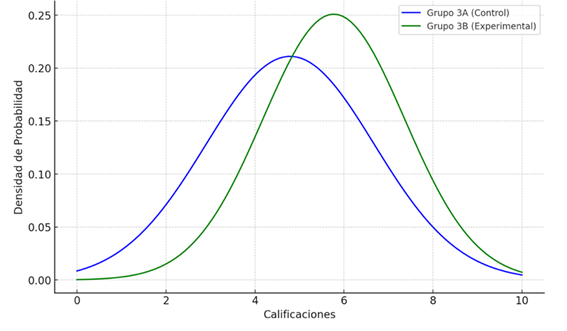
definitive conclusions about its impact on learning. However, the graphical
representation of the normal distribution curve (Figure 1) and the
Kolmogorov–Smirnov test provide a clearer view of the difference in absolute
terms, indicating an improvement in the experimental group that, although not
statistically significant, may have practical implications in the educational
field. These findings highlight the need for future research with larger
samples and robust experimental designs that allow for more precise evaluation
of the effect of ICT on academic performance, considering variables such as the
duration of the intervention, the instructional methodology, and the effective
integration of technological resources into the teaching–learning process.
Figure 1
Theoretical normal
distribution of the scores (performance).
Source: own
elaboration.
The analysis of the distribution of results
represented in Figure 1 and Table 10 reinforces the patterns observed in the Student’s t-test. Notable differences can be seen between
both groups in terms of central tendency and dispersion: the control group (3A)
obtained a mean of 4.79 with greater variability (SD = 1.89), while the
experimental group (3B) reached a higher mean of 5.77 and lower dispersion (SD
= 1.59), indicating more homogeneous scores and a tendency toward medium-high
performance.
Although these differences did not reach statistical
significance, the visual and descriptive analysis suggests the presence of a
moderate educational effect, consistent with the previous inferential results.
From a pedagogical perspective, the lower variability in the experimental group
shows that the methodology based on ICT, gamification, and Game-Based Learning
(GBL) not only favored the understanding of the
content but also reduced the performance gap between students, promoting more
equitable and stable learning. This finding aligns with recent research that
highlights the capacity of active methodologies to homogenize student progress
by integrating playful, collaborative, and continuous feedback components
within digital learning environments.
Table 10
Results of the
group
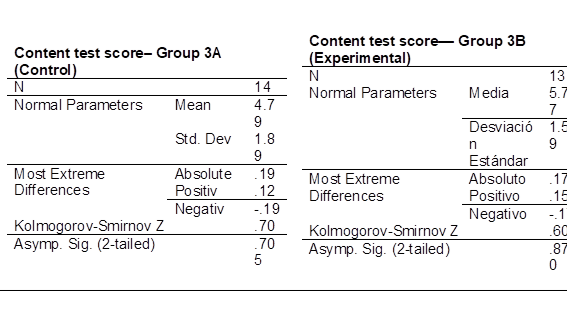
Both groups, 3A and 3B, presented p-values higher than
0.05 in the Kolmogorov–Smirnov test (Table 10), which confirms that the scores
in both cases can be considered normally distributed at the 95% confidence
level. This result validates the use of parametric tests, such as the Student’s t-test, and reinforces the methodological
soundness of the comparative analysis conducted in the previous section.
In summary, the statistical results offer a nuanced
picture of the impact of the intervention. On the one hand, the significant
correlations—such as the one observed between motivation to learn with
computers before and after the intervention (r = .385, p < .05)—indicate
that approximately 15% of the variability in motivation is consistently
associated with the use of ICT, which supports their value as mediators of
academic engagement. On the other hand, the lack of significance in other
correlations (for example, the perceived usefulness of videos or the preference
for classes with computers) and in the comparison of performance between groups
suggests that the effect of ICT is not automatic or homogeneous, but dependent
on methodological design, the type of resource used, and the context of
application.
The combination of these trends—higher means in the
experimental group, moderate effect size in performance, and greater
homogeneity of results—points to a scenario of pedagogically relevant but
statistically limited effects, consistent with the exploratory nature of the
study. In this sense, the observed motivational stability and the reduction in
score dispersion are indicators of qualitative improvement, even if they do not
reach statistical significance. These findings justify interpreting the results
from an educational rather than inferential perspective, highlighting the need
to replicate the study with larger samples and experimental designs of greater
power and control to confirm the robustness of the observed effects.
3.5.Longitudinal
changes in the usefulness of ICT and active methodologies (RQ3)
In the last decade, the impact of technologies on
education has undergone a profound transformation. While in 2014 the
introduction of digital resources—such as computers, videos, or interactive
whiteboards—generated an immediate motivational response, today their effect is
more heterogeneous and dependent on the way they are pedagogically integrated.
The results of the present study confirm this change. On the one hand, students
who already showed prior interest in ICT maintained stable levels of motivation,
whereas those with lower predisposition did not show significant improvements,
unlike what was observed a decade ago. This longitudinal variation suggests
that technology has lost its novelty effect and that its motivational potential
now depends on the methodological design and the degree of emotional engagement
it promotes. In the case of educational videos, for example, their perceived
usefulness has stabilized, reflecting saturation derived from continuous
exposure to audiovisual content. Thus, fun and engagement are no longer
automatically linked to the presence of digital resources, but rather to the
way in which they are integrated into meaningful and participatory
instructional sequences.
From a pedagogical perspective, these findings
reinforce the importance of active methodologies such as gamification and
Game-Based Learning (GBL). Far from conceiving technology as an end in itself, these strategies turn it into a means to
activate cognitive, emotional, and social processes that support lasting
learning. Their effectiveness lies in balancing challenge with students’
skills—following Csikszentmihalyi’s (1990) flow theory—and in promoting experiences
that connect with students’ interests and real contexts.
In conclusion, the results show an evolution in the
relationship between technology, motivation, and learning. ICT maintain their
pedagogical value, but their effectiveness requires planned, emotionally
meaningful, and contextualized integration. This paradigm shift has direct
implications for educational innovation: the teacher must assume the role of
designer of learning experiences, combining digital resources and active
methodologies to sustain students’ intrinsic motivation. In future research, it
would be relevant to analyze how variables such as
students’ degree of autonomy or the nature of the tasks influence this new
motivational dynamic mediated by technology.
4. Discussion and
conclusions
The results of the present study confirm that
Information and Communication Technologies (ICT) continue to positively
influence student motivation, particularly in the willingness to learn with
computers. However, unlike previous studies in which the introduction of ICT in
the classroom generated immediate improvements in emotional predisposition and
academic performance, their current impact depends more on the quality of
methodological implementation. This finding aligns with self-determination
theory (Deci and Ryan, 2000), which holds that technologies only foster
intrinsic motivation when they stimulate the student’s autonomy, competence,
and social connectedness. In this way, technology becomes a means to strengthen
intrinsic motivation only when it is pedagogically integrated in a meaningful
way. Otherwise, its influence is limited to an accessory and merely
instrumental role, without a transformative effect on learning.
Consistent with Pekrun
(2017), the non-significant nature of some correlations should not be
interpreted as an absence of impact, but as evidence that emotions and
instructional structure mediate the actual effectiveness of ICT in classroom
contexts. For their part, the non-significant correlations in aspects such as
preference for computer-based classes or the perceived usefulness of videos
should not be understood as an absence of effect, but as evidence that the
influence of ICT is mediated by emotional and didactic factors. In line with Pekrun’s (2017) theory of emotions, these differences
suggest that positive emotions associated with technology-mediated learning do
not emerge automatically, but through sustained experiences that combine
challenge, control, and enjoyment. Technology, therefore, acts as an emotional
catalyst only when framed within an instructional design that balances
cognitive demands with students’ competencies.
Performance results show moderate differences in favor of the experimental group, with lower dispersion in
scores and a higher mean (M = 5.77, SD = 1.59) compared to the control group (M
= 4.79, SD = 1.89). Although these differences did not reach statistical
significance, their coherence with the motivational patterns observed allows
for interpreting that active methodologies mediated by ICT foster more
homogeneous and equitable learning. This finding is consistent with the
classic—but still relevant—meaningful learning theory of Ausubel (1960), which
holds that deep assimilation of knowledge occurs when new content is integrated
with students’ prior experiences.
In this case, gamification and Game-Based Learning
(GBL) functioned as emotional advance organizers, capable of connecting
curricular content with students’ reality and interests, and with pre-designed
dynamics and mechanics that aimed toward meaningful activity. Likewise, the
moderate correlation between classroom enjoyment and computer use (r = .135, p
= .478), although not significant, points to the need to consider the dimension
of educational flow proposed by Csikszentmihalyi (1990). Academic enjoyment
arises when the challenge and the student’s skills are balanced; in the absence
of this balance, motivation tends to decrease, regardless of technological
mediation. This result underscores that technology, by itself, does not
guarantee emotionally stimulating experiences: its motivational potential
materializes only when the teacher plans activities that foster
self-regulation, cooperation, and a sense of shared challenge.
The
longitudinal comparison between 2014 and 2024 reveals a conceptual and
motivational transition that can be explained in light of
self-determination theory (Deci & Ryan, 2000). While in 2014 students’
responses were mediated by technological novelty and extrinsic reinforcement
mechanisms, in the current context motivation is sustained by self-regulation
and the search for competence, typical of more stable intrinsic motivation—now
accustomed to technological mediation. This evolution also corresponds to the
framework of flow theory (Csikszentmihalyi, 1990), where enjoyment and
engagement appear when challenge and ability are balanced within well-designed
digital environments. In this way, the empirical results describe not only a
change in students’ perception, but also a structural reconfiguration of
academic motivation in relation to ICT, consistent with contemporary models of
meaningful and emotionally sustained learning.
From a methodological perspective, this study provides
a replicable model of ICT integration in primary education, in which technology
acts as a pedagogical and emotional mediator, but not as an end
in itself. The incorporation of a gamified interactive digital object
constitutes a relevant contribution to the field of techno-pedagogical
didactics, demonstrating that the combination of digital resources, immediate
feedback, and playful narrative can foster more autonomous, sustained, and
meaningful student engagement. Theoretically, the study contributes to
consolidating the concept of affective digital literacy, understood as the
development of teacher and student competencies to design, integrate, and
evaluate digital experiences that activate intrinsic motivation and positive
learning emotions. This approach broadens the understanding of ICT’s impact,
proposing a conceptual synthesis between self-determination theory, flow
theory, and the principles of meaningful learning as a basis for designing
educational digital environments.
In this sense, motivation and engagement depend more
on the teaching methodology than on the technological resource itself. Whereas
a decade ago the incorporation of ICT generated excitement due to its novelty,
the current results suggest that their effectiveness depends not only on their
presence but on how they are used within a well-structured pedagogical
framework. In this regard, this study reinforces the idea that motivation is
not generated solely by resources, but by the pedagogical approach accompanying
them. Strategies such as gamification and Game-Based Learning (GBL) have proven
essential for enhancing the impact of technology in the classroom, not only for
their ability to generate enthusiasm, but for their capacity to create dynamic
learning experiences aligned with students’ interests. This finding aligns with
previous studies that highlight how combining ICT with active pedagogical
approaches can maximize their effectiveness (Janous
et al., 2022; Muñoz-Millet, 2023).
At the pedagogical level, this study highlights that
the effectiveness of ICT in the classroom can no longer be based solely on
their novelty or their isolated presence, but on how they are integrated into
instructional strategies that foster autonomy, emotional engagement, and
interaction among students. Despite advances, the relationship between ICT and
learning remains a dynamic and multifactorial field of study, with variables
such as individual preferences, familiarity with digital resources, and application
context influencing the perception of ICT usefulness and its impact on
learning.
In conclusion, this study shows that the role of ICT
in teaching has evolved, shifting from being a factor that alone generated
motivation to becoming a resource whose impact largely depends on its
articulation with active methodologies. Technology remains a key tool in the
teaching–learning process, but its true potential lies in how it is used to
enrich the educational experience and foster meaningful learning in students.
However, this study demonstrates that ICT effectiveness no longer rests on their
mere presence, but on how teachers strategically integrate them to create
dynamic, meaningful, and emotionally engaging learning environments. The
teacher’s role as a designer of learning experiences and pedagogical mediator,
using ICT and active methodologies such as gamification and GBL, is essential
to maximize educational impact.
Therefore, future research should deepen the
optimization of ICT integration in educational practice, evaluating not only
the digital tools themselves, but also the pedagogical and emotional design
that underpins them. It is not enough to introduce technology in the classroom:
it is essential that ICT be conceived as vehicles for intrinsic motivation and
sustained engagement, capable of connecting with students’ real experiences,
interests, and needs. Along these lines, it is essential that digital resources
be designed in ways that foster cognitive and emotional engagement, generating
learning environments where active participation arises from enjoyment,
autonomy, and a sense of competence. As proposed by self-determination theory
(Deci & Ryan, 2000) and confirmed by contemporary educational psychology (Pekrun, 2017), the true impact of ICT depends on their
ability to create emotionally meaningful learning experiences that transform
the student’s relationship with knowledge and lead to stimulating, lasting, and
truly transformative learning. Overall, the findings and contributions of this
study consolidate an emerging line of research that connects emotional
education with technological innovation, positioning this work as a reference
for understanding and designing educational practices centered
on digital motivation and student well-being.
Conflicts of
interest
The authors declare that they have no conflicts of
interest.
References
Abello, D. M., Alonso-Tapia, J., & Panadero, E.
(2022). Influence of classroom motivational climate and teaching style on
university students' self-regulation and performance. Revista Complutense de Educación, 33(3), 399-412. https://dx.doi.org/10.5209/rced.74455
Adell, A. (2006). Estrategias
para mejorar el rendimiento académico de los adolescentes. Editorial
Pirámide.
Anaya-Durand, A. & Anaya-Huertas, C. (2010). ¿Motivar
para aprobar o para aprender? Estrategias de motivación del aprendizaje para
los estudiantes. Tecnología, Ciencia,
Educación, 25(1), 5-14. https://bit.ly/3FrWb3V
Area, M. (2009). Manual electrónico. Introducción a la Tecnología
Educativa. Universidad de La Laguna.
Recuperado de: https://bit.ly/4id4u21
Astleitner, H. (2000). Designing emotionally sound
instruction: The FEASP approach. Instructional Science, 28, 169-198. https://doi.org/10.1023/A:1003893915778
Ausubel, D.P. (1960). The use of advance organizers in
the learning and retention of meaningful verbal material. Journal of Educational Psychology, (51), 267-272. https://doi.org/10.1037/h0046669
Bekker, C., Rothmann, S., & Kloppers, M. (2023). The
happy learner: Effects of academic boredom, burnout, and engagement. Frontiers in Psychology, 13. https://doi.org/10.3389/fpsyg.2022.974486
Buzdar, M.A., Mohsin, M.N., Akbar, R., & Mohammad,
N. (2017). Students' Academic Performance and Its Relationship with Their
Intrinsic and Extrinsic Motivation.
Journal of Educational Research, 20,(74). https://bit.ly/3XFrmz1
Almenara-Cabero, J. (2003). Replanteando la tecnología
educativa. Comunicar: Revista Científica
de Comunicación y Educación, (21), 23-30. https://doi.org/10.3916/C21-2003-04
Camacho-Morles, J., Slemp, G., Pekrun, R., Loderer,
K., Hou, H., & Oades, L. (2021). Activity Achievement Emotions and Academic
Performance: A Meta-analysis. Educational
Psychology Review, 33, 1051 - 1095. https://doi.org/10.1007/ s10648-020-09585-3.
Casanova-Mata, I. (2023). Enhancing English
acquisition: Effects of Among Us game-based gamification on language
competence, motivation, attention, and attitude towards the English subject. Education Sciences, 13(11), 1094. https://doi.org/10.3390/educsci13111094
Casassus, J. (2007). La educación del ser emocional. Editorial Cuarto Propio.
Coll, C. (1996). Constructivismo y educación escolar:
ni hablamos siempre de lo mismo no lo hacemos siempre desde la misma
perspectiva epistemológica. Anuario de Psicología, 69, 153-178.
Coll, C. (2008). Aprender y enseñar con las TIC:
Expectativas, realidad y potencialidades. Boletín
de la Institución Libre de Enseñanza, 72, 17-40. Recuperado de:
https://bit.ly/3FfseEd
Csikszentmihalyi, M. (1990). Flow. The psychology of optimal experience. New York: Harper-Row.
Dewey, J. (1995). Democracia
y educación. Madrid, España: Ediciones Morata.
Feraco, T., Resnati,D., Fregonese, D., Spoto, A.,
& Meneghetti, C. (2023). An integrated model of school students academic
achievement and life satisfaction. Linking soft skills, extracurricular
activities, self-regulated learning, motivation, and emotions. European Journal of psychology of education,
38(1), 109-130. https://doi.org/10.1007/s10212-022-00601-4.
Ge, X. (2021). Emotion matters for academic success. Educational Technology Research and
Development, 69, 67 - 70. https://doi.org/10.1007/s11423- 020- 09925-8.
Gkintoni, E., Antonopoulou, H., & Halkiopoulos, C.
(2023). Emotional Neuroscience and
Learning. An Overview. Technium Social
Sciences Journal. https://doi.org/10.47577/tssj.v39i1.8076
Goleman, D. (1996). Inteligencia Emocional. Barcelona, España: Editorial Kairós.
Goleman, D. (2012). El cerebro y la inteligencia emocional: nuevos descubrimientos,
Cataluña, España; Ediciones B.
Howard, J., Bureau, J., Guay, F., Chong, J., &
Ryan, R. (2021). Student Motivation and Associated Outcomes: A Meta-Analysis
From Self-Determination Theory. Perspectives on Psychological Science,
16, 1300 - 1323. https://doi.org/10.1177/1745691620966789.
Janous, Y., El-Hassouny, H., Laafou, M., &
Madrane, M. (2022). Effect of ICT on students achievements and motivation in
life and earth sciences subject. Pegem Journal
of Education and Instruction, 12(4), 103–112.
https://doi.org/10.47750/pegegog.12.04.11
Lozano-Fernández, L. M., García-Cueto, E., & Gallo
álvaro, P. (2000). Relación entre motivación y aprendizaje. Psicothema, 12. Recuperado a partir de https://bit.ly/3XADpO0
Méndez-Aguado C, Aguilar-Parra, J. M., Álvarez, J. F.,
Trigueros, R., & Fernández-Archilla, J.A. (2020). The Influence of
Emotions, Motivation and Habits in the Academic Performance of Primary
Education Students in French as a Foreign Language. Sustainability, 12(6):2531. https://doi.org/10.3390/su12062531
Mora, F. (2013). ¿Qué es una emoción? Arbor, 198 (759). http://dx.doi.org/10.3989/arbor.2013.759n1003.
Moya, M. (2013). De las tics a las tacs: la
importancia de crear contenidos educativos
digitales. Didáctica, Innovación y
Multimedia (DIM), 27. Recuperado de: https://goo.su/ogbs
Muñoz-Millet, O. M. (2023). Influence of tablets on
motivation towards English learning. Human
Review. International Humanities Review / Revista Internacional
De Humanidades, 17(5), 1–15. https://doi.org/10.37467/revhuman.v12.4764
Parra-González, M.A.E., Segura-Robles, A., &
Romero-García, C. (2020). Análisis del pensamiento creativo y niveles de
activación del alumno tras una experiencia de gamificación. Educar, 56(2), 475–489. https://doi.org/10.5565/rev/educar.1104
Pekrun, R. (1992). The impact of emotions on learning
and achievement: Towards a theory of cognitive/motivational mediators. Applied Psychology, 41,(4), 359376.https://doi.org/10.1111/j.1464-0597.1992.tb00712.x
Pekrun, R. (2017). Emotion and Achievement During
Adolescence. Child Development
Perspectives, (0),1-7. Http://doi.org/10.1111/cdep.12237
Pekrun, R., Goetz, T., Titz, W., & Perry, R. P.
(2002). Academic emotions in students' self-regulated learning and achievement:
A program of qualitative and quantitative research.Educational Psychologist, 37(2), 91–105.
https://doi.org/10.1207/S15326985EP3702_4
Polaino-Lorente, A. (2011). La motivación del alumno:
factor clave en la tutoría personal. Escuela
Abierta, 14(14), 9-32. Recuperado
de: https://ea.ceuandalucia.es/index.php/EA/article/view/78
Quílez-Robles, A., Usán, P., Lozano-Blasco, R &
Salavera, C. (2023). Emotional intelligence and academic performance: A
systematic review and meta-analysis. Thinking
Skills and Creativity, 49. https://doi.org/10.1016/j.tsc.2023.101355
Rebollo, M., García Pérez, R., Barragán, R., Buzón
García, O., & Vega Caro, L. (2008). Las emociones en el aprendizaje online.
Revista Electrónica de Investigación y
Evaluación Educativa, 14(1), 123. https://doi.org/10.7203/relieve.14.1.4201
Rinaudo, M., De la Barrera, M., Donolo, D. (2006).
Motivación para el aprendizaje en alumnos universitarios. Revista Electrónica de Motivación y Emoción, 9, (22). Recuperado
de: https://goo.su/Avx4eX4
Roman, A.F. (2022). The motivation of learning in
students. Journal Plus Education, 31(2).
https://doi.org/10.24250/jpe/2/2022/afr/mif.
Sánchez-Sánchez, T., Serrano-Sánchez, J. L., &
Rojo-Acosta, F. (2020). Influence of Educational Robotics on Motivation and
Cooperative Learning in Primary Education: a Case Study. Innoeduca. International Journal of Technology and Educational
Innovation, 6(2), 141–152.
https://doi.org/10.24310/innoeduca.2020.v6i2.6779
Schunk, D. H., & DiBenedetto, M. K. (2020).
Motivation and social cognitive theory. Contemporary
Educational Psychology, 60, Article 101832. https://doi.org/10.1016/j.cedpsych.2019.101832
Siraj-Blatchford, J., & Romero-Tena, R. (2017). De
la aplicación a la participación activa de las TIC en Educación Infantil. Pixel-Bit. Revista De Medios Y Educación,
(51), 165181. https://doi.org/10.12795/pixelbit.2017.i51.11
Stephanou, G. (2011) Emociones de los alumnos en la
clase escolar: antecedentes sociocognitivos y rendimiento escolar. Electronic Journal of Research in
EducationalPsychology, 9, (23), 5-47. Recuperado
de: http://www.redalyc.org/articulo.oa?Id=293122834002.
Stipek, D. (1988). Motivation
to learn: From theory to practice. Englewood Cliffs, NJ: Prentice Hall.
Tan, J., Mao, J., Jiang, Y ., & Gao M. (2021). The
Influence of Academic Emotions on Learning Effects: A Systematic Review. International Journal of Environmental
Research and Public Health, 18(18), 9678. https://doi.org/10.3390/ijerph18189678
Trujillo-Torres, J.-M., Hossein-Mohand, H.,
Gómez-García, M., Hossein-Mohand, H., & Cáceres-Reche, M.-P. (2020).
Mathematics teachers’ perceptions of the introduction of ICT: The relationship
between motivation and use in the teaching function. Mathematics, 8(12),2158.
https://doi.org/10.3390/math8122158.
Tyng, C., Amin, H., Saad, M., & Malik, A. (2017).
The Influences of Emotion on Learning
and Memory. Frontiers in Psychology,
8. https://doi.org/10.3389/fpsyg.2017.01454.
Victoria Maldonado, J. J., Fuentes-Cabrera, A.,
Fernández-Cerero, J., & Sadio-Ramos, F.J. (2024). Influencia de la Realidad
Virtual en el rendimiento académico en Educación Secundaria a través de un
meta-análisis [Influence of Virtual Reality on Academic Performance in
Secondary Education Through a Meta-Analysis]. Pixel-Bit. Revista De Medios Y Educación, 71, 107–121. https://doi.org/10.12795/pixelbit.104279
Wolfe, P.
(2006). The role of meaning and emotion in learning. New Directions for Adult and Continuing Education, 2006(110), 35-41. https://doi.org/10.1002/ace.217