
Academic literacy assisted by generative
artificial intelligence: impact on the quality of disciplinary writing
La alfabetización académica asistida
por inteligencia artificial generativa: impacto en la calidad de la escritura
disciplinaria

 Dr. José Manuel de Amo Sánchez-Fortún. Universidad de Almería. España.
Dr. Kevin Baldrich Rodríguez. Universidad
de Almería. España.
Received: 2025/02/12 Revised: 2025/11/10 Accepted: 2025/11/21 Published: 2026/01/01
How to cite:
De Amo Sánchez-Fortún, J.M.
& Baldrich Rodríguez, K. (2026). La alfabetización académica asistida por
inteligencia artificial generativa: impacto en la calidad de la escritura
disciplinaria [Academic literacy
assisted by generative
artificial intelligence: impact
on the quality
of disciplinary writing]. Pixel-Bit. Revista de
Medios y Educación, 75, Art. 2. https://doi.org/10.12795/pixelbit.113712
ABSTRACT
The present study examines the impact of integrating
generative artificial intelligence (AI) tools into the development of academic
writing skills, with a particular emphasis on disciplinary literacy and
multimodal representation as foundational pillars for the construction and
effective communication of scientific discourse. This quasi-experimental,
mixed-methods research involved 150 university students, divided into an
experimental group that exclusively used generative AI tools and a control
group that applied traditional writing strategies. The AIAS scale and the PAIR
intervention model were employed to ensure that the use of technology
complemented critical thinking processes and student authorship rather than
replacing them. Results, obtained through a validated rubric, assessed key
aspects such as textual coherence and cohesion, grammatical accuracy, proper
handling of bibliographic references, and integration of visual elements.
Significant improvements were observed across all evaluated aspects, particularly
in the ability to articulate more structured academic discourse and effectively
integrate multimodal resources. These findings underscore the potential of
generative AI not only to optimize writing processes but also to enhance
analytical skills and expand students' expressive resources in academic
contexts. The research highlights the need to establish pedagogical frameworks
to regulate its implementation, fostering critical thinking and comprehensive
education in higher education.
RESUMEN
El presente estudio examina
el impacto de la integración de herramientas de inteligencia artificial
generativa en el desarrollo de competencias de escritura académica, con un
énfasis particular en la alfabetización disciplinar y la representación multimodal
como pilares en la construcción y comunicación efectiva del discurso
científico. La investigación, de diseño cuasiexperimental y enfoque mixto,
involucró a 150 estudiantes universitarios, organizados en un grupo
experimental que utilizó exclusivamente herramientas de IAG y un grupo de
control que aplicó estrategias de composición escrita tradicionales. Se
emplearon la escala AIAS y el modelo de intervención PAIR para garantizar que
el uso de la tecnología complementara los procesos de pensamiento crítico y la
autoría del estudiante, en lugar de sustituirlos. Los resultados, obtenidos
mediante una rúbrica validada, evaluaron aspectos clave como coherencia y
cohesión textual, corrección gramatical, manejo adecuado de referencias
bibliográfica e integración de elementos visuales. Se evidenciaron mejoras
significativas en todos los aspectos evaluados, especialmente en la capacidad
para articular discursos académicos más estructurados y en la integración
efectiva de recursos multimodales. Estos hallazgos ponen de relieve el
potencial de la IAG no solo para optimizar los procesos de escritura, sino
también para fortalecer las competencias analíticas y ampliar los recursos
expresivos de los estudiantes en contextos académicos. La investigación
evidencia la necesidad de establecer marcos pedagógicos que regulen su
implementación, fomentando el pensamiento crítico y una formación integral en
la educación superior.
KEYWORDS · PALABRAS CLAVES
Generative Artificial
Intelligence; academic literacy; higher education; quality of disciplinary
writing
Inteligencia
Artificial Generativa; alfabetización académica; educación superior; calidad de
la escritura disciplinar
1. Introduction
1.1. Academic writing and disciplinary literacy
Academic writing functions as a key instrument for
integration and active participation within the scientific community of each
discipline (Biber & Gray, 2010; Carlino, 2013). Mastery of this form of
writing entails not only the capacity to communicate complex ideas clearly and
coherently, but also to contribute to the advancement of disciplinary knowledge
through discursive practices aligned with the epistemological and rhetorical
standards of each field. In higher education, such training plays a crucial role
in students’ academic success, as it supports the appropriation of the
discourses specific to each disciplinary domain and fosters autonomous,
meaningful learning.
Proficiency in writing within formal academic contexts
constitutes a complex challenge that encompasses aspects such as discursive
organisation, the appropriate use of linguistic structures associated with
formal registers, and the critical and relevant integration of bibliographic
references (McKinley, 2013). Research has shown that explicit and systematic
instruction in writing strategies contributes significantly to the development
of advanced writing competences (Fathi & Rahimi, 2024; Cassany
& Castelló, 2010). However, several factors—such
as limited time, scarce resources, insufficient teacher training, and the lack
of continuous support—hamper the effective implementation of pedagogical
practices focused on academic writing development (Jin et al., 2025). These
limitations highlight the need to explore alternative pedagogical approaches
and support tools that complement teaching practice and strengthen
teaching–learning processes in this area.
Academic production has historically been enriched
through the incorporation of alternative modes of representation—such as
images, graphs and diagrams—which, when combined with digital tools, enhance
expository clarity and contribute to more effective discursive structuring
(Kress & van Leeuwen, 2020; Díaz-Cuevas & Rodríguez-Herrera, 2024).
Multimodal writing, by integrating diverse forms of communication, facilitates
the understanding of complex concepts and promotes a dynamic interaction between
text and readers, making it a highly relevant pedagogical strategy in
educational settings (Derga et al., 2024; Walter, 2024). Within this framework,
advances in generative artificial intelligence (GenAI) have broadened the
possibilities for the revision, optimisation and enrichment of texts,
supporting the ethical and critical integration of these resources into
disciplinary literacy processes and academic training (Wang et al., 2024).
1.2. Integration of GenAI in academic writing
The incorporation of GenAI into writing processes has
been the subject of critical analysis due to its capacity to enhance discursive
cohesion, correct grammatical errors, and structure ideas in a logical manner
(Goulart et al., 2024; Acosta, 2024). Recent studies have examined different
tools (such as ChatGPT, Copilot and Gemini), highlighting their ability to
improve the organisation and clarity of texts, thereby optimising their quality
before reaching the final version (Aladini et al.,
2025; Teng, 2024).
The use of GenAI in teaching and learning requires an
approach grounded in solid pedagogical principles and appropriate regulation.
Without clear guidance, these technologies may foster dependency on automated
content generation, potentially limiting the development of key skills such as
autonomous learning and students’ argumentative capacity (García-Peñalvo, 2024;
Kalifa & Albadawy, 2024). For this reason, it is
essential to establish pedagogical frameworks that not only guide the use of
these tools but also promote metacognition and critical thinking—skills that
are crucial for enabling students to analyse, evaluate and select, in a
well-reasoned manner, the information generated by these technologies (Huang
& Teng, 2025).
Furthermore, the development of models such as the
AIAS (Artificial Intelligence Assessment Scale) has made it possible to
identify levels of use in which GenAI functions as a complementary resource
that strengthens students’ abilities without replacing them. These strategies
have proved effective in supporting more autonomous and meaningful learning,
reinforcing the importance of integrating these technologies ethically and
critically into educational processes (Perkins et al., 2024; Ayuso & Gutiérrez-Esteban,
2022). This perspective underscores the need to employ GenAI as a tool that
enriches students’ competences and fosters their overall development in
academic settings.
1.3. Benefits, challenges and ethical considerations
in the use of GenAI in higher education
The use of artificial intelligence in disciplinary
writing has shown a positive impact across multiple dimensions. Among its most
notable contributions are the optimisation of the time devoted to text
production, improvements in grammatical and stylistic accuracy, and the
mitigation of cognitive blocks that often hinder idea generation during writing
(Román-Acosta, 2023). By providing immediate and detailed feedback, these
technologies facilitate students’ autonomous detection of errors, enhancing
self-regulation processes and strengthening their confidence in written
production (Wise et al., 2024). This approach not only expands opportunities
for autonomous learning but also positions artificial intelligence as a tool
with high potential for the development of advanced competences in academic
writing.
Nevertheless, the incorporation of GenAI in
educational contexts raises the challenge of potential overreliance on these
tools, which may limit the development of fundamental skills such as
argumentation and originality in writing (Davis & Csáik,
2024; Fiorillo, 2024). This risk underscores the need to train students in the
critical use of these technologies, promoting practices that balance their
integration with the strengthening of cognitive and creative competences (Su et
al., 2024; Pigg, 2024).
From an ethical and regulatory perspective, the use of
emerging technologies raises concerns regarding model transparency and
algorithmic biases, issues that trouble the scientific community due to their
implications for fairness and reliability (Ou et al., 2024). The assistance
provided by GenAI in written composition constitutes a challenge for academic
integrity, particularly in relation to authorship attribution and the
limitations of current systems in identifying texts generated with these tools,
which complicates the detection of potential plagiarism (Casheekar
et al., 2024). In response to these concerns, regulatory proposals have been
developed that include the implementation of policies focused on the ethical
and responsible use of these technologies, together with the promotion of
digital literacy programmes incorporating principles of accountability
(García-Peñalvo, 2024). Moreover, the design of pedagogical strategies that
guide the critical and strategic use of these technologies is essential for
strengthening students’ analytical capacity during the process of reviewing and
editing AI-generated texts (García-Peñalvo et al.,
2024; Ciaccio, 2023).
2. Objectives
General objective
To analyse the impact of GenAI tools on the
development of disciplinary writing competences in university students.
Specific objectives
- To evaluate the
quality of academic texts produced with and without the use of GenAI tools,
considering dimensions such as coherence, cohesion, terminological accuracy,
argumentation, and adherence to disciplinary conventions, including
bibliographic referencing.
- To examine the
impact of GenAI tools on the different stages of the disciplinary writing
process, encompassing idea generation, planning, text structuring, revision and
editing.
- To explore
students’ perceptions regarding the use of GenAI tools in academic writing,
analysing their perceived usefulness, ease of use, and influence on confidence
and autonomy during the writing process.
- To determine the
relationship between the use of GenAI tools and the development of disciplinary
writing competences, assessing the extent to which these tools contribute to
improved argumentation, logical structuring and appropriate use of academic
language.
3. Methodology
The study adopted a mixed-methods approach
(quantitative–qualitative) and a quasi-experimental design with non-equivalent
groups, appropriate for educational contexts in which random assignment is not
feasible (Creswell, 2014; Shadish, Cook &
Campbell, 2002). The experimental group integrated GenAI tools into the
academic writing process, whereas the control group employed conventional
strategies.
The intervention was aligned with Level 3 of the AIAS
scale (Perkins et al., 2024), which defines a formative and reflective use of
GenAI. This level was selected for its relevance in educational contexts that
aim to strengthen students’ autonomy and writing competence. Within this
framework, GenAI functions as a cognitive mediator, offering feedback and
structural support without replacing authorship or critical thinking. Learning
is therefore oriented towards the development of metacognitive and discursive
competences, avoiding technological dependency.
Complementarily, the PAIR framework (Problem, AI
Selection, Interaction and Reflection) was applied as the pedagogical structure
of the intervention. This model was operationalised through work sequences in
which students (1) identified a specific writing need, (2) selected the most
suitable tool to address it, (3) interacted critically with the GenAI system by
evaluating its suggestions, and (4) reflected on the revisions made. This
process enabled GenAI to be incorporated as a dialogic resource in learning,
fostering self-regulation, critical thinking and awareness of one’s own writing
process.
3.1. Sample
A total of 150 fourth-year students from the Primary
Education Degree at the University of Almería participated in the study (75 in
the experimental group and 75 in the control group). The sample size was
determined through a power analysis (α = 0.05, power =
0.80, d = 0.50), which confirmed its adequacy for detecting significant
differences between groups (Cohen, 1988).
The selection was non-probabilistic and based on
convenience, respecting the pre-existing organisation of the groups. Students
with prior experience using GenAI tools or those who did not complete all
phases of the study were excluded. The attrition rate (3.3%) was statistically
negligible.
Before the intervention, an initial diagnostic test
was administered, consisting of a brief academic writing task on a general
educational topic. The texts were assessed using the same rubric employed in
the study to verify the initial equivalence between groups. The results
confirmed homogeneity in writing skills (t(148) =
0.87, p = 0.382), ensuring the validity of subsequent comparisons.
Figure 1
Statistical power
analysis.
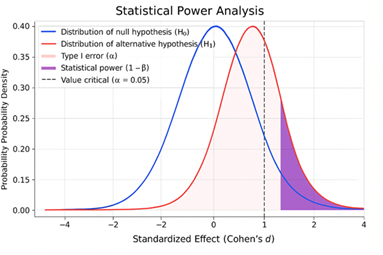
Source: own elaboration.
3.2. Study phases
The study was carried out in three phases: pre-test,
intervention and post-test.
·
Pre-test. Students were asked to produce an
argumentative essay without technological assistance (“How can AI improve
teaching and learning?”). The texts were assessed using an ad hoc rubric
composed of six dimensions: coherence, cohesion, linguistic accuracy,
argumentative strength, use of references and quality of visual elements.
·
Intervention. Over four weeks, academic writing
activities were implemented using differentiated methodologies. The
experimental group worked with tools such as ChatGPT, Copilot, Gemini,
DeepSeek, Scopus AI, Consensus, Canva and Napkin, exclusively for revising,
structuring and optimising their own texts, in accordance with Level 3 of the
AIAS scale. The control group followed traditional methods without technological mediation.
·
Post-test. Students were asked to write a new
argumentative essay (“Should the use of AI in education be regulated?”),
assessed using the same rubric. In addition, the experimental group completed a
perception questionnaire and a tool-use log (frequency, duration and type of
modifications).
3.3. Data analysis instruments
Three main instruments were used: a writing assessment
rubric, a perception questionnaire, and a log of GenAI tool use. All were
designed and validated by specialists in Language and Literature Didactics and
educational assessment.
The analysis of academic writing was conducted using a
rubric that enabled precise and consistent evaluation of the pre-test and
post-test productions. The rubric included six dimensions: textual coherence
and cohesion, grammatical and stylistic accuracy, appropriate use of
bibliographic references, quality of graphs and tables, integration of visual
elements, and academic clarity. Each dimension was rated on a Likert scale from
1 (very low) to 5 (excellent).
The instrument underwent a validation process through
expert judgement, during which specialists reviewed the clarity of the criteria
and their alignment with the study objectives. Cronbach’s alpha (α = 0.91) confirmed
a high level of internal consistency and accuracy in the evaluation.
The perception questionnaire was administered to the
experimental group to explore students’ views on the use of GenAI tools in
academic writing. It included Likert-scale items (1–5) and open-ended questions
addressing aspects such as ease of use, perceived usefulness, impact on
confidence and creativity, and challenges in technological integration.
Before administration, a pilot test was conducted with
20 students with similar characteristics to the sample but not involved in the
intervention. This phase allowed verification of item clarity and relevance,
leading to the revision of two questions. The questionnaire showed high
internal reliability (α = 0.94).
Open-ended responses were analysed through inductive
thematic coding (Braun & Clarke, 2006), carried out in three stages:
exploratory reading, open coding, and category grouping. This process
identified four main categories:
1. Facilitation of
the writing process, highlighting that GenAI helped organise ideas and improve
text structure.
2. Optimisation of
reference use, valuing the tool’s capacity to manage citations and sources.
3. Incorporation of
multimodal elements, recognising the positive impact of AI-generated graphics
and visualisations.
4. Challenges in
adapting to GenAI, referring to initial difficulties and the evaluation of the
reliability of AI-generated suggestions.
Finally, the tool-use log recorded the frequency and
duration of use of each application, as well as the functionalities employed
during the planning, drafting and revision of the essays. These data made it
possible to quantify interaction with the technology and analyse its influence
on the improvement of written production.
3.4. Data analysis
For the data analysis, SPSS software was used (IBM
SPSS Statistics for Windows, Version 28.0), applying different statistical
tests to assess the evolution of writing quality and the relationship between
the use of GenAI tools and the outcomes obtained. First, an analysis of
covariance (ANCOVA) was conducted to compare post-test scores while adjusting
for initial pre-test differences, ensuring that the effects observed were
attributable to the intervention rather than to pre-existing variations between
groups. ANCOVA was selected due to its capacity to control potential biases and
to improve the accuracy of results by reducing unexplained variability. The
assumptions of homogeneity of regression slopes and normality of residuals were
verified, ensuring the validity of the statistical model. In addition,
F-statistic and p-value results were calculated to determine the significance
of the differences identified.
Alongside the ANCOVA, descriptive analyses were
performed to characterise the frequency and duration of GenAI tool use in the
experimental group. The number of interactions with each tool, the total time
dedicated, and the specific functionalities employed were documented. To
complement the quantitative analyses, a qualitative analysis of the open-ended
questionnaire responses was carried out, enabling the identification of
patterns in students’ perceptions regarding the usefulness of the tools, the
difficulties encountered, and the impact on confidence and creativity when
writing academic texts.
The combined use of quantitative and qualitative
methods provided a comprehensive understanding of the impact of GenAI tools on
academic writing. The inclusion of ANCOVA in the statistical analysis
strengthened the reliability of the findings, ensuring that differences between
the experimental and control groups were the result of the intervention rather
than external factors. Furthermore, the validation of the instruments employed
ensured the consistency and accuracy of the data collected. This approach enabled
a rigorous determination of the impact of artificial intelligence on the
improvement of academic writing, offering both objective and subjective
evidence regarding participants’ perceptions and performance throughout the
study.
4. Results
The findings of the study show statistically
significant differences between the experimental group and the control group
across all dimensions of academic writing. The analysis of covariance (ANCOVA),
with pre-test scores included as a covariate, confirmed that the pedagogical
use of GenAI produced substantial and consistent improvements in text quality,
both in linguistic and discursive aspects as well as in multimodal components.
Table 1 presents the means, standard deviations and F-values for the post-test
in each of the evaluated dimensions.
Table 1
Comparison of
means by academic writing dimensions (post-test).
|
Evaluated dimension |
Control group (M ± DT) |
Experimental group (M ± DT) |
F |
p |
|
Coherence and cohesion |
3.5 ± 0.7 |
4.7 ± 0.5 |
52.41 |
<.001 |
|
Grammatical and stylistic accuracy |
3.6 ± 0.6 |
4.8 ± 0.4 |
58.33 |
<.001 |
|
Use of bibliographic references |
3.4 ± 0.7 |
4.7 ± 0.5 |
49.02 |
<.001 |
|
Integration of visual elements |
3.3 ± 0.8 |
4.7 ± 0.6 |
54.89 |
<.001 |
|
Academic clarity and style |
3.5 ± 0.7 |
4.8 ± 0.5 |
56.12 |
<.001 |
As shown in Figure 2, the experimental group presents
significantly higher adjusted means across all dimensions of academic writing,
once initial differences were controlled through the analysis of covariance
(ANCOVA).
The consistent separation between the two lines
reflects a sustained overall improvement, particularly in textual coherence and
cohesion, grammatical accuracy, and the use of references. These differences
confirm that the pedagogical integration of GenAI enhanced the discursive and
stylistic quality of the texts produced.
Figure 2
Adjusted mean
comparison between the experimental and control groups (ANCOVA).
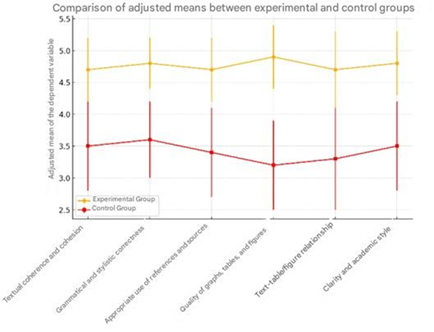
Source: The bars
indicate the 95% confidence intervals of the adjusted means. Author’s
elaboration.
Use of GenAI tools
The activity log of the experimental group enabled the
analysis of the frequency and duration of use for each tool.
As shown in Table 2, ChatGPT and Copilot were the most
frequently used, followed by Gemini and DeepSeek. Reference management tools
(Scopus AI and Consensus) and visual design tools (Canva and Napkin) showed
moderate but consistent use, indicating a balanced integration of linguistic,
documentary and visual functions.
Table 2
Frequency and
average time of use of GenAI tools (experimental group).
|
Tool |
Mean frequency (± SD) |
Mean time (min ± SD) |
|
ChatGPT |
9.2 ± 2.1 |
125 ± 15 |
|
Copilot |
7.8 ± 1.9 |
110 ± 14 |
|
Gemini |
6.5 ± 1.6 |
95 ± 12 |
|
DeepSeek |
5.9 ± 1.8 |
85 ± 10 |
|
Scopus AI |
5.3 ± 1.4 |
75 ± 11 |
|
Consensus |
4.7 ± 1.5 |
68 ± 9 |
|
Canva |
4.5 ± 1.2 |
62 ± 8 |
|
Napkin |
3.8 ± 1.0 |
55 ± 7 |
The usage pattern shows that students employed GenAI
primarily as a support resource for revising, structuring and optimising their
texts, in line with Level 3 of the AIAS scale, which promotes a formative and
reflective use of technology.
Perceptions and qualitative analysis
The perception questionnaire administered to the
experimental group confirmed a broadly positive evaluation of the use of GenAI
tools in the academic writing process.
Ninety-five per cent of participants considered that
the tools facilitated idea generation and organisation, 97% perceived an
improvement in grammatical and stylistic accuracy, and 93% highlighted the
contribution of visual resources to the clarity and presentation of their
texts. In addition, 89% reported that GenAI helped them manage their writing
time more effectively and meet deadlines.
The thematic analysis of the open-ended responses
identified five main categories (see Table 3), which synthesise the students’
most representative perceptions.
Table 3
Synthesis of
qualitative categories, evidence and pedagogical guidelines.
|
Category |
Definition |
Evidence and codes |
Relevance |
Pedagogical guideline |
|
Organisation and structuring of discourse |
Use of GenAI to plan and organise ideas |
“initial outline”, “transitions”, “mind map” |
High |
Promote planning guides and metacognitive
reflection. |
|
Grammatical and stylistic improvement |
Linguistic revision and adjustment to academic
register |
“academic tone”, “terminological coherence” |
High |
Clarify the role of GenAI as support rather than
substitution. |
|
Reference management |
Search and formatting of academic sources |
“citation verification”, “APA format” |
High |
Include protocols for traceability and
reliability. |
|
Integration of visual elements |
Use of graphics and diagrams coherent with the
text |
“graphic summary”, “text–figure cohesion” |
Medium |
Design rubrics for critical reading of visual
resources. |
|
Initial difficulties in use |
Usability barriers and comprehension of outputs |
“learning curve”, “tool opacity” |
Focused |
Provide initial training and prompt templates. |
Students’ perceptions confirm that GenAI is viewed
primarily as a cognitive mediator that facilitates planning, revision and the
integration of resources, rather than as a substitute for the writing process.
Students acknowledge both the formative potential of these tools and the need
for teacher guidance and critical reflection to ensure ethical, autonomous and
informed use.
Taken together, the quantitative results, usage logs
and qualitative perceptions converge in indicating that the didactic and
reflective integration of GenAI significantly enhances university students’
writing competence. The use of AI as a cognitive mediator promotes
self-regulation, metalinguistic awareness and the ability to carry out critical
revision of one’s own text, provided that it is
embedded within pedagogical strategies that preserve authorship, autonomy and
the ethical dimension of academic learning.
5. Discussion and
conclusions
The findings of this study confirm that the
pedagogical incorporation of GenAI tools has a positive impact on the quality
of academic writing in higher education, in line with previous research
highlighting their potential to improve discursive coherence, linguistic
accuracy and the argumentative organisation of texts (Amo Sánchez-Fortún &
Domínguez-Oller, 2024; Dai et al., 2023; García-Peñalvo, 2024; Zheng et al.,
2024). The improvements observed in the experimental group—particularly in
coherence, accuracy, use of references and integration of visual
elements—demonstrate that GenAI can function as an effective cognitive mediator
when its use is framed within a structured formative approach.
The use of Level 3 of the AIAS scale and the PAIR
model (Problem, Selection, Interaction, Reflection) was decisive in ensuring a
balanced pedagogical integration of the technology. This approach allowed GenAI
to operate as a support resource for the thinking process rather than as a
substitute for academic judgement. Students retained an active role in
planning, revising and validating their texts, thus avoiding cognitive
automation. This finding aligns with the warnings of Wise et al. (2024)
regarding the risks of excessive technological dependence, which can limit
creativity and the development of critical competences if guided-use frameworks
are not established. Similarly, Perkins et al. (2024) argue that a model of
reflective integration—such as PAIR—supports student autonomy and informed
decision-making regarding the contributions of AI.
From an epistemological perspective, the findings
invite a reconsideration of the notion of academic authorship in environments
mediated by artificial intelligence. The technology does not replace the
author’s voice; rather, it puts it to the test, requiring constant
decision-making regarding what to accept, modify or discard. In this way, the
quality of the written text depends not only on the final product but also on
the critical capacity with which the human author evaluates, adjusts and
validates automated suggestions. This interaction shapes a new scenario of
textual co-production, where cognitive responsibility and process traceability
become central pillars of contemporary academic ethics.
In pedagogical terms, the integration of GenAI
supported the acquisition of metacognitive skills. Students not only improved
discursive organisation and textual cohesion—as noted by Teng (2024) and Ou et
al. (2024)—but also developed greater awareness of their own linguistic and
structural decisions. This reflective dimension is key to preventing cognitive
dependence and consolidating critical academic literacy. Teaching students to
distinguish between what the tool suggests and what disciplinary criteria validate
therefore becomes a core competence in higher education.
The study also showed a positive impact of GenAI on
the use of academic references. Information retrieval and management tools
enhanced the precision and reliability of citations, facilitating the
construction of more robust and well-documented arguments. Recent research
confirms this potential of AI to optimise the search and processing of sources
(Dabis & Csáki, 2024; Goulart et al., 2024), although—like the present
study—it also warns of the need for systematic verification and ethical
training in the evaluation of bias and algorithmic opacity. In this sense,
digital literacy at university level must include the teaching of validation
and traceability protocols for AI-generated information.
In the field of multimodal writing, the results
indicate that the incorporation of visual and graphic elements—facilitated by
tools such as Canva or Napkin—not only enriched the presentation of texts but
also strengthened their argumentation by offering complementary representations
of concepts. This finding supports multimodality theories that highlight the
integration of different modes of representation as an essential component of
contemporary academic discourse (Kress & van Leeuwen, 2020; Xu et al., 2022).
Thus, university literacy expands into a digital and multimodal dimension that
redefines the relationship between text, image and knowledge.
From the students’ perspective, GenAI was perceived as
useful and accessible, although it required initial training for optimal use.
This result is consistent with Ayuso-del Puerto and Gutiérrez-Esteban (2022)
and García-Peñalvo et al. (2024), who emphasise that the effectiveness of
educational technologies largely depends on users’ digital literacy. For this
reason, the integration of GenAI in university teaching cannot be limited to
its instrumental dimension: it must be part of an educational project that
includes criteria for interpretation, ethics and reliability assessment.
Finally, the behaviour observed among participants
suggests a strategic and reflective interaction with the technology: students
adjusted and personalised the generated outputs rather than accepting them
automatically. This conscious use confirms the potential of GenAI as a
facilitator of critical thinking and self-regulation in the writing process
(Kang et al., 2023; Pigg, 2024). Moreover, the differentiated use of tools
according to the stage of the process—text-focused tools for planning and
drafting; visual tools for presentation—aligns with the findings of Díaz-Cuevas
and Rodríguez-Herrera (2024), which show that the impact of AI varies depending
on the task and the user’s purpose.
In conclusion, this study demonstrates that GenAI can
play a transformative role in higher education when incorporated within robust
pedagogical frameworks such as the AIAS scale and the PAIR model. Under these
conditions, the tools do not replace authorship or critical thinking; instead,
they amplify them. GenAI thus redefines university digital literacy practices,
orienting them towards comprehensive training that combines disciplinary
rigour, academic ethics and responsibility in the use of generative technologies.
Ultimately, learning to write with AI involves learning to think with
discernment, to engage in dialogue with technology and to uphold intellectual
autonomy in algorithm-mediated environments: the new horizon of academic
literacy in the digital age.
6. Limitations and
future directions
This study has certain limitations that should be taken into account when interpreting its findings. First,
the sample was non-probabilistic and composed of students from a single
institution, which restricts the generalisation of the results to other
educational contexts. Future research should consider incorporating larger and
more diverse samples, including students from different universities and
disciplines, in order to broaden the applicability of
the findings. Secondly, the diversity and continuous evolution of GenAI tools
represent an ongoing challenge. Although this study included representative
tools, the rapid advancement of these technologies requires continuous
evaluation to understand their impact on academic writing in an up-to-date
manner. Finally, the duration of the intervention—limited to four
weeks—prevents an analysis of whether the observed effects persist over time.
Longitudinal designs could be highly valuable for exploring the development of
writing competences over longer periods.
Funding
This research is funded by the project “Educational
Transformation: Exploring the Impact of Artificial Intelligence on University
Students’ Reading and Writing Development” (PID2023-151419OB-I00), under the
call for R&D&I Projects “Knowledge Generation”, within the State
Programme for the Promotion of Scientific and Technical Research and its
Transfer, as part of the Spanish State Plan for Scientific, Technical and
Innovation Research 2021–2023. Ministry of Science, Innovation and
Universities. Spanish State Research Agency. 2024–2027.
Conflicts of interest
The authors declare that they have no conflicts of
interest.
References
Acosta, D.R. (2024). Potential of artificial
intelligence in textual cohesion, grammatical precision, and clarity in
scientific writing. LatIA,
(2), 26. https://doi.org/10.62486/latia2024110
Aladini, A., Ismail,
S.M., Khasawneh, M.A.S., & Shakibaei,
G. (2025). Self-directed writing development across computer/AI-based tasks: Unraveling the traces on L2 writing outcomes, growth
mindfulness, and grammatical knowledge. Computers
in Human Behavior Reports, 17, 100566. https://doi.org/10.1016/j.chbr.2024.100566
Amo Sánchez-Fortún, J.M., & Domínguez-Oller, J.C.
(2024). Análisis sistémico de la alfabetización
discursiva en las prácticas académicas situadas: La escritura hipertextual en
trabajos de fin de grado. Revista de
Educación a Distancia (RED), 24(77).
https://doi.org/10.6018/red.574881
Ayuso-del P.D., &
Gutiérrez-Esteban, P. (2022). La Inteligencia Artificial como recurso educativo
durante la formación inicial del profesorado. RIED-Revista Iberoamericana de Educación a Distancia, 25(2), 347-358. https://doi.org/10.5944/ried.25.2.32332
Biber, D. & Gray, B. (2010). Challenging
stereotypes about academic writing: Complexity, elaboration, explicitness. Journal of English for Academic Purposes, 9(1),
2–20. https://doi.org/10.1016/j.jeap.2010.01.001
Carlino, P. (2013). Alfabetización académica: un
cambio necesario, algunas tensiones inevitables y ciertas estrategias posibles.
Educación en Contexto, 1(1), 1–15.
Casheekar, A., Lahiri,
A., Rath, K., Sanjay Prabhakar,
K.S. & Srinivasan, K. (2024). A contemporary review on chatbots, AI-powered
virtual conversational agents, ChatGPT: Applications, open challenges and
future research directions. Computer Science
Review, 52. https://doi.org/10.1016/j.cosrev.2024.100632
Cassany, D. & Castelló, M. (2010). Escribir y comunicar en contextos
científicos y académicos. Graó.
Ciaccio, E.J. (2023). Use of artificial intelligence
in scientific paper writing. Informatics
in Medicine Unlocked, 41, 101253. https://doi.org/10.1016/j.imu.2023.101253
Cohen, J. (1988). Statistical
power analysis for the behavioral science.
Lawrence Erlbaum Associates.
Creswell, J.W. (2014). Research Design: Qualitative, Quantitative, and Mixed Methods
Approaches. SAGE Publications.
Dabis, A., & Csáki, C. (2024). AI and ethics:
Investigating the first policy responses of higher education institutions to
the challenge of generative AI. Humanities
and Social Sciences Communications, 11(1),
1-13. https://doi.org/10.1057/s41599-024-03526-z
Dergaa, I., Chamari, K., Zmijewski, P. & Saad, H. B.
(2023). From human writing to artificial intelligence generated text: examining
the prospects and potential threats of ChatGPT in academic writing. Biology of sport, 40(2), 615-622. https://doi.org/10.5114/biolsport.2023.125623
Díaz-Cuevas, A. P. & Rodríguez-Herrera, J. (2024).
Usos de la inteligencia artificial en la
escritura académica: experiencias de estudiantes universitarios en 2023. Cuaderno de Pedagogía Universitaria, 21(42),
25-44. https://doi.org/10.29197/cpu.v21i42.595
Fathi, J. & Rahimi,
M. (2024). Utilising artificial intelligence-enhanced writing
mediation to develop academic writing skills in EFL learners: a qualitative
study. Computer Assisted Language
Learning, 1 40. https://doi.org/10.1080/09588221.2024.2374772
Fiorillo, L. (2024). Confronting the demonization of
AI writing: Reevaluating its role in upholding scientific integrity. Oral Oncology Reports, 12, 100685. https://doi.org/10.1016/j.oor.2024.100685
García-Peñalvo, F.J. (2024). Inteligencia artificial generativa y
educación: Un análisis desde múltiples perspectivas. Education in the Knowledge Society (EKS), 25, e31942-e31942. https://doi.org/10.14201/eks.31942
García-Peñalvo, F. J.,
Llorens-Largo, F. & Vidal, J. (2024). La nueva realidad de la educación
ante los avances de la inteligencia artificial generativa. RIED-Revista Iberoamericana de Educación a Distancia, 27(1), 9-39. https://doi.org/10.5944/ried.27.1.37716
Goulart, L., Matte, M. L., Mendoza, A., Alvarado,
L. & Veloso, I. (2024). AI or student writing? Analyzing
the situational and linguistic characteristics of undergraduate student writing
and AI-generated assignments. Journal of
Second Language Writing, 66, 101160. https://doi.org/10.1016/j.jslw.2024.101160
Huang, J., & Teng, M. F. (2025). Peer feedback and
ChatGPT-generated feedback on Japanese EFL students’ engagement in a foreign
language writing context. Digital Applied Linguistics, 2, 102469-102469. https://doi.org/10.29140/dal.v2.102469
Jin, F., Lin, C.H. & Lai, C. (2025). Modeling AI-assisted
writing: How self-regulated learning influences writing outcomes. Computers in Human Behavior,
165, 108538. https://doi.org/10.1016/j.chb.2024.108538
Khalifa, M. & Albadawy,
M. (2024). Using artificial intelligence in academic writing and
research: An essential productivity tool. Computer
Methods and Programs in Biomedicine Update, 5, 100145. https://doi.org/10.1016/j.cmpbup.2024.100145
Kress, G. & Van Leeuwen, T. (2020). Reading
images: The grammar of visual design. Routledge.
McKinley, J. (2013). Displaying critical thinking in
EFL academic writing: A discussion of Japanese to English contrastive rhetoric.
The East Asian Journal of Applied
Linguistics, 3(2), 133–157. https://doi.org/10.1075/eajal.3.2.04mck
Ou, A. W., Khuder, B.,
Franzetti, S., & Negretti, R. (2024).
Conceptualising and cultivating critical GAI literacy in doctoral academic
writing. Journal of Second Language
Writing, 66, Article 101156. https://doi.org/10.1016/j.jslw.2024.101156
Perkins, M., Furze, L., Roe, J., & MacVaugh, J. (2024). The Artificial Intelligence Assessment
Scale (AIAS): A framework for ethical integration of generative AI in
educational assessment. Journal of
University Teaching and Learning Practice, 21(06).
Pigg, S. (2024). Research writing with ChatGPT: A
descriptive embodied practice framework. Computers
and Composition, 71, 102830. https://doi.org/10.1016/j.compcom.2024.102830
Román-Acosta, D. D. (2023). Más allá de las palabras: Inteligencia
artificial en la escritura académica. Escritura
Creativa, 4(2), 36–43.
Shadish, W.R., Cook, T.D.,
& Campbell, D.T. (2002). Experimental
and Quasi-Experimental Designs for Generalized Causal Inference. Houghton
Mifflin.
Su, Y., Lin, Y. & Lai, C. (2023). Collaborating with
ChatGPT in argumentative writing classrooms. Assessing Writing, 57, 100752. https://doi.org/10.1016/j.asw.2023.100752
Teng, M.F. (2024). Metacognitive awareness and EFL
learners’ perceptions and experiences in utilizing ChatGPT for writing
feedback. European Journal of Education,
60, 1-16. https://doi.org/10.1111/ejed.12811
Trochim, W.M.K. (2006). Research Methods: The Essential Knowledge Base. Cengage Learning.
Walter, Y. (2024). Embracing the future of artificial
intelligence in the classroom: The relevance of AI literacy, prompt
engineering, and critical thinking in modern education. International Journal of Educational Technology in Higher Education, 21(15). https://doi.org/10.1186/s41239-024-00448-3
Wang, C., Wang, H., Li, Y., Dai, J., Gu, X., & Yu,
T. (2024). Factors influencing university students’ behavioral
intention to use GenAI: Integrating the theory of planned behavior
and AI literacy. International Journal of
Human–Computer Interaction, 1-23. https://doi.org/10.1080/10447318.2024.2383033
Wise, B., Emerson, L., Van Luyn, A., Dyson, B., Bjork,
C. & Thomas, S.E. (2024). A scholarly dialogue: writing scholarship,
authorship, academic integrity and the challenges of AI. Higher Education Research & Development, 43(3), 578-590. https://doi.org/10.1080/07294360.2023.2280195