
Augmented reality in STEM learning: developing
spatial skills in electrical engineering training
Realidad aumentada en el aprendizaje
de materias STEM: desarrollo de habilidades espaciales en la formación en
ingeniería eléctrica

 Dr. Ginés Morales Méndez. Universidad de Murcia. España.
Dr. Francisco del Cerro Velázquez. Universidad de Murcia. España.
Dra. Ana Belén Lozano Avilés. Universidad de Murcia. España.
Received: 2025/09/11 Revised: 2025/09/22 Accepted: 2025/10/29 Published: 2026/01/01
How to cite:
Morales Méndez, G., del
Cerro Velázquez, F., & Lozano Avilés, A.B. (2026). Realidad aumentada en el
aprendizaje de materias STEM: desarrollo de habilidades espaciales en la
formación en ingeniería eléctrica [Augmented reality in STEM learning: developing spatial skills in electrical engineering training]. Pixel-Bit. Revista de Medios y
Educación, 75, Art. 3. https://doi.org/10.12795/pixelbit.117934
ABSTRACT
This research study employs a
quantitative approach to examine the impact of augmented reality (AR) on the
spatial skills of university students enrolled in electrical engineering
programmes. For this purpose, a quasi-experimental study was conducted. The
study involved 80 students, who were divided into four homogeneous groups. The
groups were subjected to different methodologies. The application of augmented
reality (AR) utilises mobile devices (Unity and Vuforia), digital documents, 3D
simulations (ANSYS Maxwell) and laboratories. In order to assess spatial
skills, standardised assessments such as the Mental Rotation Test (MRT) and
Spatial Visualisation Test (SVT) were conducted. In addition, cognitive load
was measured using the NASA Task Load Index. Intrinsic motivation was assessed
using Keller's ARCS model, while academic performance was determined through
theoretical and practical tests on asynchronous induction motors. The results
of the study indicate that AR helped develop spatial skills and reduced
cognitive load, while maintaining a higher level of attention, relevance,
confidence, and satisfaction compared to the other three methodologies used. It
was also noted that there was an increase in academic performance. Finally, the
study establishes the technical and pedagogical feasibility of AR as an
educational resource and identifies its potential for inclusion in STEM
education.
RESUMEN
La investigación en este
trabajo estudia cuantitativamente el efecto de la realidad aumentada (RA) en
las habilidades espaciales de estudiantes universitarios en la formación de
ingeniería eléctrica. Con ese fin, se llevó a cabo un estudio cuasi-experimental con 80 estudiantes divididos en cuatro
grupos homogéneos y sometidos a diferentes metodologías: RA utilizando
dispositivos móviles (Unity y Vuforia), documentos
digitales, simulaciones 3D (ANSYS Maxwell) y laboratorios. Para evaluar las
habilidades espaciales, se realizaron evaluaciones estandarizadas como Mental Rotation Test (MRT) y Spatial Visualization Test (SVT); la carga cognitiva se midió con
NASA Task Load Index; la
motivación intrínseca se evaluó utilizando el modelo ARCS de Keller, y el
rendimiento académico se determinó mediante pruebas teóricas y prácticas sobre
motores de inducción asíncronos. Los resultados del estudio indican que la RA
ayudó a desarrollar las habilidades espaciales y redujo la carga cognitiva, al
tiempo que mantuvo un mayor nivel de atención, relevancia, confianza y
satisfacción en comparación con las otras tres metodologías empleadas. También
se identifica un aumento del rendimiento académico. Por último, el estudio
establece la viabilidad técnica y pedagógica de la RA como recurso educativo e
identifica su potencial para su inclusión en la enseñanza STEM.
KEYWORDS · PALABRAS CLAVES
Augmented reality; spatial ability; cognitive load;
engineering; STEM education.
Realidad aumentada; habilidad espacial; carga
cognitiva; ingeniería; educación STEM.
1. Introduction
Spatial skills are a vital component of engineering
education, as the ability to visualise, evaluate, and mentally manipulate
three-dimensional objects is fundamental to understanding technical concepts
and solving abstract problems. Electrical engineering, for instance, involves
interpreting circuit diagrams, placing devices on control panels, and designing
electromechanical systems. All of these activities rely on spatial knowledge
and the relevant skills associated with it, such as spatial intelligence (Uttal
et al., 2013). These skills have been widely recognised in the literature as
predictors of academic and professional success in STEM (science, technology,
engineering, and mathematics) fields, as they enable reasoning through informed
decision-making and problem-solving using structured reasoning (Sorby, 2009).
Traditionally, training in these skills has been based
on two-dimensional methods and computer-aided design (CAD). These methods have
limitations in terms of interactivity and immersion, which can hinder the
effective integration of complex and abstract information into technical
learning experiences (Garzón et al., 2019). In this regard, AR has emerged as
an innovative and disruptive technology with significant potential to transform
teaching by providing interactive 3D models as part of physical reality, generating
value and enhancing learning experiences (Azuma, 1997; del Cerro & Morales, 2021;
Asham et al., 2023). In contrast to other digital tools, AR facilitates
the creation of active and contextualised learning environments in which
students can interact, explore and experiment safely and efficiently, thereby
optimising the knowledge acquired through learning experiences
(Martín-Gutiérrez et al., 2015).
However, despite the progress made, the literature
still presents limitations in research associated with the quantitative
comparison of AR with other teaching approaches used in engineering education.
These are usually based on digital documents in pdf format supported by
audiovisual presentations, simulations and 3D designs, and traditional physical
laboratories (Ismail et al., 2019). The literature shows a lack of studies that
test how different methodologies affect the development of spatial skills, perceived
cognitive load, and intrinsic motivation among students. In order to address
this gap, it is necessary to use a quasi-experimental design that allows for
the exploration of these variables by applying standardised spatial skills
tests, validated cognitive load scales such as the NASA Task Load Index (Hart,
2006), and motivation assessment models (Ma & Lee, 2021).
In line with the above, this
study proposes a quantitative and comparative evaluation of the effect of AR in
contrast to other teaching methods for the learning and development of spatial
skills in electrical engineering students. The study will apply pre-test and
post-test assessments of these skills, the cognitive load experienced, and the
level of motivation towards learning. Our objective is to generate empirical
evidence on the validity of AR as a teaching-learning resource. This evidence
will serve as a criterion for its use in engineering education. Furthermore,
the results can be extrapolated to other STEM areas where spatial skills are a
prerequisite for the training of professionals in the digital age and Industry
4.0.
2. Augmented learning in STEM
knowledge areas
AR has established itself as a key technology in the
transformation of education in STEM disciplines by providing highly immersive
and interactive learning environments. Unlike traditional methods, AR allows
three-dimensional digital elements, annotations and interactive simulations to
be superimposed on the physical environment, facilitating the understanding of
abstract concepts by integrating them into a tangible and manipulable context
(Arena et al., 2022). Its ability to combine the physical world with virtual
representations enhances the teaching-learning process, as it allows for safe
experimentation and the development of complex cognitive skills, promoting
meaningful and autonomous learning (Prasetya et al., 2024).
From a cognitive perspective, AR represents an ideal
solution for reducing intrinsic cognitive load, as information is distributed
across different sensory modalities without overloading working memory,
facilitating the acquisition of abstract knowledge (Buchner et al., 2022). This
is particularly significant in engineering education, and in particular
electrical engineering, given that understanding electrical circuits, control
systems and electrical machines depends on simultaneous interaction with graphical,
symbolic and mathematical information (García et al. 2023). On the other hand,
AR provides students with real-time processed information to detect conceptual
errors and optimise the learning experience while reducing teacher supervision
(Wu et al., 2022).
Spatial skills are a cognitive ability of fundamental
importance in engineering education, as they relate to the ability to interpret
electrical diagrams, visualise three-dimensional configurations of control
systems (Elford et al., 2022) or understand the layout of electrical components
(Papakostas et al., 2021). Spatial skills are not only innate abilities, but
can also be improved through practice and experience in environments that allow
for the physical manipulation and exploration of three-dimensional models
(Bogomolova et al., 2020). The use of augmented environments has grown to such
an extent that it has become one of the most beneficial technological
contributions to engineering education, as it provides electrical systems that
can be visualised, rotated, and held in a physical environment, allowing for
the development of a more accurate mental model and reducing conceptual errors
(Kim & Irizarry, 2021).
The incorporation of AR into teaching has demonstrated
several significant advantages, including knowledge retention, reduced
cognitive load, and more accurate spatial problem solving (Yang et al., 2023).
Previous studies have shown that students who use AR to learn about electrical
circuits, transformers, and power distribution systems perform better on
spatial visualisation assessments than students who use traditional methods
(Kanivets et al., 2022). In addition, digital representations with physical interactions
offer the advantage of reinforcing learning mechanisms and transferring
knowledge to the real-world context, where students can develop and apply the
technical concepts they have learned (An et al., 2019;
Tarasenko et al., 2021; Álvarez-Marín & Velázquez-Iturbide, 2022).
Engineering education has evolved and has been marked
by the use of various teaching methodologies which, based on their defining
characteristics, have specific applications. Of all of these, the main ones
most commonly used in academic training are: pdf resources supported by slide
presentations, which allow information to be organised and shared in an
accessible way; computer simulations and animated three-dimensional
representations that make it possible to show the behaviour of electrical
systems in a virtual environment; and laboratories, which facilitate
interaction with the material being learned and the possibility of applying
knowledge in a practical situation. The wide range of teaching methodologies
used in engineering education means that the effectiveness of each of these
varies greatly depending on the level of interactivity, accessibility,
experimentation and extrapolation to real environments, which has led to the
search for new teaching practices such as AR.
Technological teaching resources, which include pdf
documents and slide presentations, are widely used thanks to their
accessibility, their simplicity in terms of implementation and distribution,
and the possibility of keeping all documents constantly updated (Bourbour,
2023). On the other hand, there are limitations in the area of interactivity
and three-dimensional representation, which contribute to increasing the
difficulties in assimilating complex electrical systems, as well as not
favouring the development of spatial skills (Guillén-Gámez et al, 2022). They
are also considered passive resources that can lead to poor knowledge retention
and affect students' attention levels, especially with technical content
(Oguguo et al, 2023).
On the other hand, the use of software simulations and
animated 3D designs has proven to be a useful educational resource for
modelling and analysing electrical systems in a controlled environment,
allowing students to observe the dynamic behaviour of circuits and their
components (Bogusevschi et al., 2020). However, their application requires
computers and specific software, their use may be limited, and there may be
restrictions on their use in certain educational spaces (O'Connor et al, 2021).
and although they are advantageous in terms of their graphical representation,
effective integration with the real world has not been achieved, which can
hinder the transfer of knowledge to practical contexts (Ahn et al., 2020).
Laboratories remain the norm in engineering education
as they provide experience of working directly with this type of equipment and
devices and also allow practical skills to be developed and applied in specific
situations (Kapici et al., 2019). However, laboratories have certain
limitations, such as high maintenance costs, limited access, and safety issues
associated with testing high-power electrical systems (Thees et al., 2020).
Restricted access to laboratories also limits the possibility of repeating practical
exercises, which can have a negative impact on the consolidation of learning.
In this regard, AR is presented as an integrative tool
that unifies the possibilities of more traditional systems with the immersive
and participatory possibilities of digital media. By projecting
three-dimensional models into the physical world, students will interact with
electrical circuits, electromechanical components, or control systems in a way
that reduces barriers to access to this experimental learning (Alzahrani,
2020). AR also offers advantages in terms of flexibility and safety, as it can
simulate complex real-world situations without the risk of working with certain
electrical equipment in the laboratory.
3. Methodology
The research design is quasi-experimental with a
quantitative approach, with the aim of analysing the effect of AR on improving
spatial skills and student motivation in teaching electrical engineering
content. The performance of AR implementation is compared with that of three
other teaching methodologies used in this field: digital documents (pdf and
slides), 3D simulations by ANSYS Maxwell, and laboratories. In this regard, the
impact of each method on academic performance and the cognitive load perceived
by students is also analysed, thus preserving the internal validity of this
study by assigning participants to homogeneous groups in terms of variables
that could affect performance, due to the difference in the pedagogical
methodology applied in each case (Slack & Draugalis Jr, 2001).
The overall objective of this research is to evaluate
the effectiveness of using AR on mobile devices for the development of spatial
skills in electrical engineering students, compared to other teaching methods.
Based on this overall objective, the following specific objectives are
determined:
1. Quantify the degree
of acquisition of spatial skills by students after the intervention using each
of the teaching methodologies.
2. Compare the perceived
cognitive load of students in each study group using the NASA Task Load Index
(TLX) scale (Hart, 2006).
3. Analyse student
motivation and satisfaction using a structured questionnaire based on Keller's
ARCS model (Keller, 1987).
4. Determine the
relationship between cognitive load, motivation, performance in spatial tests
and degree of learning achieved, and extract statistically significant
correlations.
5. Evaluate the
pedagogical and logistical feasibility of implementing AR in electrical
engineering education.
Based on these objectives, the following working
hypotheses are formulated:
·
H₁: AR on smartphones
contributes significantly to improving spatial skills compared to the use of
digital documents, 3D simulations and laboratories.
·
H₂: The perceived
cognitive load will be lower in students who use AR compared to those who use
digital documents, 3D simulations and laboratories.
·
H₃: The use of AR will
lead to higher levels of motivation and satisfaction in the learning process.
·
H₄: Perceived cognitive
load will be inversely proportional to test performance, such that lower
cognitive effort will be associated with higher performance.
·
H₅: The large-scale
implementation of AR on mobile devices is pedagogically viable and logistically
feasible in electrical engineering education, according to the acceptance and
ease of curricular integration indices compared to proven methods.
The initial sample for the study consisted of 80
second-year students enrolled in the Chemical Engineering degree programme at
the University of Murcia, who were registered for the Electrical and Electronic
Engineering course. The students were assigned evenly to four groups of 20
students each (Table 1), ensuring equivalence in terms of age, prior knowledge,
and digital tool proficiency. This homogeneity in the composition of the groups
allows us to effectively control the influence of variables outside the study,
thus ensuring that any differences in results are attributed to the teaching
methodology we followed in each of the experimental conditions (Lorenzi-Cioldi,
1998). All groups were taught by the same teaching team, ensuring uniformity in
instruction and eliminating biases related to content presentation or teaching
style. Thus, the independent variable of the study is also controlled, and the
impact of AR on the acquisition of spatial skills, cognitive load, motivation,
and learning acquired by students can be objectively evaluated.
Table 1
Distribution of the sample according to the teaching method used.
|
Group |
Teaching method |
N |
|
EG |
Augmented reality on smartphones (Unity + Vuforia) |
20 |
|
CG1 |
Digital documents (pdfs and slide presentations) |
20 |
|
CG2 |
3D computer simulations (ANSYS Maxwell) |
20 |
|
CG3 |
Traditional physical laboratories |
20 |
Nota: EG = Experimental Group, CG = Control Group.
The intervention was carried out in six one-hour
sessions, which were accompanied by theoretical explanations of the operation
of the asynchronous induction motor (Chen et al., 2020). These sessions are
aligned with the teaching guide for the subject, where three thematic areas
related to the electric motor have been selected, addressing operation,
connection, and automatic control.
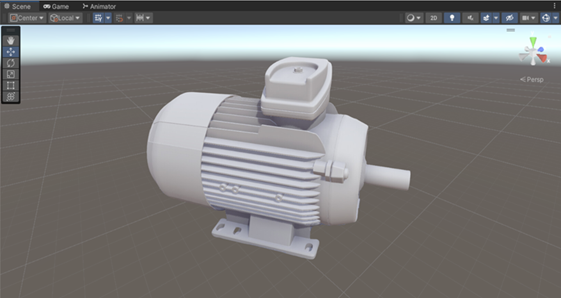
AR has been implemented on smartphones using Unity
(version 2023.2.20f1) and Vuforia Engine Package for Unity (version 10.20.3).
Unity is a real-time development platform widely used for the development of
video games and interactive applications, which allows the creation of
immersive 3D experiences. Vuforia Engine Package for Unity, compatible with
ARCore and ARKit, enables the creation of AR applications thanks to its
advanced tools for image, object and plane recognition. It is incorporated into
Unity through the Package Manager or by importing the Unity Asset Package from
the Vuforia Engine developer portal, providing flexible and accessible use on
Android and iOS devices (Figure 1).
Figure 1
3D model of an asynchronous
electric motor in Unity for subsequent integration into AR with the Vuforia
Engine.
Source:
Own elaboration.
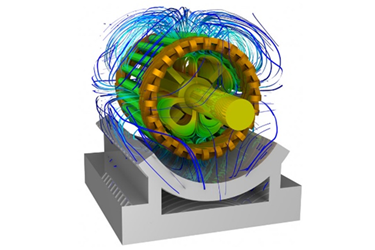
The 3D simulations are carried out using ANSYS Maxwell
(version 2024 R1), software for modelling and simulating electromagnetic fields
in 2D and 3D, which is widely used in industry for the analysis and design of
electric motors, transformers and electromagnetic devices with high simulation
fidelity (Figure 2).
Figure 2
Simulation of the
electromagnetic field in an asynchronous electric motor with ANSYS Maxwell 2024
R1.
Source:
Own elaboration.
To ensure the validity and reliability of the
measurements, standardised data collection instruments validated by other
research studies are selected. Table 2 shows the collection of instruments used
in the research and includes the variables evaluated and their corresponding
references.
Table 2
Data collection instruments
used in the research.
|
Instrument |
Variable assessed |
Reference |
|
Mental Rotation Test (MRT) |
Spatial abilities |
(Ariali, 2020) |
|
Spatial Visualization Test (SVT) |
Mental manipulation of 3D objects |
(Branoff, 2000) |
|
NASA Task Load Index (TLX) |
Perceived cognitive load |
(Hart, 2006) |
|
ARCS questionnaire |
Motivation and satisfaction |
(Ma & Lee, 2021) |
|
Content test |
Written and practical test of electrical concepts |
(Cronbach, 1951) |
The content test presented and administered by the
teaching team aims to assess the theoretical and practical application of the
electrical content taught. Given the measurement of internal consistency,
Cronbach's alpha coefficient (Cronbach, 1951) was calculated, obtaining a value
of .97, i.e., a high reliability that determines the validity of the instrument
as a tool for evaluating the content taught. In its design, the items selected
are the most representative of the curriculum, thus ensuring content validity
and suitability for the academic context. In order to assess the acquisition of
knowledge and its application in real contexts, a written and practical test
has been designed, consisting of two complementary parts.
The written test includes theoretical questions and
applied problems and covers the operation and constituent parts of the motor,
the different connection configurations, the calculation of line and phase
currents, and the analysis of characteristic curves. It also covers power
factor compensation strategies and their optimisation in industrial
environments.
The practical test covers the assembly and connection
of the motor to the appropriate connection according to the voltage
configuration, verification of its operation based on the measurement of
voltage, current and power factor at no load, identification of system losses
and performance of electrical automatisms: reversal of rotation, direct motor
start and star/delta start.
The experimental intervention phase was structured in
five stages to ensure comparison between groups and to determine which of the
teaching methodologies was having the greatest or least impact on students'
spatial skills, cognitive load, motivation and learning (Table 3).
Table 3
Experimental
intervention phase.
|
Stage |
Description |
|
Pre-test |
Initial assessment of spatial skills and prior
knowledge. |
|
Learning sessions |
Application of the teaching method assigned to each
group (AR, digital documents, 3D simulations or laboratory). |
|
Immediate assessment |
Application of the NASA TLX scale at the end of the
session to measure perceived cognitive load. |
|
Post-test |
Final measurement of spatial skills (MRT/SVT) and
motivation (ARCS). |
|
Content test |
Theoretical-practical test related to electric
motors, validating the transfer of learning. |
Data analysis was performed
using SPSS (version 28.0.1.1). Descriptive statistics were used to characterise the sample, followed by ANOVA with Tukey's
post hoc tests (Brown, 2005) to determine significant differences between
groups in spatial skills, cognitive load, motivation, and learning. In
addition, Pearson correlations were performed to examine the relationship
between cognitive load, motivation, performance on spatial tests, and learning
acquired, and ANCOVA covariance analysis (Keselman et al., 1998) was applied to
control for the impact of external variables such as familiarity with digital
technologies or level of prior knowledge.
4. Results
This section presents the findings obtained after
applying the four teaching methods investigated: AR digital documents (pdfs and
slide presentations), 3D simulations (ANSYS Maxwell) and laboratories. To
provide a comprehensive overview, the characterisation of the sample and the
overall statistical analysis (ANOVA, correlations and ANCOVA) are included. The
results relating to the development of spatial skills, perceived cognitive
load, student motivation and academic performance in the content test are presented
in detail below.
4.1. Sample characterisation and overall statistical analysis
4.1.1. Sociodemographic
characterisation and prior knowledge
The sample consisted of 80 students enrolled in the
Electrical and Electronic Engineering course, distributed equally between the
experimental and control groups. Homogeneity was ensured in variables such as
age, gender, prior knowledge and use of digital tools.
The age analysis showed an average of 21 years (range:
19-24 years), with no significant differences (p > .05) between the groups.
In terms of gender distribution, 68.8% were men and 31.2% were women, showing
equivalent proportions in each group (p > .05).
Regarding prior knowledge of electrical engineering, a
written test was administered, showing an average of 6.2 points out of a
maximum of 10. Statistical analysis confirmed the absence of significant
differences between the groups (p > .05), ensuring equivalent initial
conditions. Familiarity with digital tools was also measured on a scale of 1 to
5, obtaining an average of 3.8, with no significant differences (p > .05). Table
4 presents the detailed values of these variables for each group, showing the
homogeneous distribution of the sample, which allows the differences in the
results to be attributed exclusively to the teaching methodology used.
Table 4
Sociodemographic
characteristics and level of prior knowledge of the sample.
|
Variable |
Category/range |
EG |
CG1 |
CG2 |
CG3 |
Total |
|
Age (years) |
Mean (SD) |
20.8 (1.3) |
21.1 (1.5) |
20.9 (1.2) |
21 (1.4) |
21 (1.3) |
|
[Min.-Max.] |
[19–23] |
[19–24] |
[19–23] |
[19–24] |
[19–24] |
|
|
Gender |
Men (%) |
13 (65%) |
14 (70%) |
13 (65%) |
15 (75%) |
55 (68.8%) |
|
Women (%) |
7 (35%) |
6 (30%) |
7 (35%) |
5 (25%) |
25 (31.2%) |
|
|
Prior knowledge |
Mean (SD) |
6.2 (.8) |
6.1 (.9) |
6.3 (.7) |
6.2 (.6) |
6.2 (.8) |
|
[Min.-Max.] |
[5–8] |
[4–8] |
[5–8] |
[5–7] |
[4–8] |
|
|
Familiarity with ICT (1–5) |
Mean (SD) |
3.8 (.4) |
3.7 (.5) |
3.9 (.4) |
3.6 (.5) |
3.8 (.5) |
|
[Min.-Max.] |
[3–4] |
[3–5] |
[3–5] |
[3–5] |
[3–5] |
4.1.2. Comparisons
between groups (ANOVA) and post hoc tests
To analyse the impact of the four teaching methods
evaluated, a one-way ANOVA was applied, followed by Tukey's post hoc tests to
identify significant differences between the groups, where five key variables
were evaluated: MRT, SVT, NASA TLX, ARCS and the content test.
The results showed significant differences in all
variables (p < .01), with effect sizes (η²) between .18 and .28,
indicating a moderate to high impact of the teaching methodology (Table 5).
Table 5
One-way ANOVA and post hoc
tests for the main study variables.
|
Variable |
F |
p |
η2 |
Principal differences (Tukey) |
|
|
MRT (post-test) |
8.34 |
< .01 |
.25 |
GE > GC1 (p < .01), GE > GC3 (p
< .01), GE > GC2 (p < .05) |
|
|
SVT (post-test) |
9.11 |
< .01 |
.28 |
GE > GC1 (p < .01), GE > GC3 (p
< .01), GE > GC2 (p < .05) |
|
|
NASA TLX |
7.21 |
< .01 |
.22 |
GE < GC1 (p < .01), GE < GC3 (p
< .01), GE < GC2 (p < .05) |
|
|
ARCS |
5.66 |
< .01 |
.18 |
GE > GC1 (p < .01), GE > GC3 (p
< .05), GC2 > GC1 (p < .05) |
|
|
Content test |
9.01 |
< .01 |
.26 |
GE > GC1 (p < .01), GE > GC3 (p
< .05), GC2 >GC1 (p < .05) |
The analyses confirm that EG
achieved the best results in MRT, SVT, ARCS, and content testing, significantly
outperforming the control groups. Furthermore, EG showed the lowest cognitive
load in NASA TLX, indicating that this methodology facilitates learning with
less mental effort.
4.1.3. Pearson
correlation matrix
To analyse the relationship between the key variables
in the study, the Pearson correlation matrix was calculated, which evaluates
the association between NASA TLX, ARCS, MRT, SVT and the content test.
As shown in Table 6, there is a negative correlation
between NASA TLX and the other variables, indicating that lower cognitive load
is associated with higher motivation, better performance in spatial skills, and
better results on the content test. In particular, the strongest relationship
is with MRT (r = -.58, p < .01), suggesting that students with lower
cognitive effort tend to score higher on spatial skills. On the other hand,
ARCS shows a significant positive correlation with MRT (r = .59, p < .01)
and with the content test (r = .63, p < .01), confirming that higher
motivation is associated with better academic performance and spatial skills.
Table 6
Pearson correlations between
the main variables in the study.
|
Variable |
NASA TLX |
ARCS |
MRT |
SVT |
Content test |
|
NASA TLX |
1 |
-.55** |
-.58** |
-.50** |
-.48** |
|
ARCS |
-.55** |
1 |
.59** |
.51* |
.63** |
|
MRT |
-.58** |
0.59** |
1 |
.69** |
.65** |
|
SVT |
-.50** |
.51* |
.69** |
1 |
.54* |
|
Content Test |
-.48** |
.63** |
.65** |
.54* |
1 |
Note: *p < .05, **p < .01 (two-tailed).
4.1.4. Covariance analysis (ANCOVA)
To control for the effect of
covariates such as prior knowledge and familiarity with ICT, an ANCOVA was
applied, using the teaching method as the independent variable. This analysis
made it possible to determine whether differences in student performance
persisted after adjusting for these variables, ensuring that the effects
observed were attributable to the methodology used and not to external factors.
Table 7 shows the results of
the ANCOVA for MRT, where it can be seen that both prior knowledge (F = 12.05,
p < .01, ηp2 = .14) and familiarity with ICT (F =
7.21, p < .01, ηp2 = .09) influence performance.
However, the teaching method continues to have a significant effect on MRT (F =
12.42, p < .01, ηp2 = .33), indicating that the
methodology applied has a considerable impact on the development of spatial
skills, even after controlling for these covariates.
Table 7
ANCOVA results for MRT.
|
Source of variation |
SC |
gl |
CM |
F |
p |
ηp2 |
|
Covariate 1 |
154.27 |
1 |
154.27 |
12.05 |
< .01 |
.14 |
|
Covariate 2 |
92.33 |
1 |
92.33 |
7.21 |
< .01 |
.09 |
|
Teaching method |
280.52 |
3 |
93.51 |
12.42 |
< .01 |
.33 |
|
Error (residual) |
571.20 |
74 |
7.72 |
|
|
|
|
Total |
1098.32 |
79 |
|
|
|
|
The ANCOVA results confirm
that, even when adjusting for initial differences in knowledge and digital
familiarity, the ‘teaching method’ factor continues to have a significant
effect on MRT scores (p < .01, ηp2=.33), reinforcing the robustness of the findings.
4.2. Visualisation
of the AR prototype and physical laboratory
In order to illustrate the
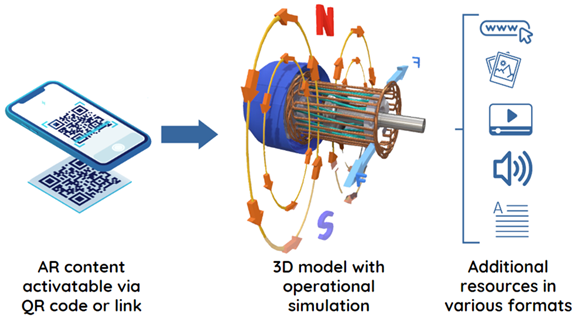
integration of AR in the study of the asynchronous induction motor, Figure 3
shows the process of activating and visualising the
content in AR. To do this, the user does not need advanced knowledge of AR
development, as it is sufficient to access the direct link or scan a QR code.
This process is carried out using the Vuforia View app (version 9.23.1) for
mobile devices, which employs a spatial recognition system based on artificial
vision that eliminates the need for physical markers (markerless
AR). This technology allows flat surfaces in the real environment to be
identified with the device's camera, thus facilitating intuitive and accessible
interaction with the superimposed virtual models.
Figure 3
Process of activating and
viewing AR content.
Source: Own elaboration.
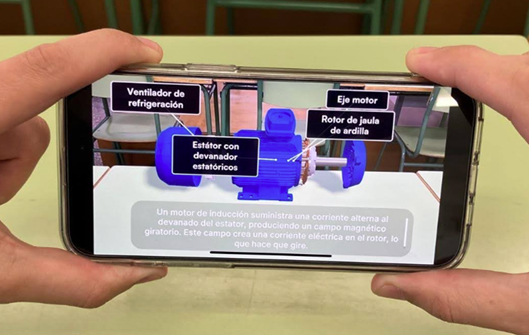
Next, Figure 4 shows the
augmented content activated on a smartphone developed in Unity (version
2023.2.20f1) using the Vuforia Engine package (version 10.20.3). The model
integrates movement, animations, and interactive labels for the main components
of the asynchronous induction motor (cooling fan, stator winding, squirrel cage
rotor, and shaft), facilitating detailed exploration of its internal structure
and operating principle.
Figure 4
3D design of an AR-enabled asynchronous induction
motor in Vuforia View, showing the cooling fan, stator winding, squirrel cage
rotor and motor shaft.
Source: Own elaboration.
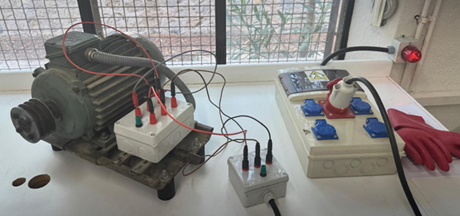
Figure 5 shows the
asynchronous induction motor in the engineering workshop (CG3), which was used
for direct starting practice, in this case star-connected, and for measuring
electrical variables (current, voltage, power factor). These practical
experiments made it possible to compare, in a real environment, the results
obtained with digital and AR methods.
Figure 5
Asynchronous induction motor
in the workshop.
Source: Own elaboration.
4.3. Development of spatial
skills
The effect of different methods on the acquisition and
improvement of spatial skills was evaluated using the MRT and SVT. Table 8
shows the descriptive results (mean and standard deviation) obtained in the
post-test for each test, as well as the mean gain values (Δ) compared to
the pre-test.
Table 8
Descriptive results in spatial
ability tests (MRT and SVT).
|
Group |
MRT Post-test (Mean ± SD) |
SVT Post-test (Mean ± SD) |
Δ MRT |
Δ SVT |
|
EG |
29.3 ± 3.1 |
25.8 ± 2.6 |
+7.2 |
+6.8 |
|
CG1 |
23.4 ± 2.9 |
20.5 ± 3 |
+4.5 |
+3.9 |
|
CG2 |
26.1 ± 3 |
22.7 ± 2.8 |
+5.9 |
+4.8 |
|
CG3 |
24.2 ± 2.5 |
21.1 ± 2.2 |
+5 |
+4.1 |
It was observed that the EG,
which used AR on smartphones, achieved significantly higher values in MRT and
SVT compared to the control groups. Δ was also higher in the EG, suggesting that the interactivity and
immersion provided by AR created an environment conducive to the development of
mental rotation and spatial visualisation skills.
ANOVA showed statistically
significant differences in the final MRT (F(3.76) = 8.34, p <
.01) and SVT (F(3.76) = 9.11, p < .01) values. Tukey's post hoc
tests confirmed that the most pronounced difference was between the EG and the
CG1 and CG3 control groups (p < .01). Although the group with 3D simulations
using ANSYS Maxwell (CG2) also showed substantial improvements, their results
were statistically inferior to those of the EG, although superior to those of
CG1 and CG3 (p < .05).
4.4. Perceived cognitive load
The effect of different methods Cognitive load was
assessed using the NASA TLX scale, administered at the end of each work session
(immediate post-test). The factors analysed included mental demand, physical
demand, temporal demand, effort, frustration, and perceived performance. Table
9 summarises the average values of the total cognitive load obtained by the
participants in each group.
Table 9
Perceived cognitive load
according to the NASA TLX scale (immediate post-test).
|
Group |
NASA TLX (Mean ± SD) |
|
EG |
39.2 ± 5.8 |
|
CG1 |
47.5 ± 6.2 |
|
CG2 |
42.6 ± 5.5 |
|
CG3 |
45.8 ± 5.9 |
The ANOVA for perceived
cognitive load (NASA TLX) showed significant differences between the groups (F(3.76)
= 7.21, p < .01). The EG reported the lowest levels of cognitive load,
ranking below CG1 and CG3 (p < .01) and slightly below CG2 (p < .05).
This finding supports the hypothesis that AR, by offering graphic and
informative representations that are highly integrated with the physical
environment, facilitates the distribution of cognitive processing and reduces
the mental effort required to understand the configuration and operation of the
asynchronous induction motor.
4.5. Student motivation
Motivation and perceived
satisfaction were assessed using a 1-to-5 Likert scale questionnaire based on
Keller's ARCS model (1987), which considers Attention, Relevance, Confidence
and Satisfaction as key dimensions of commitment to the learning task. Table 10
details the mean scores for each dimension in the four study groups.
Table 10
Motivation results (ARCS
model) in the post-test phase.
|
Group |
Attention (A) |
Relevance (R) |
Confidence (C) |
Satisfaction (S) |
ARCS Global |
|
EG |
4.32 ± .47 |
4.2 ± .42 |
4.18 ± .4 |
4.35 ± .38 |
4.26 ± .32 |
|
CG1 |
3.86 ± .51 |
3.9 ± .56 |
3.72 ± .48 |
3.78 ± .50 |
3.81 ± .46 |
|
CG2 |
4.1 ± .44 |
4.06 ± .4 |
4.05 ± .42 |
4.11 ± .41 |
4.08 ± .39 |
|
CG3 |
3.94 ± .47 |
4.01 ± .46 |
3.96 ± .45 |
3.92 ± .44 |
3.96 ± .43 |
The ANOVA analysis confirmed
statistically significant differences in the dimensions of Attention (F(3.76)
= 6.79, p < .01), Relevance (F(3.76) = 5.66, p < .01),
Confidence (F(3.76) = 5.1, p < .05) and Satisfaction (F(3.76)
= 6.02, p < 0.01). The EG group had the highest scores in all dimensions of
the ARCS questionnaire, highlighting the ability of AR to maintain attention, contextualise content in a relevant way and generate
confidence in the execution of practical tasks.
4.6. Performance in the
content test
Academic performance and the transfer of technical
learning about asynchronous induction motors were measured using a content test
designed by the teaching team, consisting of theoretical questions and
practical application exercises, as detailed in the methodology section. Table
11 shows the overall average score for this test (scale of 0 to 10 points), as
well as the proportion of correct answers in the practical exercises on
star-delta connection and the calculation of currents and powers.
Table 11
Content
test results.
|
Group |
Overall score (0-10) |
Correct answers in practical
exercises (%) |
|
EG |
8.64 ± .77 |
88.3 |
|
CG1 |
7.38 ± .81 |
74.5 |
|
CG2 |
8.05 ± .82 |
81.7 |
|
CG3 |
7.9 ± .7 |
79.6 |
The results indicate that EG
obtained the highest scores in both the overall rating and the resolution of
practical exercises, followed by groups GC2 and CG3. The ANOVA showed
significant differences in the final score (F(3.76) = 9.01, p <
.01), with an effect size (η2 = .26) suggesting a moderate
impact of the AR methodology on academic performance in electrical engineering
content. Tukey's post hoc comparisons revealed significant differences between
EG and GC1 (p < .01), as well as between EG and CG3 (p < .05), confirming
the superiority of the AR-based method in facilitating theoretical and
practical understanding of the asynchronous induction motor.
4.7. Correlational analysis
and joint effects
Pearson correlations were explored between cognitive
load (NASA TLX), motivation (ARCS), spatial skills performance (MRT, SVT) and
content test scores, as previously presented in Table 6. Significant inverse
correlations were found between NASA TLX and academic variables (MRT, SVT,
ARCS, Grade), as well as positive and statistically relevant correlations
between spatial skills and content test scores.
The negative coefficients between NASA TLX and MRT/SVT
(r = -.58, r = -.5) support hypothesis H₄, indicating that
lower cognitive load translates into better results on spatial tests,
suggesting that students who experience less mental effort have a greater
ability to mentally manipulate three-dimensional representations.
Likewise, the negative correlation between NASA TLX
and ARCS (r = -.55, p < .01) supports hypothesis H₂, as it indicates that students with lower cognitive
load experience greater motivation in their learning process, reinforcing the
idea that AR facilitates learning by better distributing the mental processing
load.
On the other hand, the existence of a strong positive
correlation between ARCS and the content test (r = .63, p < .01) validates
hypothesis H₃, in that increased
motivation directly leads to higher academic performance, i.e., students who
are more involved in the teaching activity can achieve more meaningful and
effective learning.
Finally, the positive association between MRT/SVT and
the content test (r = .65 and r = .54, respectively) validates hypothesis H₁, such that students with better spatial skills obtain
better grades in the final assessment, which highlights the relevance of
developing these skills in electrical engineering education.
An ANCOVA was also carried out to control for
differences in familiarity with digital tools and prior knowledge (Table 7).
The model adjustment did not alter the statistical significance of the teaching
method on the outcome variables, which reinforces the findings and confirms
that AR is the main determining factor in improving student performance and
motivation.
5. Discussion
The findings obtained from this research establish
evidence of the effectiveness of AR as a teaching resource for addressing the
learning of technical content in electrical engineering, specifically in the
development of spatial skills, in reducing cognitive load, and in improving
motivation levels among students.
One of the most important findings of this study is
the positive effect of AR on the development of spatial skills, which were
measured using standardised MRT and SVT tests. An improvement was observed in
the EG, which used AR with smartphones to interactively visualise an
asynchronous induction motor, compared to the CG in both tests. The differences
found are statistically significant, in addition to having relevant effect
sizes, which shows that AR generates more suitable conditions for encouraging mental
rotation processes, visualisation of three-dimensional representations, and
spatial manipulation. This statement is related to the results of Singh et al.
(2019), for whom augmented environments in electronics laboratories allow for a
significant improvement in students' spatial skills. Along the same lines,
research by Thees et al. (2020) indicates that remote laboratories with AR are
capable of connecting physical interaction with virtual models, which benefits
students' spatial learning of automation and industrial control concepts (Fidan y Tuncel, 2019).
From a cognitive point of view, given that AR showed a
clear decrease in the cognitive load perceived by participants, as assessed by
the NASA TLX scale, the result validates hypothesis H₂ that underpinned the study, in the same way as
Sweller and Chandler's (1991) Cognitive Load Theory, which indicates that good
learning design requires minimising extrinsic load in order to make way for
germinal load. AR in our research promoted the distribution of information
across several sensory channels: visual, spatial, and auditory, to enable
parallel processing of knowledge. Kapici et al. (2019) had already detected
that AR in the handling of electronic measuring equipment such as oscilloscopes
and generators significantly reduces the cognitive load on students.
Bogusevschi et al. (2020) also showed that interaction with augmented models
leads to an appreciable decrease in mental effort. The effects described by
Mejías Borrego and Andújar Márquez (2011) in the case of teaching
electromagnetism were similar; they concluded that three-dimensional
visualisation favours the construction of mental models and reduces the working
memory load. Furthermore, previous research has already demonstrated the potential
of augmented environments as cognitive support systems through immediate
feedback (del Cerro & Morales 2017).
The correlations and covariance analyses performed in
this study also corroborate the existence of a significant inverse relationship
between spatial intelligence and cognitive load, as well as a positive
correlation between motivation and content testing. Therefore, the results
obtained validate hypothesis H₄ and reinforce the
assertion that AR not only influences isolated variables, but also has a
significant impact on cognitive, motivational, and performance factors. The
same type of relationship is in line with the findings of Ibáñez and
Delgado-Kloos (2018), who indicate that students with higher intrinsic
motivation tend to achieve better concept retention and perform more accurately
in practical tasks. Bautista et al. (2025) also concluded that the motivation
produced by AR not only contributes to a better predisposition towards
learning, but also has quantifiable effects on critical thinking and academic
performance (Marini et al., 2022; Yang et
al., 2023).
Student motivation measured using Keller's ARCS model
also shows positive results. The EG group obtained significantly higher scores
in the four dimensions of the model, demonstrating that augmented environments
produce an autonomous, immersive, and satisfying learning experience. For their
part, An et al. (2019) and Marini et al. (2022) agree that AR fosters interest
and a sense of competence by allowing students to actively explore electrical
devices. Similarly, Martín-Gutiérrez et al. (2015) stated that AR eliminates
the fear of making mistakes when using expensive or dangerous equipment, which
leads to greater self-confidence. In the same vein, Yang et al. (2023)
highlighted the fact that augmented laboratories allow for autonomous and
flexible learning, which generates greater satisfaction with the task and
reduces the need for constant teaching guidance.
With regard to the academic test of the content, it
was found that the EG performed significantly better than the three CG. This
data demonstrates and reaffirms hypothesis H₁, which assumes that AR favours the transfer of
knowledge from the theoretical to the practical level, as multiple studies have
argued. Morales and del Cerro (2024) indicated in their study that students who
used AR in industrial training environments improved their ability to apply
technical concepts to real-world problem solving. Along the same lines, Kim and
Irizarry (2021) indicate that augmented environments help students perform
complex electrical installation procedures by improving accuracy and reducing
the error rate, which coincides with the findings obtained in this study on the
assembly and analysis of the induction motor in star-delta configuration.
From a methodological perspective, the study
demonstrated the pedagogical and technical feasibility of AR on mobile devices,
as supported by hypothesis H₅. The implementation
of AR with Unity and Vuforia provided accessible, flexible, and low-cost means
that point to the scalability of this technology in higher technical education.
Asham et al. (2023) propose that the use of mobile technologies can help bridge
the gap in access to immersive environments for curriculum integration during
university and technical college education. Several studies (Chen et al., 2019;
Achachagua & Chinchay, 2022) show that mobile AR applications are capable
of replicating laboratory practices with high fidelity, even in distance
learning contexts or those with limited laboratory equipment.
6. Conclusions
The research studies the effect of AR on the spatial
skills of electrical engineering students and compares its applicability as a
learning method with digital documents, three-dimensional simulators, and
laboratories. The results show that the implementation of AR through mobile
devices has clearly positive effects on STEM learning, specifically in
engineering, the representation of spatial objects, and the mental manipulation
of three-dimensional objects. Interaction with augmented environments improved
students' spatial skills considerably more than CG. In addition, the immersive
interactivity of AR is beneficial for cognitive processes related to mental
rotation and spatial object representation, as it reduces students' cognitive
effort.
From a motivational perspective, students who used AR
showed greater attention, relevance, confidence, and satisfaction compared to
those who used traditional methods. Increased perception of learning ability
and greater intrinsic motivation had a direct impact on academic performance.
The technical and pedagogical feasibility of AR has
also been demonstrated, highlighting its ease of implementation through
platforms such as Unity and Vuforia, which are effective, scalable, and
economically viable for adoption in university technical curricula. Therefore,
AR is considered an educational tool with unique potential to improve spatial
skills, reduce cognitive load, and increase motivation, providing tangible
benefits for training in electrical engineering and other STEM disciplines.
On the other hand, limitations related to sample size
and intervention duration were identified, limiting the possible generalisation
of the results. Furthermore, the study was limited to electrical engineering
students only, suggesting that further studies are needed to explore the
potential of AR in contexts related to STEM education.
Ultimately, future research directions point to the
proposal of new studies with larger samples and longer interventions, as well
as the exploration of the effect of AR on long-term learning and knowledge
retention. Another avenue of research is to replicate the study by integrating
other emerging technologies to compare best practices and methodologies in
higher education.
Data Availability
Statement
The dataset used in this study is available upon
reasonable request to the corresponding author.
Ethics approval
Not applicable
Conflicts of interest
The authors declare that they have no conflicts of
interest.
References
Achachagua, Y. H. Y., & Chinchay, H. E. G.
(2022). La realidad aumentada y su efecto en la habilidad espacial de
estudiantes de ingeniería mecánica. Revista de Educación a Distancia
(RED), 22(70). https://doi.org/10.6018/red.509931
Ahn, S., Kim, T., Park, Y. J., & Kim, J. M.
(2020). Improving effectiveness of safety training at construction worksite
using 3D BIM simulation. Advances in Civil Engineering, 2020(1),
2473138. https://doi.org/10.1155/2020/2473138
Álvarez-Marín, A., & Velazquez-Iturbide, J. A.
(2022). Augmented reality and engineering education: A
systematic review. IEEE transactions on learning technologies, 14(6),
817-831. https://doi.org/10.1109/TLT.2022.3144356
Alzahrani, N. M. (2020). Augmented reality: A
systematic review of its benefits and challenges in e-learning contexts. Applied sciences, 10(16),
5660. https://doi.org/10.3390/app10165660
An, J., Poly, L. P., & Holme, T. A. (2019).
Usability testing and the development of an augmented reality application for
laboratory learning. Journal of Chemical Education, 97(1),
97-105. https://doi.org/10.1021/acs.jchemed.9b00453
Arena, F., Collotta, M.,
Pau, G., & Termine, F. (2022). An overview of augmented reality. Computers, 11(2),
28. https://doi.org/10.3390/computers11020028
Ariali, S. (2020). Training of mental rotation ability
in virtual spaces. Journal of Technical Education (JOTED), 8(2),
46-63. https://doi.org/10.48513/joted.v8i2.207
Asham, Y., Bakr, M. H., & Emadi, A. (2023).
Applications of Augmented and Virtual Reality in Electrical Engineering
Education: A Review. IEEE Access. https://doi.org/10.1109/ACCESS.2023.3337394
Azuma, R. T. (1997). A Survey of Augmented Reality. Presence: Teleoperators
& Virtual Environments, 6(4), 355–385. https://doi.org/10.1162/pres.1997.6.4.355
Bautista, L. E., Maradei, F., & Pedraza, G. (2025). Análisis de la
Disposición Espacial de Contenido en entornos de Realidad Aumentada y su Efecto
en la Carga Cognitiva de los Usuarios. Pixel-Bit. Revista de Medios y
Educación. https://doi.org/10.12795/pixelbit.109089
Bogomolova, K., van der Ham, I. J., Dankbaar, M. E., van
den Broek, W. W., Hovius,
S. E., van der Hage, J. A.,
& Hierck, B. P. (2020). The effect of
stereoscopic augmented reality visualization on learning anatomy and the
modifying effect of visual‐spatial abilities:
A double‐center randomized controlled trial. Anatomical
sciences education, 13(5), 558-567. https://doi.org/10.1002/ase.1941
Bogusevschi, D., Muntean, C.,
& Muntean, G. M. (2020). Teaching and learning physics using 3D virtual
learning environment: A case study of combined virtual reality and virtual
laboratory in secondary school. Journal of
Computers in Mathematics and Science Teaching, 39(1),
5-18. https://doi.org/10.70725/297454nsjryb
Bourbour, M. (2023). Using
digital technology in early education teaching: learning from teachers’
teaching practice with interactive whiteboard. International
Journal of Early Years Education, 31(1), 269-286. https://doi.org/10.1080/09669760.2020.1848523
Branoff, T. J. (2000). Spatial visualization
measurement: A modification of the Purdue Spatial Visualization
Test—visualization of rotations. The Engineering
Design Graphics Journal, 64(2). https://doi.org/10.18260/edgj.v64i2.145
Brown, A. M. (2005). A new software for carrying out
one-way ANOVA post hoc tests. Computer methods and programs in biomedicine, 79(1),
89-95. https://doi.org/10.1016/j.cmpb.2005.02.007
Buchner, J., Buntins, K., & Kerres,
M. (2022). The impact of augmented reality on cognitive load and performance: A
systematic review. Journal of Computer Assisted Learning, 38(1),
285-303. https://doi.org/10.1111/jcal.12617
Chen, Y., Wang, Q., Chen, H., Song, X., Tang, H.,
& Tian, M. (2019). An overview of augmented reality technology. In Journal
of Physics: Conference Series (Vol. 1237, No. 2, p. 022082). IOP Publishing. https://doi.org/10.1088/1742-6596/1237/2/022082
Chen, L., Wang, X., Min, Y., Li, G., Wang, L., Qi, J.,
& Xu, F. (2020). Modelling and investigating the impact of asynchronous
inertia of induction motor on power system frequency response. International
Journal of Electrical Power & Energy Systems, 117,
105708. https://doi.org/10.1016/j.ijepes.2019.105708
Cronbach, L.
J. (1951). Coefficient alpha and the internal structure
of tests. Psychometrica, 16(3), 297-334. https://doi.org/10.1007/BF02310555
del Cerro Velázquez, F.,
& Morales Méndez, G. (2017). Realidad Aumentada como herramienta de mejora
de la inteligencia espacial en estudiantes de educación secundaria. Revista
de Educación a Distancia (RED), (54). http://dx.doi.org/10.6018/red/54/5
del Cerro Velázquez, F.,
& Morales Méndez, G. (2021). Systematic review of the development of spatial
intelligence through augmented reality in stem knowledge areas. Mathematics, 9(23),
3067. https://doi.org/10.3390/math9233067
Elford, D., Lancaster, S. J., & Jones, G. A.
(2022). Exploring the effect of augmented reality on cognitive load, attitude,
spatial ability, and stereochemical perception. Journal of Science
Education and Technology, 31(3), 322-339. https://doi.org/10.1007/s10956-022-09957-0
Fidan, M., & Tuncel, M. (2019). Integrating
augmented reality into problem-based learning: The effects on learning
achievement and attitude in physics education. Computers & Education,
142, 103635. https://doi.org/10.1016/j.compedu.2019.103635
García, F. M., Rojas, L. E.
B., & Pedraza, G. (2023). Carga cognitiva y esfuerzo mental durante el
cambio de contexto en entornos de realidad aumentada con fines de aprendizaje
procedimental. Pixel-Bit. Revista de Medios y Educación, 68,
305-340. https://doi.org/10.12795/pixelbit.97479
Garzón, J., Kinshuk, Baldiris,
S., & Fabregat, R. (2019). Systematic review and
meta-analysis of augmented reality in educational settings. Virtual Reality,
23(4), 447–459. https://doi.org/10.1007/s10055-019-00379-9
Guillén-Gámez, F. D.,
Cabero-Almenara, J., Llorente-Cejudo, C., & Palacios-Rodríguez, A. (2022). Differential
analysis of the years of experience of higher education teachers, their digital
competence and use of digital resources: Comparative research methods. Technology,
Knowledge and Learning, 27(4), 1193-1213. https://doi.org/10.1007/s10758-021-09531-4
Hart, S. G. (2006). NASA-task load index (NASA-TLX);
20 years later. In Proceedings of the human factors and ergonomics
society annual meeting (Vol. 50, No. 9, pp. 904-908). Sage CA: Los
Angeles, CA: Sage publications. https://doi.org/10.1177/154193120605000909
Ibáñez, M. B., & Delgado-Kloos, C. (2018). Augmented reality
for STEM learning: A systematic review. Computers &
Education, 123, 109–123. https://doi.org/10.1016/j.compedu.2018.05.002
Ismail, A., Festiana, I., Hartini, T. I., Yusal, Y., &
Malik, A. (2019). Enhancing students’ conceptual understanding of electricity
using learning media-based augmented reality. In Journal of Physics:
Conference Series (Vol. 1157, No. 3, p. 032049). IOP Publishing. https://doi.org/10.1088/1742-6596/1157/3/032049
Kanivets, O. V., Kanivets, I. M., & Gorda, T. M. (2022). Development of
an augmented reality mobile physics application to study electric
circuits. Educational Technology Quarterly, 2022(4),
347-365. https://doi.org/10.55056/etq.429
Kapici, H. O., Akcay, H., & de Jong, T. (2019). Using hands-on and
virtual laboratories alone or together―which works better for acquiring
knowledge and skills?. Journal of science education and technology, 28(3),
231-250. https://doi.org/10.1007/s10956-018-9762-0
Keller, J. M. (1987). Development and use of the ARCS
model of motivational design. Journal of Instructional Development, 10(3), 2–10. https://doi.org/10.1007/BF02905780
Keselman, H. J., Huberty, C. J., Lix, L. M., Olejnik,
S., Cribbie, R. A., Donahue, B., ... & Levin, J.
R. (1998). Statistical practices of educational researchers: An analysis of
their ANOVA, MANOVA, and ANCOVA analyses. Review of
educational research, 68(3), 350-386. https://doi.org/10.3102/00346543068003350
Kim, J., & Irizarry, J. (2021). Evaluating the use
of augmented reality technology to improve construction management student’s
spatial skills. International Journal of Construction Education and
Research, 17(2), 99-116. https://doi.org/10.1080/15578771.2020.1717680
Lorenzi-Cioldi, F. (1998). Group status and
perceptions of homogeneity. European review of social psychology, 9(1),
31-75. https://doi.org/10.1080/14792779843000045
Marini, A., Nafisah, S., Sekaringtyas,
T., Safitri, D., Lestari, I., Suntari,
Y., ... & Iskandar, R. (2022). Mobile augmented reality learning media with
Metaverse to improve student learning outcomes in science class. International
Journal of Interactive Mobile Technologies, 16(7).
https://doi.org/10.3991/ijim.v16i07.25727
Martín-Gutiérrez, J., Fabiani, P., Benesova, W.,
Meneses, M. D., & Mora, C. E. (2015). Augmented reality
to promote collaborative and autonomous learning in higher education. Computers in Human
Behavior, 51, 752–761. https://doi.org/10.1016/j.chb.2014.11.093
Mejías Borrero, A., & Andújar Márquez, J. M.
(2011). A Pilot Study of the Effectiveness of Augmented
Reality to Enhance the Use of Remote Labs in Electrical Engineering Education. Springer Science+Business
Media, LLC. https://doi.org/10.1007/s10956-011-9345-9
Morales Méndez, G., &
del Cerro Velázquez, F. (2024). Augmented reality in Industry 4.0 assistance and
training areas: A systematic literature review and bibliometric analysis. Electronics, 13(6),
1147. https://doi.org/10.3390/electronics13061147
O'Connor, M., Stowe, J., Potocnik, J., Giannotti, N.,
Murphy, S., & Rainford, L. (2021). 3D virtual reality simulation in
radiography education: The students' experience. Radiography, 27(1),
208-214. https://doi.org/10.1016/j.radi.2020.07.017
Oguguo, B., Ezechukwu, R., Nannim, F., & Offor, K. (2023). Analysis of teachers in
the use of digital resources in online teaching and assessment in COVID
times. Innoeduca. International
journal of technology and educational innovation, 9(1),
81-96. https://doi.org/10.24310/innoeduca.2023.v9i1.15419
Papakostas, C., Troussas,
C., Krouska, A., & Sgouropoulou,
C. (2021). Exploration of augmented reality in spatial abilities training: a
systematic literature review for the last decade. Informatics in
Education, 20(1), 107-130. http://dx.doi.org/10.15388/infedu.2021.06
Prasetya, F., Fortuna, A., Samala, A. D., Rawas, S., Mystakidis, S., Wulansari, R. E., & Kassymova,
G. K. (2024). The impact of augmented reality learning experiences based on the
motivational design model: A meta-analysis. Social Sciences
& Humanities Open, 10, 100926. https://doi.org/10.1016/j.ssaho.2024.100926
Singh, G., Mantri, A., Sharma, O., & Dutta, R.
(2019). Evaluating the impact of the augmented reality learning environment on
electronics laboratory skills of engineering students. Computers &
Applications in Engineering Education, 27(6), 1361–1375. https://doi.org/10.1002/cae.22156
Slack, M. K., & Draugalis
Jr, J. R. (2001). Establishing the internal and external validity of
experimental studies. American journal of health-system pharmacy, 58(22),
2173-2181. https://doi.org/10.1093/ajhp/58.22.2173
Sorby, S. A. (2009). Educational research in
developing 3-D spatial skills for engineering students. International
Journal of Science Education, 31(3), 459–480. https://doi.org/10.1080/09500690802595839
Sweller, J., &
Chandler, P. (1991). Evidence for cognitive load theory. Cognition and
instruction, 8(4), 351-362. https://doi.org/10.1207/s1532690xci0804_5
Tarasenko, R. O., Amelina, S. M., Semerikov, S. O.,
& Shynkaruk, V. D. (2021). Using interactive
semantic networks as an augmented reality element in autonomous learning.
In Journal of Physics: Conference Series (Vol. 1946, No. 1, p.
012023). IOP Publishing. https://doi.org/10.1088/1742-6596/1946/1/012023
Thees, M., Kapp, S., Strzys,
M. P., Beil, F., Lukowicz, P., & Kuhn, J. (2020). Effects of augmented
reality on learning and cognitive load in university physics laboratory
courses. Computers in Human Behavior, 108,
106316. https://doi.org/10.1016/j.chb.2020.106316
Uttal, D. H., et al. (2013). The malleability of
spatial skills: A meta-analysis of training studies. Psychological
Bulletin, 139(2), 352–402. https://doi.org/10.1037/a0028446
Vandenberg, S. G., & Kuse, A. R. (1978). Mental
rotations, a group test of three-dimensional spatial visualization. Perceptual and
Motor Skills, 4, 599–604. https://doi.org/10.2466/pms.1978.47.2.599
Yang, X., Mao, W., Hu, Y., Wang, J., Wan, X., &
Fang, H. (2023). Does augmented reality help in industrial training? A
comprehensive evaluation based on natural human behavior
and knowledge retention. International Journal of Industrial Ergonomics, 98,
103516. https://doi.org/10.1016/j.ergon.2023.103516