
Artificial Intelligence Literacy in Higher
Education: A Reflective Analysis of Training Needs and Student
Literacidad en Inteligencia Artificial
en la Educación Superior: Un Análisis Reflexivo sobre Necesidades Formativas y
Percepciones Estudiantiles

 Dr. Emmanuel Magallanes. Universidad Politécnica de Zacatecas. México.
Dr. José Iván López Flores. Universidad Autónoma de Zacatecas. México.
Dra. Carolina Carrillo García. Universidad Autónoma de Zacatecas. México.
Received: 2025/09/01 Revised: 2025/10/29 Accepted: 2025/11/21 Published: 2026/01/01
How to cite:
Magallanes, E., López
Flores, J.I., & Carrillo García, C. (2025). Literacidad en Inteligencia
Artificial en la Educación Superior: Un Análisis Reflexivo sobre Necesidades
Formativas y Percepciones Estudiantiles [Analysis of a Practical Case of a Didactic Model
for Critical Thinking with Artificial Intelligence (AI) in Higher Education]. Pixel-Bit, Revista de Medios y Educación, 75,
Art. 4. https://doi.org/10.12795/pixelbit.117817
ABSTRACT
Drawing from a historical
perspective on the integration of technology into academic life, this article
reflects on the school's unavoidable responsibility in the media and
technological education of students. Using a qualitative approach, it argues
that just as traditional media literacy was once crucial, it is now imperative
to integrate artificial intelligence (AI) literacy as an essential component of
the curriculum. To explore this educational need, a diagnostic study was
conducted with 392 university students through a survey measuring their
perceptions on AI literacy, from its utility to its ethical implications. Data
analysis, using descriptive statistics, reveals that students identify a high
utility for AI, primarily in instrumental tasks such as writing texts and
searching for information. However, they report a scarce integration of these
tools into their formal learning processes and a limited understanding of their
fundamentals and scope. This dissonance between functional use and lack of academic
integration underscores a significant gap, highlighting the urgent need for
higher education institutions to assume a proactive role in developing critical
competencies in artificial intelligence.
RESUMEN
Partiendo de una retrospectiva histórica sobre la
incorporación de la tecnología a la vida escolar, este artículo expone una
reflexión sobre la ineludible responsabilidad de la escuela en la formación
mediática y tecnológica de los estudiantes. Desde un enfoque cualitativo, se
argumenta que, como en su momento fue crucial alfabetizar en medios
tradicionales, es imperativo integrar la literacidad en inteligencia artificial
(IA) como un componente esencial del currículo. Para explorar esta necesidad
formativa, se realizó un estudio diagnóstico con 392 alumnos de diversas
universidades, aplicando una encuesta para medir sus percepciones en las
dimensiones de la literacidad en IA, desde de su utilidad hasta sus
implicaciones éticas. El análisis de datos, mediante estadística descriptiva,
revela que los estudiantes universitarios identifican una alta utilidad de la
IA principalmente en tareas instrumentales, como la redacción de textos y la
búsqueda de información. Sin embargo, reportan una escasa integración de estas
herramientas en sus procesos de aprendizaje formales y una limitada comprensión
de sus fundamentos y alcances. Esta disonancia entre el uso funcional y la
falta de integración académica subraya una brecha significativa, evidenciando
la urgencia de que las instituciones de educación superior asuman un rol
proactivo en el desarrollo de competencias en IA.
KEYWORDS · PALABRAS CLAVE
Artificial Intelligence Literacy; Higher Education;
Digital Competencies; Educational Technology; University Curriculum.
Literacidad en Inteligencia Artificial; Educación
Superior; Competencias Digitales; Tecnología Educativa; Currículo
Universitario.
1. Introduction
No tools will make a man a skilled workman, or master
of defence, nor be of any use to him who has not learned how to handle them,
and has never bestowed any attention upon them
—Plato, The Republic
The field of artificial intelligence (AI), once the
domain of science fiction, has become a subject of interest to the general
public. However, it should be noted that this access does not guarantee correct
use, which is understood as conscious, ethical, and effective use. The notion
that ease of use is synonymous with competence is a pervasive misconception
that persists with the advent of each new technology. Within the domain of
education, this notion poses a significant challenge, as it fosters the erroneous
belief that technological integration guarantees profound and effortless
learning merely by virtue of its presence.
In the early days of silent film, Béla Balázs proposed
a "Theory of Film" that began with reflections on education up to
that point. It is noteworthy that the author's film theory commenced with a
chapter entitled "The Dangers of Ignorance," which reads as
follows:
At our universities there are chairs for literature
and all arts except that of the film. The first Art Academy which included the
theory of film art in its curriculum was opened in Prague in 1947. The
text-books used in our secondary schools discuss the other arts but say nothing
of the film. Millions hear about the aesthetics of literature and painting who
will never make use of such knowledge because they read no books and look at no
pictures. But the who frequent the movies are left without guidance—no one
teaches them to appreciate film art. (Balázs, 1970, p. 18)
He posits that 1947 marks a late date—he would perish
in 1949, and the work containing the quote would be published in 1957—and even
titles one of his chapters "Missed Opportunity." With respect to the
notion of culture and the cultured individual, Balázs astutely noted that a
cultivated individual would be familiar with the lives and works of Leonardo da
Vinci, Beethoven, and Michelangelo. However, it was possible to be considered
"cultured" without being acquainted with Eisenstein, a prominent
director of his era. For the critic, it is essential that the audience be
adequately prepared before encountering a film. He employs a term from one of
his presentations to describe this preparation in film appreciation:
film-conscious, which could be translated as "cinematic awareness."
This term implies that it is not something spontaneous or fortuitous, but
rather, it is something that must be acquired, refined, reflected upon, and
worked on. Consequently, the optimal environment for cultivating cinematic
awareness is within the structured environment of a school:
Until there is a chapter on film art in every
text-book on the history of art and on aesthetics; until the art of the film
has a chair in our universities and a place in the curriculum of our secondary
schools, we shall not have firmly established in the consciousness of our
generation this most important artistic development of our century. (Balázs,
1970, p. 19)
Film classes have not been incorporated into the
secondary school curriculum, nor are there any thematic units dedicated to
films in textbooks. The concept of "film awareness" has not been
established as either an objective or a subject of study. Bálazs
asserts that we have not yet developed the capacity to engage in truly
discerning film viewing. Subsequent to the advent of cinema, television emerged
as a dominant medium, gaining a ubiquitous presence in households and
institutions. This ascendance can be attributed to two key factors: its
extensive reach and its accessibility. Consequently, it was hypothesized that
the platform would be highly accessible for students and educators, serving as
an effective educational medium and pedagogical instrument for the state. At
that time, Ferrés and Pisticelli
sounded a note of caution:
Media competition, therefore, necessitates the
cultivation of a discerning aptitude, particularly concerning one's own
critical faculties. This is due to the preeminence of
the emotional brain over the rational brain, which renders it more precise to
characterize human beings as rationalizing animals rather than as rational
animal. (Ferrés & Piscitelli, 2012, p. 79)
A critical examination of the medium is imperative,
extending beyond its mere utilization. These authors, particularly Ferrés, conducted extensive research, studying entire
cities in Spain (Ferrés Prats et al., 2012) and a
highly diverse population, for example in the Autonomous Community of
Andalusia. The investigation revealed "serious deficiencies" in the
capacity to interpret audiovisual messages in a reflective and critical manner.
The study indicates that, in many cases, the degree of competence is not
optimal. This finding refutes the hypothesis that ease of use will inevitably
lead to mastery of the medium or technology.
Conversely, when discussing deficiencies, it is
imperative to ascertain the specific elements that are absent. The researchers
proposed a series of dimensions in which the degree of media competence of the
individuals surveyed could be determined. As posited by Aguaded
et al. (2011) on page 99, "Training needs affect the six dimensions that
make up this competence: aesthetics, languages, ideology and values,
technology, production and programming, and reception and audience." This
reinterpretation of the act of "watching television" as a
communicative act gives rise to further implications. The comprehensive
understanding of television necessitates an amalgamation of competencies,
including but not limited to language and speech proficiency, as well as
expertise in cinematography and visual arts. Television can only be utilized to
its full potential within the context of this paradigm. Television has long
been the subject of criticism, particularly among children and young people,
leading to the pejorative appellation "the idiot box." It is possible
that not all of the effects can be attributed to the "idiot box," or
alternatively, the "idiocy" of the box may be a reflection of the
user's deficiency in media literacy.
At this juncture, parallels can be drawn between this
work and previous cinematic experiences. Ferrés's
(2019) work distinguishes between the concepts of "educating with
television" and "educating on television," highlighting the
significance of recognizing the distinct nature of these approaches in
educational settings. The modification in preposition signifies a profounder
reflection, as technology is regarded as an educational medium, yet scant
attention is devoted to media education. The necessity of media literacy, which
is defined as the ability to evaluate and comprehend the content of various
media forms, stems from the need to ascertain the individual's level of mastery
in the aforementioned dimensions. It is important to note that, as in cinema, merely
watching television will not automatically develop these skills; they must be analyzed, reflected upon, and taught in school.
In this context, if an educational institution
neglects to instruct its students in the art of television viewing, what kind
of world is it preparing them for? It is incumbent upon educational
institutions to facilitate the interpretation of their culture's symbols by
nascent generations of students. Which symbols does the educational system help
to interpret in the present day? To which culture does this refer? If the
purpose of education is to prepare citizens to integrate into society in a
thoughtful and critical manner, it is pertinent to consider how citizens who
are not prepared to critically engage in the activity to which they devote most
of their time will integrate. (Ferrés, 1994, p. 15)
As indicated by several sources (Choi et al., 2023;
National Survey on the Availability and Use of Information Technologies in
Households [ENDUTIH] 2024, n.d.; Statistics on the Digital Situation in Mexico
2023-2024 - Branch, 2025; Ganson et al., 2023), the average user spends
approximately eight hours per day engaging with digital content. This screen
time is comparable to the time allocated for sleep or work, as noted by Ferrés. In light of this observation, it is recommended
that the subject be incorporated into the school curriculum.
Digital technologies, including the internet, have
introduced both challenges and opportunities across various aspects of daily
life, a phenomenon referred to as the "digital divide." However, this
divide can be seen as a reoccurrence of the earlier phenomenon of the
television divide. According to Van Dijk (2017), the discourse surrounding the
digital divide frequently gives rise to misinterpretations.
It is noteworthy that prior to Van Dijk's observation,
Ferrés employed the term "degrees,"
aligning with the perspective that discourse on "gaps" signifies a
void, reminiscent of a Manichean dichotomy between possession or
non-possession. This static position precludes discourse on growth or improvement.
After elucidating the aforementioned points, it is evident that a significant
error occurs when discussing gaps in general terms. The author has categorized
gaps into three distinct types: physical access, skills access, and usage
access.
The initial disparity pertains to physical access,
defined as a user's ability to access a device, such as a computer. The
feasibility of this access is contingent upon a multifaceted set of factors,
including economic, social, and geographic circumstances, in addition to other
variables. Two additional points merit emphasis. First, this is the most
extensively studied gap and is regarded as the most significant. It is
attributed to individual characteristics, such as economic status or age, as
these are associated with purchasing power. Secondly, teachers and schools
exert minimal to no influence on this type of gap.
The second gap pertains to skills. It is important to
acknowledge that the issue of digital inequality does not conclude once
physical access has been attained; rather, it commences when digital media is
integrated into daily life. As Van Dijk (2017, p. 2) asserts, the eight hours
of internet use previously referenced demonstrate the significant role that
digital technology plays in contemporary daily life.
Consequently, the second gap constitutes a component
of society's training requirements. The author designates these competencies as
"digital or media literacy," though he cautions that assessing them
poses significant challenges due to their absence from formal educational
curricula. Instead, these competencies are cultivated through individuals'
experiential learning and practical application. Consequently, he aligns with
the perspectives of Bálazs and Ferrés,
acknowledging the absence of a structured framework for this knowledge, which
hinders its evaluation. The third barrier to access pertains to the utilization
of the system, which is known as usability. This phenomenon is evident in the
duration of technology usage, as well as in the activity and creativity
exhibited during use, which can be defined as technological appropriation. It
is only by surmounting the initial two obstacles that one can attain the third.
The advent of the concept of digital literacy has
given rise to two fundamental inquiries: the establishment of a precise
definition and the development of a reliable measurement scale. Despite the
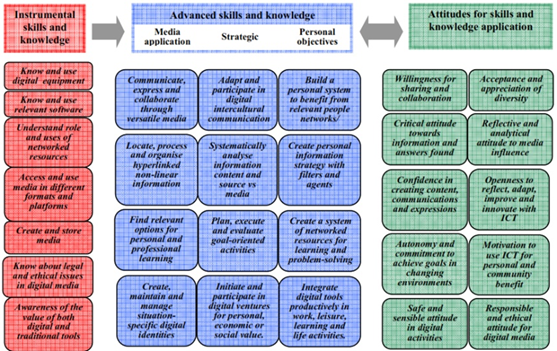
numerous approaches to its definition, Ala-Mutka (2011) offers a comprehensive
framework for understanding digital literacy.
Figure 1
Mapping Digital Literacy. (Source: Ala-Mutka, 2011, as
cited in Álvarez, 2012)
Source: own elaboration.
In alignment with Bálazs's
discernment of cinematic elements and Ferrés's
proficiency in media, Ala-Mutka introduces a multifaceted array of components,
a consequence of the inherent characteristics of the medium. In contrast to the
relatively passive nature of film and television, the internet fosters a more
dynamic and interactive environment, where users not only consume content but
also actively produce it, including messages, content, and other forms of
communication. For instance, ethical considerations in the former media milieu
entailed the discretion to access or withhold access to content, or, in
pertinent instances, to exhibit or refrain from exhibiting content. In essence,
ethical action entailed the decision to either view or withhold viewing. In the
context of digital tools, the ethical considerations are considerably more
intricate, as they encompass the prerogative to view, share, edit, suggest,
create, or modify content, among other potential actions.
Kirsti Ala-Mutka's approach does not exclude previous
media forms such as film or television; rather, it integrates them as
fundamental components of its methodology. Moreover, the notion of
"everyday life" is understood to encompass both professional and
leisurely activities (Eurostat, 2018). A hierarchical system of levels was
established, ranging from mastery to skill to competence to literacy. A certain
degree of technical expertise is also required in order to function effectively
in the media and to ensure safe and ethical navigation.
The study of digital literacy witnessed a substantial
surge around 2020 (Reddy et al., 2020, 2023; Tinmaz
et al., 2022, 2023), attributable to the closure of educational institutions
due to the pandemic. Consequently, digital literacy assumed a more prominent
role (Magallanes Ulloa, 2023). A significant proportion of this scientific
output exhibited common denominators, including the necessity to integrate it
into the curriculum and, in cases where it is included, to augment its presence
(Alowais et al., 2024; Breakstone et al., 2018; W.
Ng, 2012; Reddy et al., 2023; Spante et al., 2018).
Consequently, its necessity was not only academic but also practical, as it had
the potential to enhance employability (Nikou et al., 2022) and even act as a
health variable (Arias López et al., 2023).
As the world was beginning to return to what was
termed the "new normal" in the post-pandemic era, new Generative
Artificial Intelligence services emerged in 2022. In contrast to the other
technologies mentioned, Generative Artificial Intelligence immediately overcame
the initial two barriers to AI adoption: access and skills. Although the notion
of artificial intelligence is not a novel concept, it historically resided
within the confines of secret laboratories and the realm of science fiction
films. However, beginning in 2022, it has undergone a significant shift,
becoming accessible on a vast scale through various devices and seamlessly
integrating into critical aspects of modern communication, such as office
automation, messaging services, and email. Moreover, they were, at least in
part, free. The advent of user-friendly, chat-type interfaces, which utilize
natural language, has effectively dismantled the skills barrier. The sole
remaining impediment is the utilization barrier.
In the opinion of some scholars (Bender, 2024; H. Wang
et al., 2020), the use of AI is simply another skill that should be included
within the scope of digital literacy. However, the prevailing consensus is that
a distinct framework should be developed for AI. Long and Magerko
(2020) commence with four fundamental inquiries: What is AI? What can AI do?
How does AI work? The utilization of AI is a subject that merits careful
consideration. A further inquiry concerns the public's perception of AI. The
approach's brilliance lies in its simplicity, which effectively eliminates AI
specialization.
Consequently, the initial dimensions for AI literacy
are delineated as follows: Awareness, Use, Evaluation, and Ethics. Awareness is
defined as the ability to identify and comprehend AI technology when utilizing
AI-related applications. The term "use" is employed to denote the
capacity to employ and leverage AI technology to execute tasks with optimal
efficiency. The evaluation process entails the capacity to meticulously analyze, methodically select, and critically assess AI
applications and their outcomes. Ethics pertains to the capacity to discern the
responsibilities and risks inherent in the utilization of AI technology. (B.
Wang et al., 2023)
Conversely, Ng et al. (2021b) proposed a
classification of AI literacy into four fundamental dimensions: knowledge and
understanding of AI, utilization and application of AI, evaluation and
development of AI, and consideration of ethics in AI. Touretzky
et al. (2019) advanced a series of five fundamental concepts for the
integration of artificial intelligence in K-12 education, encompassing the
domains of perception, representation and reasoning, learning, natural
interaction, and the social implications of AI. Zhang et al. (2023) developed a
secondary school curriculum centered on fostering AI
literacy, meticulously structured around three fundamental components:
fundamental AI concepts, ethical and social implications, and vocational
guidance in AI-related careers. From the literature, an alternative theoretical
framework is posited, encompassing four dimensions: the ABCE (affective, behavioral, cognitive, and ethical) framework. The ABCE
dimensions of AI literacy development in students comprise four essential
areas: the affective aspect, which refers to attitudes, emotions, and interests
toward AI; the behavioral aspect, related to actions
and the practical application of knowledge about AI; the cognitive aspect,
focused on the theoretical and conceptual understanding of AI; and the ethical
dimension, which involves critical reflection on the moral and social implications
of using this technology.
As with digital literacy, these dimensions yield a
catalogue of AI competencies.
Table 1
Essential skills for using AI by different authors
|
Author(es) |
Focus
Main |
Key
Components (Summary) |
|
(Long & Magerko,
2020) |
16 Holistic Competencies |
Recognition, Understanding, ML Steps, Data
Literacy, Ethics. |
|
(Ng et al., 2021a, 2021b) |
Cognitive Taxonomy (Bloom) |
6 levels: Know, Understand, Apply, Analyze, Evaluate, Create in AI. |
|
(Rizvi et al., 2023) |
4 Levels of Depth |
From Social/Ethical (biases) to the
“Engine” (technical functioning). |
|
(Annapureddy et
al., 2024) |
Generative AI Skills |
12 skills: Prompt Engineering, Content
Detection, Evaluation, Ethics. |
Bloom's Taxonomy (1979) is widely regarded as a
foundational work in this field, as it provides a taxonomic framework that
enables the refinement and grading of AI literacy competencies. The dimensions
and skills delineate a more expansive framework for the utilization of AI. A
comprehensive understanding of the degree of mastery or knowledge, user
profiles, and types of use facilitates the transcendence of dualisms such as
"knows or does not know," "has or does not have." This
understanding reveals that the relationship with AI is considerably more
intricate than contracting a service or the specific use of a particular
application. The aforementioned framework facilitates the formulation of
inquiries that delineate this relationship and enable future comparisons. The
instrument presented in this study is predicated on these theoretical
frameworks.
2. Method
A digital questionnaire was disseminated via Google
Forms to 392 university students representing various Mexican institutions. The
sampling method was implemented for the sake of convenience. The sample
included 203 women and 189 men, aged between 17 and 56 (M = 20.82, SD = 4.19).
Participants were grouped into four areas: The distribution of disciplines is
as follows: engineering (58.16%), social sciences (35.20%), basic sciences
(3.32%), and health sciences (3.32%).
The instrument was composed of two sections. The
initial phase of the study entailed the collection of sociodemographic data,
encompassing age, gender, institutional affiliation, and the specific field of
study. The second study incorporated 47 Likert items, which were organized into
five dimensions: knowledge and skills, affective dimension, ethical dimension,
contextual application, and academic experience. Additionally, it included
eight open-ended questions. Responses were then coded on a four-point scale
ranging from 1, representing the lowest level of agreement, to 4, representing
the highest level of agreement. The open-ended nature of the questions posed
allowed for the articulation of opinions and perspectives in a manner that was
not constrained by predefined responses.
The questionnaire was approached from two
perspectives: quantitative and qualitative. In the first case, a Confirmatory
Factor Analysis (CFA) was performed, and the five-factor model demonstrated an
adequate fit (CFI = 0.914, TLI = 0.903, RMSEA = 0.043, SRMR = 0.052).
Subsequently, a cluster analysis was applied to identify natural subgroups in
the sample. The three-group solution was the most interpretable and
statistically robust, delineating the profiles of "Curious
Observers," "Informed Skeptics," and
"Disconnected."
However, this article emphasizes qualitative and
exploratory analysis, incorporating all responses, including those not
integrated into the validated model, with special attention to open-ended
questions. Instruments from previous studies (Carolus et al., 2023; Hornberger
et al., 2023; Koch et al., 2024) and our own formulations, adapted to the Latin
American context, were utilized to design the items.
Each subscale reflects a specific component of AI
literacy:
·
The possession of knowledge and skills is indicative
of an individual's comprehension of AI principles and the utilization of its
associated terminology. This understanding is further evidenced by the capacity
to employ or elucidate the mechanisms employed by the field.
·
The affective dimension is defined as the set of
psychological and emotional responses associated with interacting with
artificial intelligence systems. These responses include interest, motivation,
and emotional comfort.
·
The concept of ethical awareness encompasses a range
of factors, including responsibility, the regulatory framework, and critical
reflection on the social implications of AI.
·
The contextual application of artificial intelligence
(AI) involves the evaluation of its relevance and practicality within academic
and professional contexts.
·
Academic experience: This category encompasses the
interaction with tools, content, or methodologies related to artificial
intelligence within the context of a formal educational environment.
The open-ended responses in the questionnaire were analyzed using an R-assisted thematic analysis procedure
aimed at identifying patterns of meaning in students' perceptions of Artificial
Intelligence (AI).
The processing was executed with the tidytext, dplyr, stringr, and ggplot2 packages, employing a mixed
exploratory approach. Initially, the text underwent tokenization, which
entailed the conversion of each response into a distinct lexical unit.
Subsequently, the text underwent lexical cleaning, a process that involved the
removal of punctuation marks and stopwords in both
Spanish and English. This approach ensured the retention of words with relevant
semantic meaning, including accented variants of Spanish.
Subsequently, an inductive semantic classification
based on lexical matches was applied, grouping terms according to their
conceptual proximity. The analysis was conducted within the framework of three
distinct thematic fields.
1. The utilization of
instruments is frequently associated with various terms such as
"use," "task," "tool," "application,"
"assistance," and "writing."
2. The following
concepts are associated with the algorithm, data processing, machine
intelligence, and learning:
3. The following
ethical issues are to be considered: ethical and moral principles,
responsibility, risk, privacy, and plagiarism.
The detection of each word was accompanied by its
automatic assignment to the relevant field, facilitated by the implementation
of regular expressions (str_detect). To ensure the
semantic validity of the categories, a manual review process was conducted by
researchers. Unclassifiable occurrences were grouped into the category Other,
which was subsequently inspected to verify the absence of relevant terms.
Representative textual citations were selected to illustrate the meaning of
each category. These citations were anonymized and linked to the original
questions.
3. Results
The following section presents a selection of the
obtained results. First, in terms of knowledge:
Table 2
Comparison of items in the knowledge section
|
Item |
Strongly agree |
Agree |
Disagree |
Strongly disagree |
Total |
|
C3. I can describe what AI is |
20.15% |
70.15% |
9.44% |
0.26% |
100.00% |
|
C1. I can tell whether the technologies I use are
based on AI |
24.23% |
65.82% |
9.44% |
0.51% |
100.00% |
|
C5. I can explain what an algorithm is |
17.86% |
55.36% |
23.47% |
3.32% |
100.00% |
|
C16. I know some programming language |
17.86% |
34.18% |
31.63% |
16.33% |
100.00% |
As demonstrated in Table 2, there is a negative
correlation between the degree of specialization and the level of confidence.
While students demonstrated an ability to describe AI, their confidence levels
were lower when it came to recognizing it in technologies or explaining an
algorithm, a fundamental concept for comprehending it.
It is imperative that when utilizing AI, there is at
least a rudimentary understanding of its operational mechanisms, without
attaining a level of specialization. In the domain of AI, generativity is a
distinguishing feature that underscores the potential for creation. The
knowledge of a programming language has been shown to broaden the scope of both
understanding and use of the resource.
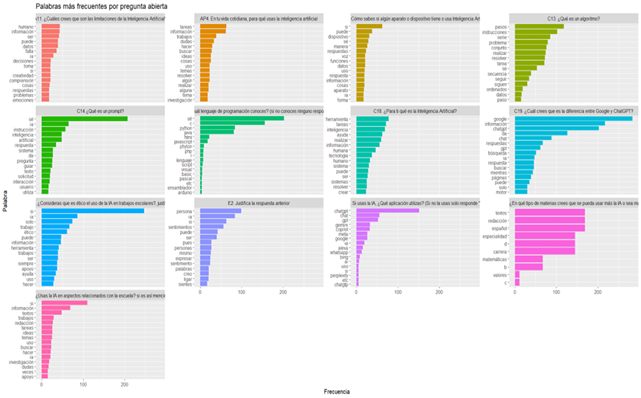
The textual exploration facilitated the identification
of the most frequently occurring words in each of the open-ended questions in
the questionnaire (Figure 2). A high recurrence of terms is observed in the
context of the conceptual understanding of artificial intelligence (e.g.,
algorithm, data, learning, system), its instrumental use in academic contexts
(e.g., tasks, writing, composition, help), and, to a lesser extent, ethical
aspects (e.g., ethical, plagiarism, responsibility).
Figure 2
Most frequent words per open-ended question
Source: own elaboration.
The semantic classification procedure yielded three
primary themes: instrumental use (n = 2,213), conceptual understanding (n =
1,401), and ethical reflection (n = 129). In addition to these main themes, a
residual set of unclassifiable responses (n = 22,963) was identified. According
to the established classification system, three distinct fields of meaning have
been identified. The subsequent discussion will delve into the nature of these
fields, supported by a series of illustrative quotations.
3.1. Instrumental use
The responses in this group describe artificial
intelligence as a practical tool that facilitates everyday
or academic tasks. Students have indicated the efficacy of the program in
facilitating the composition of written texts, the execution of searches, and
the expeditious resolution of problems. For instance, when queried about their
conception of artificial intelligence, several students offered the following
responses:
The advent of this novel technology signifies a
paradigm shift in the realm of problem-solving methodologies, particularly in
scenarios that demand expertise and cognitive acumen. This sophisticated
apparatus facilitates expeditious and efficacious resolution of challenges,
thereby redefining the landscape of problem-solving methodologies.
In a similar vein, when queried about the utilization
of artificial intelligence in daily life, respondents frequently cited its
application in writing and academic support:
"For tasks that require a tutor. The daily tasks
are as follows: Writing texts, messages, etc."
The objective is to facilitate the research process
and thereby reduce the time required to complete the task.
In this field, a functional perspective on AI, centered on efficiency and productivity, predominates, with
minimal conceptual or ethical problematization.
3.2. Conceptual understanding.
The responses in this category demonstrate varying
degrees of comprehension of concepts such as algorithms, learning, and data
processing. Participants' definitions of AI vary, with some offering structured
definitions and others confounding AI with databases or automatic systems. In
response to the query "What is an algorithm?", several participants
provided the following written responses:
"A clear, ordered set of data."
In the inquiry "What is the distinction between
Google and ChatGPT?", the differentiation between information retrieval
and automated response generation is discernible:
Google is a search engine, and ChatGPT is an
artificial intelligence program designed to respond to a variety of problems.
These statements exemplify an emerging understanding,
frequently associated with user experiences rather than formal technical
knowledge.
3.3. Ethical reflection.
This group raises moral considerations about the
responsible use of AI, especially in schools. A tension exists between
recognizing its value as a support tool and concerns about plagiarism or loss
of learning. When queried about the ethical considerations surrounding the
integration of artificial intelligence in academic pursuits, respondents were
invited to share their perspectives. Justify your answer," elicited
ambivalent opinions:
The utilization of a foundation, a point of departure,
or a source of correction and inspiration is essential for the effective
application of this method. Conversely, the absence of such a basis renders the
process unethical and ultimately ineffective.
The act in question is not regarded as ethical due to
its resemblance to cheating. However, if it is deemed to be a method of
encouraging learning, then it is considered ethically acceptable.
The act is ethically sound to a certain extent, but
not in its entirety.
This category, although present in a limited number of
cases, reflects an emerging critical stance towards the ethical dilemmas of
using AI in education.
From an ethical standpoint, 69% of students expressed
support for the utilization of AI in academic tasks, yet 67% deemed its
application during examinations to be improper. When presented with a range of
potential applications of AI, including calculations, data organization, and
summaries, the most popular option was: It is recommended that the utilization
of artificial intelligence be confined to tasks such as structuring, generating
ideas, editing, or correcting. The execution of the majority of the work should
be conducted by the individual. Conversely, in the context of examinations, the
predominant responses were "Disagree" and "Strongly
disagree," accounting for 67.35% of the responses.
A significant proportion of students, 43%, noted the
heightened relevance of artificial intelligence in the domain of language and
communication. This figure surpasses the 37% who identified its importance in
their respective professional fields and the 17% who deemed it applicable to
mathematics. Furthermore, a series of inquiries were posed, including the
following: "I utilize AI for professional endeavors
pertaining to..." The subsequent results were obtained:
· The fifth exercise pertains to calculus. The
majority of students indicated that they rarely (44.64%) or never (38.01%) use
AI for work related to calculus. A mere 13.78% of respondents indicated that
they use the feature almost always, while a significantly smaller percentage of
3.57% reported using it always. This observation indicates a potential
underutilization of AI in this domain, which may be attributed to either a
preference for more conventional methods or the imposition of traditional
practices.
· Graphs (EX6): The pattern exhibited by this
phenomenon is analogous to that observed in calculus.
· Images (EX7): A more balanced distribution is
evident, with the majority of students opting for the intermediate options.
· Writing (EX8): In this domain, the presence of AI is
particularly pronounced. According to the findings of the study, 35.97% of the
participants reported utilizing the tool for writing texts with high frequency,
while 10.46% indicated that they employed it consistently. A mere 36.99% of
respondents indicated that they use it rarely, while a significantly smaller
percentage of 16.58% reported never using it. This finding underscores the
notion that students perceive artificial intelligence as a valuable and readily
available resource to facilitate writing processes.
While a substantial majority, amounting to 86%, concur
that the integration of AI into the academic milieu is a favorable
proposition, a notable proportion, amounting to 74%, assert that they do not
employ AI in their instructional practices. Conversely, among students pursuing
careers in education, the proportion who "agree" declines to 75.44%.
With respect to homework, in the field of education, 10.53% of students
strongly agree with the utilization of AI for academic assistance, while 43.86%
express agreement. Among the other fields of study, 15.22% strongly agree, and
62.69% agree. These data suggest a growing acceptance of the integration of
artificial intelligence in academic pursuits among students from diverse
disciplines, with the exception of those in the field of education. A
correlation has thus been established between acceptance, use, and knowledge.
The qualitative results, when considered in
conjunction with the statistical findings, serve to augment the understanding
of the students' articulation of practical, conceptual, and ethical perceptions
of artificial intelligence. This comprehensive perspective on the students' AI
literacy provides a more nuanced and multifaceted understanding of their
comprehension and application of artificial intelligence.
4. Conclusions
The selection of the sample was based on convenience,
which limits the generalizability of the results. AI is employed by students
primarily for writing purposes rather than for mathematical calculations. The
extent of integration varies according to discipline. Computer science students
demonstrate a greater degree of understanding, while education students exhibit
a lack of confidence and skepticism, which may hinder
its future educational implementation. From an ethical standpoint, there is a
general consensus on the utilization of this method as a complement, with a
notable exception regarding its application in assessments. The paucity of
integration of artificial intelligence into academic life is highlighted,
underscoring an urgent need for formal training.
This is analogous to the urgency that Béla Balázs
identified in cinema, a sentiment that has also been transferred to other
technologies. It is imperative to draw from prior experiences to ensure the
effective integration of AI into academic life and to cultivate readiness for
its growing significance in various facets of daily life.
Funding
This research received no external funding.
Data Availability
Statement
The datasets used and/or analyzed
during the current study are available from the corresponding author on
reasonable request.
Competing
Interests
The authors declare no competing interests.
References
Aguaded, J. I., Ferrés i Prats, J., Pérez Rodríguez, M. A., Sánchez
Carrero, J., Delgado Ponce, Á., & Cruz Díaz, M. R. (2011). El grado de
competencia mediática en la ciudadanía andaluza. Grupo Comunicar.
Ala-Mutka, K. (2011). Mapping Digital Competence:
Towards a Conceptual Understanding.
Alowais, M., Rudd, G.,
Besa, V., Nazar, H., Shah, T., & Tolley, C. (2024). Digital literacy in
undergraduate pharmacy education: a scoping review. Journal of the American
Medical Informatics Association, 31(3), 732–745. https://doi.org/10.1093/ijpp/riae013.042
Alvarez, D. (2012). Los PLE en el marco
europeo de Competencias Digitales. e-aprendizaje. http://bit.ly/45HV76T/
Annapureddy, R., Fornaroli,
A., & Gatica-Perez, D. (2024). Generative AI Literacy: Twelve Defining
Competencies. Digital Government: Research and Practice, 6(1),
1–21. https://doi.org/10.1145/3685680
Arias López, M. del P., Ong, B. A., Borrat Frigola, X., Fernández, A.
L., Hicklent, R. S., Obeles, A. J. T., Rocimo, A. M., & Celi, L. A. (2023). Digital literacy
as a new determinant of health: a scoping review. PLOS Digital Health, 2(10), e0000279. https://doi.org/10.1371/journal.pdig.0000279
Balázs, B. (1970). Theory of the
Film; Character and Growth of a New Art.
Bender, S. M. (2024). Awareness of Artificial
Intelligence as an Essential Digital Literacy: ChatGPT and Gen-AI in the
Classroom. Changing English: Studies in Culture and Education, 31(2),
161–174. https://doi.org/10.1080/1358684X.2024.2309995
Bloom, B. (1979). Taxonomía
de objetivos educativos. Alcoy Marfil.
Breakstone, J., McGrew, S., Smith, M., Ortega, T.,
& Wineburg, S. (2018). Why we need a new approach to teaching digital
literacy. Phi Delta Kappan, 99(6),
27–32. https://doi.org/10.1177/0031721718762419
Carolus, A., Koch, M. J., Straka, S., Latoschik, M. E., & Wienrich,
C. (2023). MAILS - Meta AI literacy scale: Development and testing of an AI
literacy questionnaire based on well-founded competency models and
psychological change- and meta-competencies. Computers in Human Behavior:
Artificial Humans, 1(2), 100014.
https://doi.org/10.1016/j.chbah.2023.100014
Choi, E. J., King, G. K. C., & Duerden, E. G.
(2023). Screen time in children and youth during the pandemic: A systematic
review and meta-analysis. Global
Pediatrics, 6,
100080. https://doi.org/10.1016/J.GPEDS.2023.100080
Encuesta
Nacional sobre Disponibilidad y Uso de Tecnologías de la Información en los
Hogares (ENDUTIH) 2024.
(s/f). Recuperado el 9 de junio de 2025, de
https://bit.ly/4n6GMXv
Estadísticas
de la situación digital de México 2023-2024 - Branch. (s/f). Recuperado el 9 de junio de 2025,
de http://bit.ly/41AdZSW
Eurostat. (2018).
Estadísticas de energía renovable. En Statistics Explained.
Ferrés, J. (1994). Televisión y educación.
Paidós.
Ferrés, J., & Piscitelli,
A. (2012). La competencia mediática: propuesta articulada de dimensiones e
indicadores. Comunicar, XIX(38), 75–82. https://doi.org/10.3916/c38-2012-02-08
Ferrés Prats, J., Aguaded-Gómez,
I., & García-Matilla, A. (2012). La competencia mediática de la ciudadanía
española: dificultades y retos. Revista ICONO14. Revista científica de
Comunicación y Tecnologías emergentes, 10(3), 23–42.
https://doi.org/10.7195/ri14.v10i3.201
Ganson, K. T., Nagata, J. M., Jones, C. P.,
Testa, A., Jackson, D. B., & Hammond, D. (2023). Screen time,
social media use, and weight-change behaviors: Results from an international
sample of adolescents. Preventive Medicine, 168, 107450.
https://doi.org/10.1016/J.YPMED.2023.107450
Hornberger, M., Bewersdorff, A., & Nerdel, C. (2023). What do university students know about
Artificial Intelligence? Development and validation of an AI literacy test. Computers
and Education: Artificial Intelligence, 5(June), 100165.
https://doi.org/10.1016/j.caeai.2023.100165
Koch, M. J., Carolus, A., Wienrich,
C., & Latoschik, M. E. (2024). Meta AI literacy
scale: Further validation and development of a short version. Heliyon, 10(21). https://doi.org/10.1016/j.heliyon.2024.e39686
Long, D., & Magerko, B.
(2020). What is AI Literacy? Competencies and Design Considerations. Conference
on Human Factors in Computing Systems - Proceedings, 1–16.
https://doi.org/10.1145/3313831.3376727
Magallanes Ulloa, E. (2023).
La Literacidad Digital, el otro síntoma de la pandemia. En M. Mónica Muñoz, N.
Castillo Olvera, V. León Moncada, & Taberna Libraria
Editories (Eds.), Alternativas desde la
competencia comunicativa. Educación, Violencia y Pandemia (pp. 83–97).
Universidad Autónoma de Zacatecas.
Ng, D. T. K., Leung, J. K. L., Chu, K. W. S., & Qiao,
M. S. (2021a). AI Literacy: Definition, Teaching, Evaluation and
Ethical Issues. Proceedings of the Association for Information Science and
Technology, 58(1), 504–509. https://doi.org/10.1002/pra2.487
Ng, D. T. K., Leung, J. K. L., Chu, S. K. W., &
Qiao, M. S. (2021b). Conceptualizing AI literacy: An exploratory review. Computers
and Education: Artificial Intelligence, 2.
https://doi.org/10.1016/j.caeai.2021.100041
Ng, W. (2012). Can we teach digital natives digital
literacy? Computers and Education, 59(3), 1065–1078.
https://doi.org/10.1016/j.compedu.2012.04.016
Nguyen, L. A. T., & Habók, A. (2024). Tools for assessing teacher digital literacy: a
review. Journal of Computers in Education, 11(1), 305–346. https://doi.org/10.1007/s40692-022-00257-5
Nikou, S., De Reuver, M.,
& Mahboob Kanafi, M. (2022). Workplace literacy skills—how information and
digital literacy affect adoption of digital technology. Journal of
Documentation, 78(7), 371–391.
https://doi.org/10.1108/JD-12-2021-0241/FULL/PDF
Oh, S. S., Kim, K.-A., Kim, M., Oh, J., Chu, S. H.,
& Choi, J. (2021). Measurement of digital literacy among older adults:
systematic review. Journal of medical Internet research, 23(2),
e26145.
Pérez, J., & Murray, M. (2018). Introducing DigLit Score: An Indicator of Digital Literacy Advancement
in Higher Education. Proceedings of the 2018 InSITE
Conference, 013–020. https://doi.org/10.28945/4037
Reddy, P., Chaudhary, K., & Hussein, S. (2023). A
digital literacy model to narrow the digital literacy skills gap. Heliyon, 9(4), 2405–8440.
https://doi.org/10.1016/J.HELIYON.2023.E14878/ATTACHMENT/C809EC21-F250-4687-A117-B85F5EDC5BF8/MMC1.DOCX
Reddy, P., Sharma, B., & Kaylash
Chaudhary, F. (2020). Digital Literacy: A Review of Literature. International
Journal of Technoethics, 11(2).
https://doi.org/10.4018/IJT.20200701.oa1
Rizvi, S., Waite, J., & Sentance,
S. (2023). Artificial Intelligence teaching and learning in K-12 from 2019 to
2022: A systematic literature review. Computers and Education: Artificial
Intelligence, 4, 100145. https://doi.org/10.1016/j.caeai.2023.100145
Spante, M., Hashemi, S. S., Lundin, M., & Algers, A. (2018). Digital competence and digital literacy
in higher education research: Systematic review of concept use. Cogent
Education, 5(1), 1–21. https://doi.org/10.1080/2331186X.2018.1519143
Tinmaz, H., Fanea-Ivanovici,
M., & Baber, H. (2023). A snapshot of digital literacy. Library Hi Tech
News, 40(1), 20–23. https://doi.org/10.1108/LHTN-12-2021-0095
Tinmaz, H., Lee, Y. T., Fanea-Ivanovici,
M., & Baber, H. (2022). A systematic review on digital literacy. Smart
Learning Environments, 9(1).
https://doi.org/10.1186/s40561-022-00204-y
Touretzky, D., Gardner-McCune, C., Martin, F., &
Seehorn, D. (2019). Envisioning AI for K-12: What should every child know about
AI? Proceedings of the AAAI conference on artificial intelligence, 33(01),
9795–9799.
Van Dijk, J. (2017). Digital Divide: Impact of Access.
The International Encyclopedia of Media Effects, 1–11.
https://doi.org/10.1002/9781118783764.wbieme0043
Wang, B., Patrick Rau, P.-L., & Yuan, T. (2022). Measuring
user competence in using artificial intelligence: validity and reliability of
artificial intelligence literacy scale.
https://doi.org/10.1080/0144929X.2022.2072768
Wang, B., Rau, P. L. P., & Yuan, T. (2023).
Measuring user competence in using artificial intelligence: validity and
reliability of artificial intelligence literacy scale. Behaviour
and Information Technology, 42(9), 1324–1337.
https://doi.org/10.1080/0144929X.2022.2072768
Wang, H., Liu, Y., Han, Z., & Wu, J. (2020).
Extension of media literacy from the perspective of artificial intelligence and
implementation strategies of artificial intelligence courses in junior high
schools. Proceedings - 2020 International Conference on Artificial
Intelligence and Education, ICAIE 2020, 63–66.
https://doi.org/10.1109/ICAIE50891.2020.00022
Yoon, J., Lee, M., Ahn, J. S., Oh, D., Shin, S.-Y.,
Chang, Y. J., & Cho, J. (2022). Development and validation of digital
health technology literacy assessment questionnaire. Journal of medical
systems, 46(2), 13.
Zhang, H., Lee, I., Ali, S., DiPaola, D., Cheng, Y.,
& Breazeal, C. (2023). Integrating ethics and career futures with technical
learning to promote AI literacy for middle school students: An exploratory
study. International Journal of Artificial Intelligence in Education, 33(2), 290–324.