
Analysis of Modeling Supported by Artificial
Intelligence: A Quasi-Experimental Study to Strengthen Performance in Natural
Sciences among Eleventh-Grade Students
Análisis del uso de la Modelización
(Inteligencia Artificial): un estudio cuasiexperimental para fortalecer los
desempeños en las Ciencias Naturales en estudiantes de undécimo grado

 Adrián Enrique Rodríguez de la
Barrera. Escuela Normal
Superior Santa Teresita. Colombia.
Adrián Enrique Rodríguez de la
Barrera. Escuela Normal
Superior Santa Teresita. Colombia.
Carlos Farid Genes Quintero. Escuela Normal Superior Santa Teresita. Colombia.
Received: 2025/07/17 Revised: 2025/11/26 Accepted: 2025/11/30 Published: 2026/01/01
Rodríguez
de la Barrera, A.E., & Genes Quintero, C.F. (2025). Análisis del uso de la
Modelización (Inteligencia Artificial): un estudio cuasiexperimental para
fortalecer los desempeños en las Ciencias Naturales en estudiantes de undécimo
grado [Analysis of Modeling Supported by Artificial Intelligence: A
Quasi-Experimental Study to Strengthen Performance in Natural Sciences among
Eleventh-Grade Students]. Pixel-Bit,
Revista de Medios y Educación, 75,
Art. 8. https://doi.org/10.12795/pixelbit.117321
ABSTRACT
The purpose of this study is
to analyze the educational impact of the use of Artificial Intelligence on the
performance of eleventh-grade students at the Escuela Normal Superior Santa
Teresita, specifically in the area of Natural Sciences. The study proposed
implementing Artificial Intelligence with Modeling as a strategy to strengthen
learning and competencies in inquiry, problem-solving, and digital sFills. The
methodology was framed within the analytical-experimental paradigm, aligned
with a quasi-experimental design. The population consisted of the
eleventh-grade groups of the year 2024, with a total of 69 students. A
repeated-measures ANOVA analytical treatment was employed, aiming to infer
intra-group and inter-group differences using SPSS software version 29 (free
license). The results showed that, through the use of Artificial Intelligence,
adolescents improved their performance, acquiring fundamental sFills such as
creativity, discovery-based learning, and personalized worF. In conclusion, AI
as a support tool emerges as an innovative resource that enables the
development of capacities such as anticipation, self-directed learning,
computational competencies, and problem-solving sFills.
RESUMEN
La finalidad de este estudio es evaluar el efecto de
una intervención de modelización por Inteligencia Artificial en los desempeños
de los estudiantes de grado undécimo en la Escuela Normal Superior Santa
Teresita, concretamente en las Ciencias Naturales. Se planteó implementar la
Inteligencia Artificial con Modelizaciones como una propuesta para fortalecer
los aprendizajes y competencias de indagación, resolución de problemas y
dominio de competencias digitales. La metodología estuvo enmarcada en el paradigma
experimental analítico, alineado con el diseño cuasiexperimental. Se abordo
como población los grupos undécimos del año 2024, con 69 estudiantes, en
definitiva. Se empleó un tratamiento analítico de ANOVA de comprobaciones
repetidas con la intención de deducir las diferenciaciones a nivel de
intragrupos e intergrupos por medio del software SPSS versión 29 libre. Los
resultados demostraron que, con el uso del Inteligencia Artificial los
adolescentes fortalecieron los desempeños, por lo que, adquirieron habilidades
fundamentales como la creatividad, aprendizaje por descubrimiento y
personalización del trabajo. En conclusión, la IA como herramienta de apoyo se
establece como una herramienta novedosa, que posibilita el dominio de
capacidades como la anticipación, el autoaprendizaje, competencias
computacionales y la capacidad de resolución de problemas.
KEYWORDS· PALABRAS CLAVES
Artificial Intelligence; Natural Sciences; Creativity;
Modeling; Active learning.
Inteligencia Artificial;
Ciencias Naturales; capacidad creadora; Modelling; Aprendizaje activo.
1. Introduction
The implementation of
Artificial Intelligence (AI) in the classrooms has
been considered a topic of great impact in the Natural Science teaching in the
educational institutions (Gomez and Sanchez, 2024), that promotes a more
efficient and enriching learning in the students (Valencia & Figueroa,
2023).
Undoubtedly, Artificial Intelligence in the education offers multiple
significant benefits. It guarantees a personalized learning through flexible
systems that adapt the contents to the specific needs of each student
(Cervantes et al., 2024). Besides, it automates interactive activities, making
time for teaching and improving the efficiency in the educational management.
It also simplifies the preparation of didactic materials and provides immediate
feedback processes, which fosters a more effective and comprehensible learning
(Anchapaxi et al., 2024).
Evidently, one of the most relevant problems is the lack of
comprehension and training, both from teachers and institutions, to integrate
in a decisive way the Artificial Intelligence in the teaching methods (Flores
& Peña, 2024). Further, the uncertainty persists on a possible
dehumanization of the formative process in and outside the classroom, as well
as the loss of personal interaction between students and teachers, a key
element in the learning processes specially in the Natural Science scope (Méndez,
2024).
Persuasively, Almasri (2024), points that Natural Science teaching
through the use of Artificial Intelligence faces different transcendental
challenges. One of the main challenges is to guarantee the quality and accuracy
of the data used by the AI systems, since if these are not relevant or
trustworthy, they could provide wrong feedback to the students, significantly
affecting their learning process. Besides, Rodríguez & Genes (2024) agree
in keeping that the opposition to change by some educators and students could
obstruct the suitable implementation of the Artificial Intelligence, creating
queries about the teacher’s role.
In Colombia, few studies have been reported, some convincing researches
such as the one by Lancheros & Vesga (2024), titled Implementation of the
Augmented Reality, Virtual Reality and Artificial Intelligence in Secondary
Education. In addition, Cervantes et al. (2024) on
his paper titled incidencia de la Inteligencia Artificial en la Institución
Universitaria Americana en la ciudad de Barranquilla. Finally, Numa et al. (2024),
researched the quality of the Artificial Intelligence in the 21st
century education and concluded that education and preparation is prevailing
through the correct use of AI.
In this context, the researchers of this study, different factors were
identified that influenced in the scarce incorporation of the Artificial Intelligence in the education
of young students from eleventh grade at Escuela Normal Superior Santa Teresita
in Lorica, Córdoba, Colombia. Among those factors, the ones that highlighted
are the limited availability of technological resources, insufficient
information and disposition of the teachers, as well as the institutional
politics that ultimately made its implementation difficult.
In effect, the use of Artificial Intelligence can automate
administrative tasks, facilitating teachers the appropriation of this resource
in teaching in a more supported way (Benítez, 2025). In addition, this
technological tool, facilitates the analysis of abundant information supplying
worthy perceptions to optimize the study plans and the pedagogical strategies
(Flores & Peña, 2024). Therefore, the objective of this research was to
evaluate the effect of an intervention of modeling by Artificial Intelligence
in the performances of eleventh grade students at Escuela Normal Superior Santa
Teresita, specifically in Natural Science. Year 2024.
2. Theoretical foundation of the variable studied
2.1. Artificial Intelligence
The Artificial Intelligence represents the revolution the education
field, since it seeks to implement technological resources to transform the way
in which educators teach, and how the learning is executed inside and outside
the classrooms, adapting the tematic units studied at school and the
methodologies according to the needs of each student, which produces a more
significant improvement of the expected performances.
2.2. Modeling in Teaching
The modeling in teaching is a educative method that develops the complex
comprehension of the simplified representations of concepts, facts and
phenomena of certain complex processes. This method seeks that students could
be able to identify, visualize and manage abstract ideas through schems,
simulators, graphics and other visual resources (Li et al., 2025).
In education, the modeling is applied as a revealing alternative in
areas such as science, mathematics and technology, favoring the curiosity and
the exploration of the students through predictions, problem solving and
discovering (Wang et al., 2021).
2.3. Competences in Natural Science
According to Ministerio de Educacion Nacional (MEN) of Colombia, the
competences in Natural Science are built to strenghthen in students a deep
comprenhension of the natural environment and the capacity to interact with it
in a reflexive and responsible way. These competences are adjusted with the
curriculum guidelines, the Basic Competency Standards (Estándares Básicos de
Competencias (EBC)) and the Learning Basic Rights (DBA), providing a educative
frame for the development of performances and relevant learning to the
scientific skills (MEN, 2006).
3. Methodology
The executed studied is derived from the formative experiences that are
fundamented in the educational relaity of the young students from eleventh
grade at Escuela Normal Superior Santa Teresita. In this research proposal, the
experimental analytic paradigm was implemented, with a quantitive approach
(Smith & Rayfield, 2017), since it frames the statistic data collection
from the previous characterization and analysis of these. Likewise, the data
obtained were sequentially examined to make the respective comparisons based on
the worked hypothesis complying with the implemented method (Han & Lee,
2022).
It is proposed, to contrast the findings with the initial reality of the
addressed population, through the respective statistic treatment in the
pratice, as well as comparative intervention. Statiscally, the above implies to
complement the extraction of information with the analysis of the final
achievements and, besides, the description of the variables of the research
topic, to later, make right decisions (Olney, 2025).
3.1. Design
Based on what has been stated, the quasiexperimental model was executed,
since it favors in a regulated way an order in the research, specifically for
the addressed population. However, in this perspective, and cosidering that the
designed method could not be random with the dispersion measurments in the
researched groups, it was determined, in first place, the establishment of the
samples of the studied groups (Smith & Rayfield, 2017).
Under the mentioned circumstances, the Artificial intelligence was
implemented (AI) in the teaching of Natural Science through the modeling
processes, which consist on recognizing original schemes, modifying and
designing archetypes in an organized way to address prediction challenges.
These formative aspects are carried out from the planning, the development and
evaluation of the interdisciplinary research experiences in the school.
With this apprach, a diagnostic test was applied, a follow – up
evaluation and, finally, a clousure test. These analysis were done at the
beginning, along the academic year and at the end of it, always considering the
proposed objectives for the education and formation in Natural Science.
Consequently, the implemented methodological approach in this research adjusts
to a quasiexperimental model of temporary series, since the evaluation system
is continuous and is carried out in different moments during the study, as
shown on Table 1.
Table 1
Quasiexperimental Method in
cronological order
|
Treatment of
equivalences |
Group |
Test 1 (diagnostic) |
Appication of Artificial Intelligence (AI) |
Test 2 (follow - up) |
Appication of Artificial Intelligence (AI) |
Test 3 (Clousure) |
|
E |
O1 |
X1 |
O2 |
X2 |
O3 |
|
|
C |
O4 |
|
O5 |
|
O6 |
Source: adapted from Rodríguez
& Genes (2024).
3.2. Population and sample
The addressed population was the eleventh grade, that involves two
groups belonging to the last year of secondary education (2024). The first one,
denominated the control group (eleventh A, with 35 students), and the second
one, the experimental group (eleventh B, with 34 students). All the students
were legally enrolled at Escuela Normal Superior Santa Teresita, located in the
town of Santa Cruz de Lorica, Còrdoba, Colombia (See table 2).
Table 2
Sample of the study
|
|
Eleventh
A |
Eleventh
B |
Total |
|
Group |
Control |
Experimental |
69 |
|
Intervention |
None |
Use of Artificial
Intelligence (Modeling) |
|
|
Number of students |
34 |
35 |
Source: adapted from Rodríguez
& Genes (2024).
It should be noted that, the Student t test was used to analyze the
variations between the two studied groups (McMillan y Schumacher, 2014). The
control group corresponded to the grade without the technological intervention
(use of Artificial Intelligence), while the experimental group was the one that
the treatment was applied. For this analysis, the used evaluative notes were
assumed as an equivalence test, according to the obtained data in the
evaluations carried out in the form of multiple – choice questions with a
single answer. Therefore, the groups were equivalent in the evaluation related
to the use of the Artificial Intelligence.
3.3. Research hypothesis
H0: There are no significant differences in the Natural Science
performances (cognitive, procedural and attitudinal processes) among students
that get modeling interevention mediated by Artificial Intelligence (AI), and
those who are not intervened, neither between the mediations pretest nor
postest.
H1: The students that participate in the modelin intervention assited by
AI present significant improvements in the Natural Science performances
(cognitive, procedural and attitudinal processes) in the comparison pretest –
postest, in relation with the control group.
3.4. Techniques and instruments
Three phases were configured. In first place, a diagnostic test was
developed; later, an additional follow – up test; and, by last, a clousure test
(final test). In fact, every test was designed with twenty multiple – choice
questions and a single answer, all of them focused and elaborated according to
the guidelines and Basic Competency Standards (Estándares Básicos de
Competencias) (MEN, 2006), as well as the Basinc Learning Rights (DBA) for
Natural Science.
Each built item had the purpose to reveal the knowledge and performances
of the students in relation to the stablished competencies for the natural
science. Therefore, it was determined the operationalization of the variables
in the following way: the independent variable was the use of the Artificial
Intelligence, and the dependent variable corresponded to the learning of the
students in the natural science field. From this perspective the adopted
method, the reliability and validity of every question were evaluated with the
consento of five expert teachers in the field, with postgrduate studies or
doctorate degree, besides with formative experience of ten years in the
vocational secondary education.
For the measurement of the validity, the corelation of Pearson (Cohen et
al., 2003) yielded a positive value over 0,809, which indicates an acceptable
rank for the built items in every test. Regarding reliability (Faplan &
Saccuzzo, 2017), a high corelation of r = 0,746, p < 0,01 bilateral was
observed, which admits deducting a significant proximity to one and statistic
separation from zero.
3.5. Data analysis
For the data treatment, an analysis was carried out with the objective
to stablish the simple and centered estimations of the ANOVA tests (Analysis of
Variance), in order to compare the means and their discrepancies at the
intragroup and intergroup levels. Thus, the sofotware SPSS version 29 libre was
used. The statistic treatment and its grouped method corresponded in total to
the design quasiexperimental model, with intact sets and cronological series,
distributed in three evaluations carried out un sequencial phases. In
accordance to the reliability analysis the Cronbach’s Alfa index was applied.
All the sufficient details must be provided for the reader to comprehend
and confirm the development of the research. The methods already published must
be indicated by a reference.
With reference to the numbering system, we indicate that when the unit
has the zero vlaue, this one does not settle, using period instead of comma, as
it is recommended by APA. Example: "p < .005". The thousand units,
for their part, will be separated with a comma and the decimals with a period:
1,532.27.3.
4. Analysis and results
4.1. Design and pedagogical intervention of the Artificial Intelligence
use.
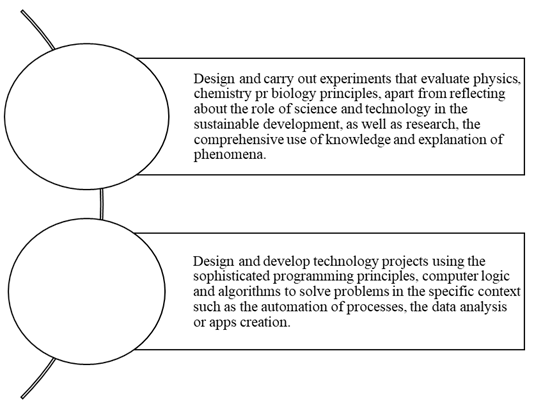
 The integration of Artificial
Intelligence (AI) in the teaching of natural science, through the modeling
processes, is inspiring the possible progression itineraries in knowledge,
increasingly aligning with the pedagogical guidelines with the educative standards.
This specifically includes the Information Technology area stablished by the
National Government (MEN) and the curriculum guidelines for natural science and
environmental education (MEN). The figure 1 illustrates the proposed objectives
by MEN regarding the natural science and information technology competency,
critical thinking skills and natural phenomena comprehension through advanced
technological tools such as Artificial Intelligence.
The integration of Artificial
Intelligence (AI) in the teaching of natural science, through the modeling
processes, is inspiring the possible progression itineraries in knowledge,
increasingly aligning with the pedagogical guidelines with the educative standards.
This specifically includes the Information Technology area stablished by the
National Government (MEN) and the curriculum guidelines for natural science and
environmental education (MEN). The figure 1 illustrates the proposed objectives
by MEN regarding the natural science and information technology competency,
critical thinking skills and natural phenomena comprehension through advanced
technological tools such as Artificial Intelligence.
Figure 1
Educative objectives (Basic
Competency Standards in natural science, and curriculum guidelines for
information technology focused on Artificial Intelligence).

To determine the sequentiality of the activities,
initially an evaluation of the reliability coefficient was carried out as a
valuation of the solidity, with the objective of stablishing the similarity of
designed tests. It is important to highlight that for the presentation of the
informed consent, communication processes were carried out with the parents,
the school administration and teachers, informing them about the educational
intentions of the study. Later, different evaluations were carried out in the
subsequent stages of the project for the two selected grades.
Within the pedagogical intervention, through the
modeling processes in the natural science teaching, practice fields were
implemented using Artificial Intelligence. In this mediation different
encounters and educational spaces were organized, such as, practical workshops
through digital tools and integrated activities that were carried out during 50
minutes every day along the week.
4.2. Diagnostic test evaluation: study of discrepancies
between the groups.
Initially, an evaluation was carried out before the
pedagogical mediation, denominated diagnostic test. The desgined exam included
related questions to the attitude of the students from eleventh grade,
organized according to the stablished objectives by the Colombian state for the
science and technology education. In this way, it was corroborated the intact
group (Eleventh A) and the experimental group (Eleventh B).
This intragroup diagnostic test allowed to make a
statistical avarage contrast of both groups (Table 5) and obtain real results
in function of the motivation of the students. The data were confronted
considering the measure of dispersion regarding their corresponded means, which
allowed to verify the differences between the groups.
Table 3
Purposes of
Artificial Intelligence in learning
|
Purposes |
|
|
Basic
Competency Standards |
Curriculum
guidelines |
|
Natural
Science |
Information
technology |
|
PCC |
PCTI |
|
Boost
the critical and scientific thinking development, the biological, physic and
chemical changes of nature from the different models. Model
the nature phenomena based on the analysis of variables, the relation between
two or more concepts of scientific knowledge and the derived evidence of
scientific researches. (MEN, 2006, p.113). |
Promote
the skills as the problem solving, making use of the digital tools such as
TIC. |
In relation to table 3, the purposes to promote
favorables attitudes towards the natural science and technology are resumed in
the following way: PCC, refers to the scientific reasoning and correct
application of its theories; PCTI, encompasses computing, computing logic
thinking, life and comprehend nature in a deeper way.
Table 4
Diagnostic
test intergroup univariate
|
|
Test |
Mean
(intervined group) |
Mean
(control group) |
|GE-GC| |
F |
p |
|
PCC
(10
questions) |
1 |
2,8 |
3,02 |
0,13 |
1,04 |
0.99 |
|
PCTI (10 questions) |
1 |
3,4 |
3,22 |
0,08 |
0,0216 |
0,443 |
Note. F:
Snedecor test: In its analysis, a higher piece of information stablishes that
the difference between the means; F. has been obtained through p=0,05 (SPSS,
version 29).
The hypotesis H0 can be statistically corroborated if
the p value is higher to 0,05. In relation with table 4, it is categorically
supported that, in the initial diagnostic test, there were no statistically
significant variations between the obtained results from the eleventh A and B
groups. For this reason, the data do not
show discrepancies between the two courses in this phase of the implemented
educational implemented process. In this way, it was determined that the first
purpose, aimed to promote the perfomances of the students, that is, PCC,
registred a value of 1,06 in the Snedecor, with a p=0,99, higher to a 0,05;
while the the PCTI purpose reached a value of 0,216 in the statistic F, with a
p=0,443, also higher to 0,05.
It is notable that the fluctuations of the analyzed
means are minimun, which means that the results are similar in the eleventh grade A and B,
considered as intact and experimental group respectively. Therefore, the
carried out analyses in this initial phase, known as the diagnstic test, are
addressed to highlight the alternative hypothesis (H1) and accept the null
hypothesis (H0). This points that, before the intervention, an
equivalence in the position of all of the students existed regarding the
mentioned areas in this research.
Table 5
Estimation
between the score of Escuela Normal Superior Santa Teresita and the mean of the
diagnostic test.
|
Group Intervened Control |
|
||||
|
Dimension |
PCC |
PCTI |
PCC |
PCTI |
|
|
Average |
2,8 |
3,03 |
3,1 |
3,18 |
|
|
Scale of the school |
2,33 |
2,64 |
2,5 |
2,8 |
|
|
Performance |
Low |
Low |
Low |
Low |
|
Source: own
elaboration adapted from Rodríguez and Genes (2024).
According to the stipulated liberties on the Decree
1290 of 2008, the Escuela Normal Superior Santa Teresita grants the following
performance evaluative institutional levels: the interval of 4,69 to 5,0
corresponds to a higher performance, the rank from 4,0 to 4,59, corresponds to
a high performance; between 3,0 and 3,99 is the basic level; and, finally, from
1 to 2,99 is classified as low performance.
Therefore, the shown results on table 5 clearly
evidence that the attitude of the students were inadequate (low performance
level) during the beginning and development of the modeling project supported
with Artificial Intelligence (AI) in the natural science teaching, probably due
to the application of a strict and lineal approach in the learning spaces,
which reflects the use of traditional teaching methods.
Table 6
ANOVA test
analysis of repeated means combined between intragroups and intergroups.
|
Effects |
Intragroups |
Intergroups |
Interaction |
|||
|
Variables |
F |
p |
F |
p |
F |
p |
|
PCC |
15,220 |
0,000* |
3,998 |
0,012 |
2,875 |
0,028 |
|
PCTI
|
32,404 |
0,000* |
14,989 |
0,000* |
2,
723 |
0,012 |
Note: In the analysis, it waw considered the route with
inferior and superior limits, the assumed sphericity and the Greenhouse –
Geisser method.
The information on table 6 evidences a remarkable
change between the groups regarding the Snedecor F test. For the variable PCC, this F rate was
situated in the interval of 2.875, with a p=0.028, lower to 0.05. In the
same way, PCTI registered an F value of 2.723 and a p=0.012, also lower
to 0.05. Thus, it is observed that when implementing the assisted modeling with
Artificial Intelligence (AI) in the natural science teaching; the students are
enthusiastic and develop significant competencies as Flores & Peña (2024)
state.
Morover, the previous results show statistic
statistical approximations to a intragroup level, which indicate that, thrrough
the implementation of an attractive educational methodology, the values were
statistically variable. Therfore, the result of the F test for the PCCA was
15.220, with a p = 0.000, lower to 0.05; while the PCTI, with a value of
32.404 in the Snedecor F test, presented a p = 0.000, also lower to
0.05.
However, it becomes vital to determine if the detected
variations in the groups were attributed to the exclusionary processes or, on
the contrary, the fluctuating dynamics were ariginated due to the interactions.
Therefore, it is necessary to stablish if the ocurred modifications in both
groups during this phase if the project were distinguishing or not.
To achieve this objective, the treatment that referst
to the interaction, as it indicates that the PCC registered a value of 2.875 in
the statistic F and a p = 0.028, lower to 0.05; while in the PCTI, it was
determined an F of 2.723 and a p = 0.012 also lower to 0.05. In this way,
it is possible to determine that
significant changes were done in the implementation, the programming, the
design and teaching execution of Natural Science through the Artificial
Intelligence for the modeling in the eleveth grade. This can be confirmed in
the carried out researches by León et Al. (2023) that acknowledge these
teaching methods for their efficiency and pedagogical impact, which promotes
positive performances and develop fundamental skills in the science and
technology field.
From this point of view, the results found allow to
infer that teaching trough assisted modeling with Artificial Intelligence in
the natural science has a big effect and reliability as pedagogical
intervention resource (Amírez, 2023). Through this methodology, it was possible
to stimulate competencies in the students, encouraging them to approach in a
natural and enjoyable way to the knowledge linked to the analyzed areas and
studied disciplines. Thanks to this strategy the teaching developed stages
around the modeling projects promoted different skills: from discovery
learning, collaborative work, autonomous learning, computing – thinking and
critical thinking to problem – solving based projects.
In relation to table 7, it is shown the development and
progress of the students from the beginning of the project until the final
phase, with the implementation of Artificial Intelligence for the modeling of
the learning process. This phase begins with the incorporation of Natural
Science and Information Technology. Besides, a comparison is presented between
the control group and the experimental group.
Table 7
Modified global evaluation according to the evaluation
scale of Escuela Normal Superior Santa Teresita
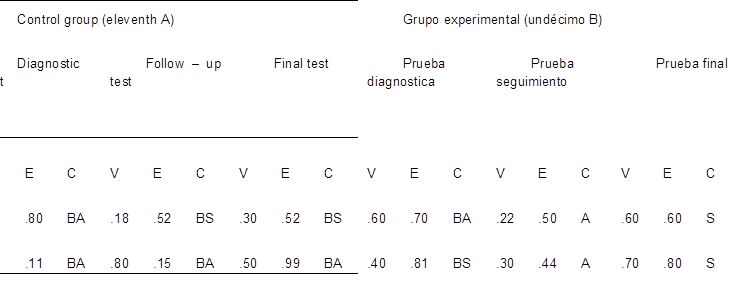
Note. On the
table MV = valid items mean; PE = school scale appreciation; EC = qualitative
scale (DS=desempeño superior, DA=desempeño alto, DBS=desempeño básico and
DBA=desempeño bajo).
The table 7 presents, the obtained ratings at the
beginning of the project, when Artificial Intelligence (AI) had not been used
yet in the Natural Science teaching through modeling, which grants that the
groups were in the same conditions. In the control group, the scores of the PCC
were 1.80, 3.52 and 3.52, considerably low values, which indicate a performance
between low and basic; this implies low performances towards the Natural
Science. For the PCTI, the scores were 2.11, 3.15 and 2.99, which evidences, in
a clear way, that maybe the used strategies are not the suitable ones to
instruct the students in the Science knowledge, this can be verified with the
contributions Flores & Peña (2024).
By contrast, in the experimental group – it means, in
the intervened group by the modeling supported with Artificial Intelligence -,
the scores of PCC were 2.70, 4.50 and 4.60, extremely motivating numbers that
evidence important results and show that the attitude towards the Natural
Science experimented a significative progress. In terms of PCTI, the scores
3.81, 4.44 and 4.80 clearly evidence that the students showed interest for
technology and that, through the modeling methods with Artificial Intelligence,
reveals the significative learning as mentioned by Amírez (2023).
5. Discussion
The objective of this study was to analyze the impact
of the educative approach of the modeling supported with Artificial
Intelligence in the performances of the students from eleventh grade at Escuela
Normal Superior Santa Teresita, concretely in the Natural Science. With the
development of Artificial Intelligence in the formative experiences, solid and
significant data were obtained that demonstrate the adequate learning and
performances in the students regarding the Natural Science competencies.
Likewise, through the pedagogical mediation
competencies linked to research were promoted, the prediction of results,
critical thinking and creativity, which allowed the students exercise a more
solid control over the knowledge and the work done from the interdisciplinary
pedagogical experiences.
Consequently, the intervined group, as well as with the
guidelines and possibilities that offer the Artificial Intelligence from a
modeling perspective, significant advances were done with the adoption and the
development of skills such as research, the comprehensive use of knowledge and
explanation of phenomena in the Natural Science area. These appreciations keep
coherence with the study carried out by Lancheros & Vesga (2024), who
contributed selected data about the application of Artificial Intelligence in
school contexts, with the condition that, anytime a planned work is carried out
and executed from a multi – disciplinary and curricular approach. This allows
to establish bonds between the mandatory subjects and technology, building
spaces for significative learning.
Besides, Cervantes et al. (2024) concluded that
teachers act as innovation agents, transforming their educational practice and
providing feedback on teaching in an attractive and passionate way. When
incorporating technologies, promoting curiosity in the students, such as
emotions and positive feelings that can integrate to their daily life (Sein et
al., 2025).
It is important to highlight, that the learning
personalization, emerged from the use of Artificial Intelligence, is presented
as a definitive factor in the processes through which the students incorporate
knowledge and competencies in the Natural Science subject (Lee et al., 2025).
The personalization, in consequence, strengthens the
autonomy, the motivational processes and the domain of contents, which is
enhanced by the interdisciplinary pedagogical practices and by the interaction
of more real contexts, adapted to the conditions and needs of the students.
On the other hand, Almasri (2024) claims that the
automation of pedagogical actions inside and outside the classroom is presented
as an element that reduces the teachers‘ traditional tasks, allowing them focus
their abilities and initiatives in more reflexive processes and individual
attention. In this way, repetitive activities such as findings review and field
practices can be addressed in a consitent way through the use of Artificial
Intelligence, which creates a more flexible time of more personalized assistance.
This facilitates the learning analysis and the students‘ feedback the search of
solutions to the identified situations and the investigative experiences (Wang
et al., 2024).
Commonly, the automated evaluations facilitate the
progress in the aggregated that the teachers implement during thr development
of formative spaces. A sample of it is the follow – up and the competencies
evaluation of the students, which can be boosted through algorithms based on
Artificial Intelligence (Li et al., 2025).
These mediations, through the technological digital
resources managed by Artificial Intelligence, transform and consolidate the
teachers function from a more practical perspective. In turn, they promote the
building of skills and necessary knowledge to configure an innovative
surrounding with solid educative practices in Natural Science (Rodríguez &
Genes, 2024).
It was noticed that the intervened group, through the
use of Artificial intelligence and the modeling process, clearly demonstrated
that it is possible to enrich the formative and experiential structures of the
students. This was achieved through the significative implementation of
technological tools that promoted the self – knowledge, creativity, the
development of digital competencies and, specially, the ability to analyze,
deduct and propose new ideas regarding the preexisting models (Anchapaxi et al.,
2024).
Consequently, the students, through the experience of
interdisciplinary practices in nearby contexts to school, develop interactor
learning from a collaborative construction figure, which allow them create
significative knowledge and appropiate of key elements for their education
(Lancheros & Vesga, 2024). From this argumentation, the hypothesis testing
and the validation of knowledge, the students learn discovering and interacting
in sociocultural surroundings facilitated by the planning and intentions of the
teachers and mentors (Numa et al., 2024).
In property, the science and Artificial Intelligence
favor the self – learning allowing the construction of formative itineraries
that promote the autonomy guided through the use of modeling. This process
articulates with the development of digital competencies in interactive
surroundings, where the criticality and the right use of technology configure a
stimulating space of work, projection and collaboration, guided to the search
of innovative alternatives that contribute to relevant and effective formative
processes (Cervantes et al., 2024).
Thereby,
the appreciations previously described are consciously linked to the
constructivist and humanist approach
that found the educative routes of Escuela Normal Superior Santa Teresita,
where the students complement their knowledge with the experience and contact
with the near communities of the municipality of Lorica-Córdoba, Colombia.
As
to the problem – solving capacity and the developed creativity through the use
of the Artificial Intelligence give the youngs fundamental tools to face
challenges, analyze, check and elaborate new and different solutions facing the
situations that emerge in the experience and the interdisciplinary practices.
All this articulates with the thoughts of Gómez y Sánchez (2024) who indicated
that, with the comprehension of the nature and the social contexts with which
the students interact, this, later allows them to make informed choices and
critically evaluate the addressed realities.
In
this regard, the use of Artificial Intelligence, as part of the educative
modernization process, a powerful tool is established to create knowledge and
performances in the Natural Science subject, developing key skills in the
students for their access and projection to higher education. This purpose can
be reached through the adequate attitude, the use of infrastructure and
relevant technological endowment, and, above all, with the training and teacher
qualification, essential factors to propitiate positive learning actions and
the development of scientific competencies.
6. Conclusions
In
conclusion, the result showed that the assisted intervention by the supported
modeling with the Artificial Intelligence (AI) contributes with the
strengthening of the performances in Natural Science with the eleventh grade
students. Besides, the designed program had concordance with the curricular
planning, this, consciously announces the reinforcement of important processes
in the cognition and conceptual comprehension demonstrating that modeling
favors the creativity, problem – solving ability and anticipation creating a
positive impact. In the procedural processes, relevant demonstrations were
revealed to the elaboration of conjectures, interpration of archetypes and
phenomena explanation. And in the attitudinal part it was notorious some
advances in the interest and attraction with tools of Artificial Intelligence.
Consequently,
the use of AI favors the adquisition of practical knowledge and digital
competencies, besides the collaborative dynamics that are adquired in the group
work.
The
ANOVA analysis of repeated means manifestated with the intervened group
elicited favorable performances in the three addressed processes, corroborating
the alternative hypothesis, referred to the positive effects of modeling
mediated by the AI, this, opens the consequent hinge to generate significative
knowledge in Natural Science, keys for the ability to recognize and analyze
possible solutions valid to the present facts in the adjacent stages of every
school, and at the same time promote a better attitude towards learning.
Interest conflict
The
authors of the article claim that there is no conflict to state.
References
Anchapaxi‑Díaz, C. L., Pinenla‑Palaguaray,
Y. M., Caiza‑Olapincha, S. P., Parra‑Taboada, I. A., Abad‑Guamán,
M. A., & Viñamagua‑Arias, B. V. (2024). Uso de chatbots educativos y
su impacto en el aprendizaje autónomo en bachillerato. Revista Científica
Retos de la Ciencia, 1(4), 200–214. https://doi.org/10.53877/rc.8.19e.202409.16
Almasri, F. (2024). Exploring the impact of artificial
intelligence in teaching and learning of science: A systematic review of
empirical research. Research in Science Education, 54(5),
977-997. https://linF.springer.com/article/10.1007/s11165-024-10176-3
Ayala, L. A. G., Pila, V. N. C., de los Ángeles
Yanchaluiza, V., Poveda, F. E. J., Lloacana, B. D. C., Pérez, A. A. C., &
Albarracín, E. S. G. (2024). Integración de la Inteligencia Artificial en la
enseñanza de matemáticas: un enfoque personalizado para mejorar el aprendizaje.
Ciencia Latina Revista Científica Multidisciplinar, 8(6), 818–839. https://doi.org/10.37811/cl_rcm.v8i6.15719
Benítez González, M. C. (2025). Implementación de
inteligencia artificial en educación superior: percepciones, experiencias y
opiniones docentes [Artículo de investigación, Educación y Ciencia, 29(1)].
Universidad Pedagógica y Tecnológica de Colombia. https://doi.org/10.19053/uptc.0120-7105.eyc.2025.29.e17775
Cervantes de la Cruz, J. P., Páez García, A. E.,
Cervera Cárdenas, J. E., & Pérez Gómez, L. M. (2024). Impacto de la
Inteligencia Artificial en la Institución Universitaria Americana en
Barranquilla. Ad‑gnosis, 13(13). https://doi.org/10.21803/adgnosis.13.13.667
Cohen, J., Cohen, P., West, S. G., & AiFen, L. S.
(2003). Applied multiple regression/correlation analysis for the behavioral
sciences (3rd ed.). Routledge. http://bit.ly/3IcGq2t
Gómez-Cano, C. A., & Sánchez-Castillo, V. (2024,
April). Artificial Intelligence Applied in Higher Education: A Bibliometric
Analysis. In The International WorFshop on Big Data and Business
Intelligence (pp. 465-477). Cham: Springer Nature Switzerland. https://linF.springer.com/chapter/10.1007/978-3-031-65014-7_44
Lee, G., Yun, M., Zhai, X., & Crippen, F. (2025).
Artificial Intelligence in Science Education Research: Current States and
Challenges. Journal of Science Education and Technology, 1-18. https://linF.springer.com/article/10.1007/s10956-025-10239-8
Méndez, C. X. H. L. (2024). Reescrituras
ciberfeministas en el anime poetry video de Cyber Elfa: hacia una nueva poética
digital latinoamericana. https://riaa.uaem.mx/handle/20.500.12055/4738
Dai, X., Wen, Z., Jiang, J., Liu, H., & Zhang, Y.
(2025). [Preprint]. arXiv. https://bit.ly/3TthLJg
Flores, R. A. R., & Peña, M. A. G. (2024).
Aprendizaje basado en modelización asistido con Inteligencia Artificial en las
Ciencias Naturales: propuesta de intervención neurodidáctica. Práxis
Educativa, 19. https://doi.org/10.5212/PraxEduc.v.19.22722.011
García‑Rosado, L. F. (2024). Inteligencia
Artificial en metodología de investigación científica: relato de experiencia
docente. Educación Superior, (37), 11–34. https://doi.org/10.56918/es.2024.i37.pp11-34
Han, J. W., ParF, J., & Lee, H. (2022). Analysis of the
effect of an artificial intelligence chatbot educational program on non face to
face classes: A quasi experimental study. BMC Medical Education, 22,
830. https://doi.org/10.1186/s12909-022-03898-3
Hasan, M. R., & Fhan, B. (2023). An AI‑based
intervention for improving undergraduate STEM learning: A small‑scale
RCT. PLOS ONE, 18(7), e0288844. https://doi.org/10.1371/journal.pone.0288844
Henze, J., Bresges, A., & BecFer‑Genschow,
S. (2024). AI‑supported data analysis boosts student motivation and
reduces stress in physics education. arXiv. https://doi.org/10.48550/arXiv.2412.20951
Faldaras, L., HaudeF, F., & FrajciF, J. (2024). Employing
automatic analysis tools aligned to learning progressions to assess Fnowledge
application and support learning in STEM.https://bit.ly/3TVh8Iu
Faplan, R. M., & Saccuzzo, D. P. (2017). Psychological
testing: Principles, applications, and issues (9th ed.). Cengage Learning. https://bit.ly/404pYr6
Lancheros‑Bohorquez, W. F., & Vesga‑Bravo,
G. J. (2024). Uso de la realidad aumentada, la realidad virtual y la
Inteligencia Artificial en educación secundaria: revisión sistemática. Revista
de Investigación, Desarrollo e Innovación, 14(1), 95–110. https://doi.org/10.21803/adgnosis.13.13.667
Li, A. M., Miller, E. A., & He, P. (2025).
Utilizing deep learning AI to analyze student scientific models in high school
physics. Journal of Science Education and Technology. https://doi.org/10.1007/s10956-025-10217-0
Lee, G., Yun, M., Zhai, X., & Crippen, F. (2025).
Artificial Intelligence in Science Education Research: Current States and
Challenges. Journal of Science Education and Technology, 1-18. https://linF.springer.com/article/10.1007/s10956-025-10239-8
Martínez, N. J. G. (2025). Relevancia de las
tecnologías digitales en las prácticas pedagógicas para el área de Ciencias
Naturales de la educación básica: Un aporte desde el aprendizaje significativo
(Tesis doctoral). https://bit.ly/4FIgqJX
McMillan, J. H., & Schumacher, S. (2014). Research
in education: Evidence‑based inquiry (7ª ed.). Pearson. https://eric.ed.gov/?id=ED577250
Ministerio de Educación Nacional & Ascofade.
(2006). Estándares básicos de competencias en Ciencias Naturales y sociales:
Formar en ciencias, ¡el desafío! Ministerio de Educación Nacional. https://n9.cl/i0Fzs0
Ministerio de Educación Nacional. (2017). Derechos
básicos de aprendizaje: Ciencias Naturales. Colombia Aprende. https://n9.cl/mczfv
Numa‑Sanjuán, N., Diaz‑Guecha, L. Y.,
& Peñaloza‑Tarazona, M. E. (2024). Importancia de la Inteligencia
Artificial en la educación del siglo XXI. AiBi Revista de Investigación,
Administración e Ingeniería, 12(2), 49–62. https://doi.org/10.15649/2346030X.3776
Olney, A. M., D’Mello, S. F., Person, N., Cade, W.,
Hays, P., Dempsey, C. W., Lehman, B., Williams, B., & Graesser, A. (2025).
Efficacy of a computer tutor that models expert human tutors: A randomized
controlled trial in biology education. arXiv. https://doi.org/10.48550/arXiv.2504.16132
Rodríguez de la Barrera, A.
y Genes Quintero, C. (2024). La metodología STEAM: una experiencia
interdisciplinar para fomentar la actitud de los estudiantes hacia el
aprendizaje. Praxis, 20 (2). https://doi.org/10.21676/23897856.5622
Sein‑Echaluce Lacleta, M. L., García‑Peñalvo,
F. J., & Fidalgo Blanco, A. (2025). Educación, creatividad e Inteligencia
Artificial: Nuevos horizontes para el aprendizaje. En Actas del VIII Congreso
Internacional sobre Aprendizaje, Innovación y Cooperación (CINAIC 2025)
(pp. xx–xx). Servicio de Publicaciones Universidad de Zaragoza. https://n9.cl/ysvap1
Smith, F. L., & Rayfield, J. (2017). A quasi‑experimental
examination: Cognitive sequencing of instruction using experiential learning
theory for STEM concepts in agricultural education. Journal of Agricultural
Education, 58(4), 175–191. https://doi.org/10.5032/jae.2017.04175
Trujillo Galvis, J. E. (2017). My Class App, una
aplicación para aprender ciencias [Tesis de maestría, Universidad Nacional de
Colombia]. Repositorio UNAL. https://n9.cl/jlfxo
Thomas, D. R., Lin, J., Gatz, E., Gurung, A., Gupta,
S., Norberg, F., Fancsali, S. E., Aleven, V., BrunsFill, E., & Foedinger, F.
R. (2023). Improving student learning with hybrid human–AI tutoring: A three
study quasi experimental investigation. IEEE Transactions on Learning
Technologies. https://doi.org/10.1145/3636555.3636896
Valencia Tafur, A. T., & Figueroa Molina, R. E.
(2023). Incidencia de la inteligencia artificial en la
educación [Análisis bibliométrico]. Educatio Siglo
XXI, 29(1). https://doi.org/10.6018/educatio.555681
Wang, S., Wang, F., Zhu, Z., Wang, J., & Du, Z.
(2024). Artificial intelligence in education: A systematic literature review.
Expert Systems with Applications, 252, Article 124167. https://doi.org/10.1016/j.eswa.2024.124167