
The Use of Educational Breakout with Augmented Reality in Initial
Teacher Training: Students’ Perceptions of Motivation, Collaboration and
Learning
El uso del Breakout educativo con realidad aumentada en la formación inicial
docente: percepciones del alumnado sobre motivación, colaboración y aprendizaje

 Santos Urbina Ramírez. Universitat de les Illes Balears. España.
 Gemma Tur Ferrer. Universitat de les Illes Balears. España.
Sofia Villatoro Moral. Universitat de les Illes Balears. España.
Adolfina Pérez Garcias. Universitat de les Illes Balears. España.
Received: 2025/03/02 Revised: 2025/03/03 Accepted: 2025/12/15 Published: 2026/05/01
How to cite:
Urbina Ramírez, S., Tur Ferrer, G., Villatoro Moral, S.,
& Pérez Garcias, A. (2026). The Use of Educational Breakout with Augmented Reality in Initial Teacher Training: Students’
Perceptions of Motivation, Collaboration, and Learning [El
uso del breakout educativo con realidad aumentada en
la formación inicial docente: percepciones del alumnado sobre motivación,
colaboración y aprendizaje]. Pixel-Bit,
Revista de Medios y Educación, 76, Art. 8. https://doi.org/10.12795/pixelbit.116184
ABSTRACT
In the field of higher
education, gamification and the use of technologies such as augmented reality
have gained prominence due to their potential to foster student motivation,
active engagement and learning. This study aims to analyse university students'
perceptions of a gamified augmented reality-based breakout experience
implemented in Early Childhood and Primary Education degree programmes, and to
explore its relationship with personal variables and design aspects of the
activity. Upon completion of the experience, a 20-item questionnaire was
administered to 131 students. The instrument demonstrated high internal
consistency (α=0.886).
The results indicate highly positive evaluations in terms of engagement,
collaboration, and motivation, and moderately positive, yet still favourable,
perceptions regarding reflection and learning. Significant correlations were
found among the various evaluated components. The observed positive
correlations suggest that a well-structured activity and appropriate dynamics
may be associated with greater satisfaction toward this type of pedagogical
approach. The study supports the potential of gamified augmented reality-based
strategies in initial teacher education and highlights the need to further
investigate this field through additional samples and complementary
methodologies.
RESUMEN
En el ámbito de la educación superior, la gamificación y el
uso de tecnologías como la realidad aumentada han cobrado importancia por su potencial
para fomentar la motivación, la implicación activa y el aprendizaje del
alumnado. Este estudio tiene como objetivo analizar la percepción de
estudiantes universitarios sobre una experiencia gamificada
con realidad aumentada, en formato breakout, aplicada
en los grados de Educación Infantil y Primaria, y explorar su relación con
variables personales y aspectos del diseño de la actividad. Finalizada la
experiencia, se administró un cuestionario formado por 20 ítems, al que
respondieron 131 estudiantes. El instrumento mostró una alta consistencia
interna (α=0.886). Los resultados revelan valoraciones muy positivas en
los aspectos de implicación, colaboración y motivación, y algo más moderadas,
aunque también favorables, en reflexión y aprendizaje. Se encontraron
correlaciones significativas entre los distintos elementos evaluados, las
cuales sugieren que una estructura bien diseñada y una dinámica adecuada
podrían estar asociadas con una mayor satisfacción hacia este tipo de enfoques
pedagógicos. El estudio respalda el potencial del enfoque gamificado
con realidad aumentada en la formación inicial docente y plantea la necesidad
de ampliar las investigaciones en este ámbito con nuevas muestras y
metodologías complementarias.
KEYWORDS · PALABRAS CLAVES
Educational
breakout; augmented reality; higher education; Teaching innovation; initial
teacher training; Breakout educativo; realidad aumentada; educación superior;
innovación docente; formación inicial docente
1. Introduction
Several studies have indicated that traditional teaching methodologies
may be insufficient to capture students’ interest, thereby adversely affecting
levels of engagement and motivation in the classroom (Suryani et al., 2022;
Murillo-Zamorano et al., 2021; Manzano-León et al., 2021). This body of
evidence underscores the pivotal role of pedagogical approaches in fostering
student motivation (Jiménez, 2020; Tang & Hu, 2023). In response to this
challenge, a range of pedagogical approaches that incorporate digital
technologies and more active learning dynamics have gained increasing
prominence, among which gamification occupies a notable position.
1.1 An overview of gamification and educational breakouts in the classroom
In recent years, growing interest in the adoption of active learning
methodologies within higher education has prompted the exploration of
approaches aimed at enhancing student engagement and fostering the development
of skills. Among these proposals, gamification and the educational breakout
have emerged as two strategies which, from complementary perspectives,
introduce playful dynamics into formal educational settings.
Deterding et al. (2011) define gamification as the use of game design
elements in non-game contexts, a definition that has been widely adopted within
educational research. Building on this conceptualisation, numerous studies have
examined its potential in higher education to enhance motivation, engagement
and academic performance (Cerezo & Pujolà, 2024;
Khaldi et al., 2023; Moreno Fuentes, 2019; Li et al., 2023). Key features of
this approach include the provision of clear instructions to maintain focus on learning
objectives (Kalogiannakis et al., 2021), the use of
rewards and the encouragement of competition (Peñafiel,
2021), as well as the promotion of student engagement and interest (Nand et
al., 2019).
From a broader perspective, gamification enables the design of
meaningful learning experiences, enhancing academic performance by fostering
motivation through playful means without excessively extending the duration of
the activity (Destre et al., 2022; Svanberg &
Bergh, 2023). According to Treiblmaier and Putz
(2020), this approach primarily impacts intrinsic motivation—understood in
terms of curiosity and enjoyment—by moderating the effect of external
incentives. Yang (2023) further notes that success or failure in gamified
activities directly shapes students’ emotional responses: success tends to
generate positive feelings reinforced by rewards and points, whereas failure
may lead to frustration. Nevertheless, when task difficulty is appropriately
calibrated, optimal levels of motivation can be achieved. Ultimately, the aim
is not only for students to acquire knowledge, but also to enhance their
engagement and academic success (Pujolà &
Herrera, 2020).
In this regard, several studies, including those conducted by Duterte
(2024), Lampropoulos and Sidiropoulos (2024), and Manzano-León et al. (2021),
suggest that beyond motivational benefits, gamification may also lead to
improved learning outcomes, thereby supporting academic performance. Moreover,
these dynamics promote peer collaboration, afford students greater autonomy and
enable less punitive forms of assessment (Ardila-Muñoz, 2019).
Nevertheless, gamification has also been subject to critical scrutiny.
As highlighted by Almeida et al. (2024), a substantial body of research reports
findings that call into question its capacity to enhance learning outcomes and,
in some cases, even student motivation.
Among the various forms of educational gamification, the educational
breakout approach stands out as a collaborative experience in which students
are required to solve a series of interconnected puzzles or challenges in order to unlock a sealed box. Although it does not
involve physically escaping from a space, the activity emulates the logic of
escape rooms, fostering teamwork, critical thinking and active engagement
within an educational context (Rouse, 2017). Its application in higher
education has been associated with the development of transversal skills such
as cooperation, problem-solving and time management (Sanz-Prieto & de
Pablo, 2021; Moreno Fuentes, 2019). In addition, Serrano and Martínez Carmona
(2024) highlight its potential to enhance motivation and learning, as well as
to promote the development of professional skills, including collaboration,
problem-solving and decision-making in authentic educational settings.
The versatility of this approach allows for the incorporation of digital
resources and virtual environments, thereby enriching the educational
experience (Corchuelo, 2018; Cuevas et al., 2021).
Many gamification experiences make use of different digital media, such as
augmented reality (AR). Consequently, the integration of gamification with AR
constitutes a powerful educational tool, increasing motivation and engagement
by offering more immersive and engaging learning experiences (Chóez & Larreal, 2023; García-Iruela
et al., 2022).
1.2 Augmented reality as a complementary resource
to gamification and educational breakouts
AR has gradually been incorporated into educational contexts as an
immersive tool aimed at enriching the teaching-learning process. When combined
with strategies such as gamification and educational breakouts, it introduces
an interactive component that encourages participation and increases interest
in the proposed tasks. Within the context of initial teacher education, this
integration is particularly relevant, as it supports the development of key
professional skills, including creative problem-solving, collaborative work and
decision-making in dynamic environments (Sanz-Prieto & de Pablo, 2021).
AR overlays virtual images onto the real environment through devices
such as smartphones or tablets, enabling user interaction (Coimbra et al.,
2015). In educational settings, it can enhance learning through interactive
explorations, providing novel experiences that facilitate the understanding of
complex concepts (Chóez & Larreal, 2023).
Furthermore, it may foster the development of research-related skills
(Rodríguez-Cardoso et al., 2019).
Recent studies on gamification supported by AR highlight that such
approaches increase motivation and optimise both participation and learning
outcomes (Ramadhan et al., 2022; Weng et al., 2023). Lampropoulos et al. (2022)
also note its application in fields such as STEM education and language
learning.
In light of the above, an
educational innovation project was developed, approved and funded by the
University of the Balearic Islands (Spain). The project was implemented over
two academic years and involved teaching staff from the Early Childhood
Education (GEI) and Primary Education (GEP) degree programmes within the field
of Educational Technology. During the first iteration, a gamified activity
incorporating augmented reality through QR codes was designed as a concluding
task for the unit on digital media design in education, adopting the
educational breakout format. A narrative was created specifically for this
purpose, in which the main character required students’ assistance to answer
ten questions and solve a final puzzle to reveal an inspirational message.
In the second year of implementation, several improvements were
introduced. The instructional materials, developed using ActivePresenter,
were exported in SCORM format and integrated into the institutional learning
platform (Moodle), thereby facilitating access and enabling the recording of
user interactions. Working in pairs, students were required to locate ten
markers placed within the classroom or its immediate surroundings and correctly
answer the proposed questions in order to obtain an
encoded phrase. The questions, presented in a multiple-choice format, prompted
students to view an image or video associated with an educational multimedia
resource and to select the most appropriate option. Each correct response
generated a code that could be used to solve a subsequent puzzle, ultimately
providing access to the final solution.
As can be observed, the design of the activity is oriented towards
active and skills-based learning, integrating an educational narrative with the
collaborative completion of challenges.
The overall aim of the study was to analyse the perceptions of students
enrolled in Early Childhood and Primary Education regarding the implemented
experience.
The following specific objectives were also established:
·
To examine students’ evaluation of the gamified
experience in relation to motivation, engagement, collaboration, reflection and
learning.
·
To identify potential differences according to
personal variables such as gender, degree programme, self-perceived digital
competence and route of access to higher education.
·
To assess students’ perceptions of the activity design
in terms of structure, content, dynamics and duration.
·
To explore the relationships between evaluations of
the activity design and the different aspects perceived during the experience.
2. Methodology
To address the research objectives, a quantitative methodology with a
descriptive and correlational design was adopted.
2.1 Data collection instrument
An ad hoc questionnaire was developed for data collection, grounded in
the conceptualisation of gamification within educational contexts. The
instrument was validated through expert judgement by eight specialists in the
field of Educational Technology. In its final version, it comprises 20 items
organised into two sections: the first gathers participants’ profile
information, while the second includes items aimed at evaluating the session
and the activity. This second section contains two six-point Likert-type scales
(0-5), which assess the session (five items) and the activity design (four
items), respectively. The questionnaire, which was refined based on feedback
from its use during the first year of the project, is available in the Zenodo repository at the following link: https://zenodo.org/doi/10.5281/zenodo.11401226
Internal consistency was assessed using Cronbach’s alpha coefficient,
yielding a value of α=0.886, which indicates
a high level of reliability.
The questionnaire was administered via Google Forms during a class
session following the completion of the gamified activity.
2.2
Participants
The study participants comprised 131 university students, of whom 74
were enrolled in the fourth year of GEI and 57 in the third year of GEP.
3. Results
First, the results related to participants’ characteristics are
presented, including self-perceived digital competence. This is followed by the
overall results of students’ evaluations of the gamified session in relation to
motivation, engagement and reflection, as well as comparisons across different
groups (route of access to higher education, digital competence, gender and
degree programme). Finally, results concerning the design of the activity, the
dynamics implemented and its duration are reported.
3.1 Participant characteristics: age,
degree programme, gender, route of access to higher education and perceived
digital competence
The mean age of participants was 22.39 years, with ages ranging from 19
to 45. In terms of degree programme, 74 students were enrolled in GEP (56.49%),
while 57 were studying GEI (43.51%). With regard to
gender, 108 participants identified as female (82.44%), 22 as male (16.79%) and
one as non-binary (0.76%).
The predominant route of access to higher education was the University
Entrance Examination (PBAU); however, nearly half of the students enrolled in
GEI (43.86%) had accessed university through a higher vocational qualification
(Table 1).
Table 1
Distribution by degree
programme and route of access to higher education
|
|
GEI |
GEP |
|
PBAU |
54.39% (31) |
81.08% (60) |
|
Higher vocational qualification |
43.86% (25) |
14.86% (11) |
|
Other university studies |
1.75% (1) |
1.35% (1) |
|
Access
for applicants aged over 25, 40 or 45 |
0 |
2.70% (2) |
Participants were also asked to self-assess their level of digital
competence (DC) on a scale from 1 to 10. The mean perceived level was 7.42.
When comparing GEI and GEP groups, mean scores of 7.14 and 7.62 were observed,
respectively. A score above 7 may be considered indicative of a high level of
confidence in one’s digital skills. Overall, these mean values suggest that GEI
students perceive themselves as slightly less digitally competent than their
GEP counterparts (Table 2).
Table 2
Distribution of
responses according to self-assigned digital competence (DC) scores
|
|
1 |
2 |
3 |
4 |
5 |
6 |
7 |
8 |
9 |
10 |
|
GEI |
1.8% |
0% |
0% |
0% |
0% |
21.4% |
39.3% |
28.6% |
8.9% |
0% |
|
GEP |
0% |
0% |
0% |
1.4% |
0% |
12.2% |
27% |
43.2% |
13.5% |
2.7% |
In line with the above, the data suggests that students from both degree
programmes perceive themselves as having a relatively high level of digital
competence, with responses concentrated in the medium-to-high range of the
scale. Considering the percentages obtained, GEP students tend to perceive
themselves as more competent than GEI students at the highest levels (scores of
8 to 10), with proportions of 59.4% and 37.5%, respectively.
Despite this tendency, the Chi-square test yielded a p-value of 0.153,
indicating that there is no statistically significant association between
degree programme and self-perceived digital competence.
When analysing self-perceived digital competence by gender, male
participants reported slightly higher self-assessments, with 63.6% of responses
falling within the three highest score categories (8-10), compared to 47.2%
among female participants. Conversely, female participants showed a higher
concentration of responses in the mid-range of the scale (scores of 6-7),
accounting for 50.9%, compared to 36.3% among male participants.
However, no statistically significant relationship was found between
self-perceived digital competence and gender, as indicated by the Chi-square
test (p=0.406).
3.2. Evaluation of the gamified session in relation to motivation,
engagement, learning, collaboration and reflection
With regard to the evaluation of the
gamified activity, students reported a high level of satisfaction across the
assessed dimensions. Collaboration and engagement received the highest ratings,
with mean scores of 4.52 and 4.38, respectively. Motivation also stood out,
with a mean of 4.24. Lower, albeit still favourable, ratings were observed for
the items related to reflection and learning, with mean scores of 3.76 and
3.55, respectively, bearing in mind that the scale ranged from 0 to 5.
In terms of response distribution, the collaboration item concentrated
88.5% of responses in the two highest categories (4 and 5), while engagement
accounted for 88.6% and motivation for 84% of responses at these upper levels.
As noted above, the reflection and learning items yielded comparatively lower
percentages, with 73.3% and 64.1% of responses, respectively, falling within
the highest score categories.
3.2.1 Relationships among the session evaluation items
To examine the relationships among the evaluated items, Spearman’s
correlation coefficient was applied. The analysis yielded positive correlations
with p-values below 0.05 across all pairwise comparisons, indicating that the
different assessed dimensions are closely interrelated.
Focusing on the strongest associations, two relationships are
particularly noteworthy:
·
Engagement and collaboration: a strong and
statistically significant correlation was found between engagement and
collaboration (p=0.001; ρ=0.510), suggesting that
students who reported higher levels of engagement also perceived greater
collaboration during the activity.
·
Learning and reflection: this pair exhibited the
highest correlation (p=0.001; ρ=0.550), indicating that
students who reported higher levels of learning also tended to report greater
reflection during the activity.
3.2.2 Relationship between session evaluation and route of access to
higher education
When applying the Kruskal-Wallis test, only one
statistically significant relationship was identified: that between the route
of access to higher education and the evaluation of reflection (p=0.043).
Subsequent pairwise comparisons with Bonferroni correction allowed for a more
detailed examination of this effect. A value close to the significance
threshold (p=0.055) was observed when comparing students who accessed
university through PBAU with those who did so via a higher vocational
qualification. The latter group obtained a higher mean score (4.08 compared to
3.62), suggesting that students entering university through a higher vocational
pathway tend to place greater value on reflection than those accessing via
PBAU.
3.2.3 Relationship between session evaluation and gender
The Mann-Whitney U test yielded statistically significant p-values
(p<0.05) for the association between gender and three dimensions: engagement
(p=0.019), learning (p=0.026) and collaboration (p=0.035). In all three cases,
female participants showed higher mean ranks, indicating a more positive
perception of these aspects. This pattern is further supported by the group
mean scores presented in Table 3.
Table 3
Mean session evaluation
scores by gender
|
|
Engagement |
Learning |
Collaboration |
|
Male |
4.09 |
3.05 |
4.18 |
|
Female |
4.44 |
3.66 |
4.58 |
3.2.4 Relationship between session evaluation and degree programme
When comparing students from the two degree
programmes, the overall evaluation of the session was very positive in both
cases, although ratings were consistently higher among GEI students.
Specifically, for the motivation item, this group concentrated 89.4% of
responses in the two highest categories, compared to 79.7% among GEP students.
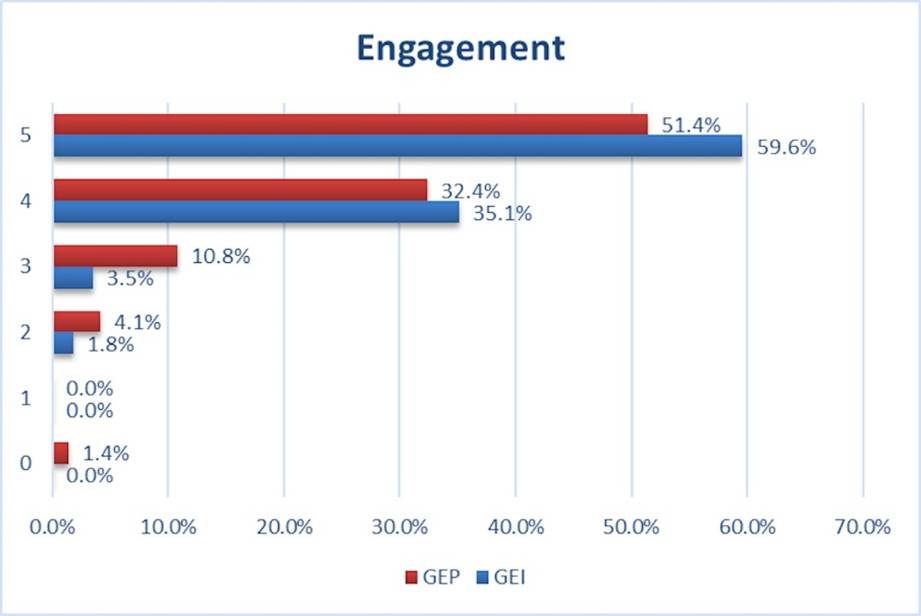
Regarding task engagement, GEI students accounted for 94.7% of responses at the
highest levels, whereas GEP students reached 83.8% (Figure 1). Similarly, in
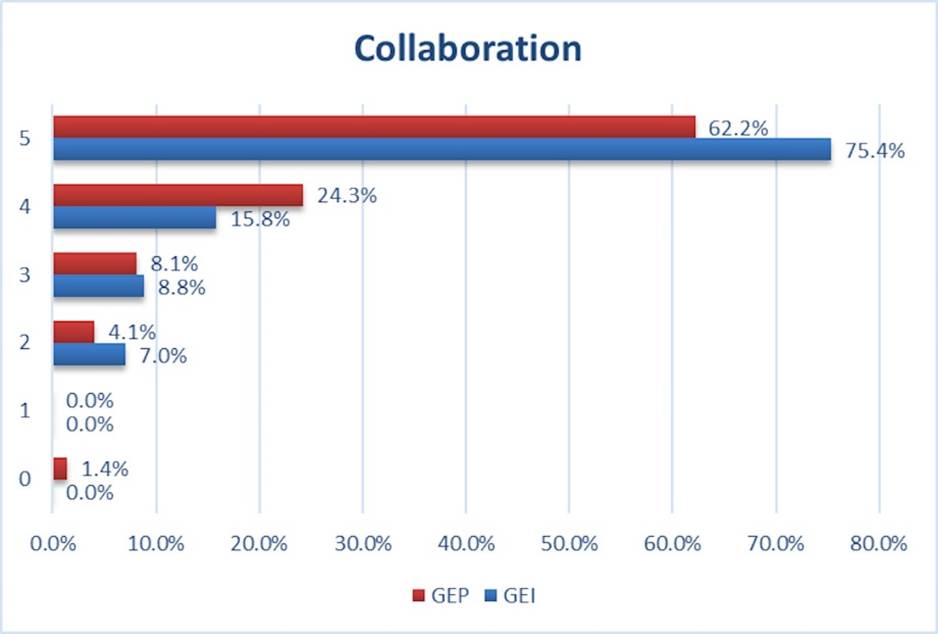
terms of collaboration, the percentages were 91.4% for GEI and 78% for GEP
(Figure 2). For learning, the corresponding values were 77.2% and 54%, and for
reflection, 85.9% and 63.5%, respectively.
Figure 1
Comparison of engagement
ratings by degree programme (GEI and GEP)
Source: own elaboration.
Figure 2
Comparison of collaboration
ratings by degree programme (GEI and GEP)
Source:
own elaboration.
When applying the Mann-Whitney U test, statistically significant
associations were found for the learning (p=0.002) and reflection (p=0.001)
items, which were also the two dimensions that received the lowest ratings,
particularly among GEP students. To determine the direction of these
differences, mean ranks were examined for both items, revealing that values
were noticeably higher for the GEI group. This suggests that GEI students
evaluated both learning and reflection more positively than their GEP counterparts
in the proposed activity. This trend is also reflected in the group mean scores
for these items (Table 4).
Table 4
Mean session evaluation
scores by degree programme
|
|
Learning |
Reflection |
|
GEI |
3.88 |
4.09 |
|
GEP |
3.30 |
3.51 |
3.2.5 Relationship between session evaluation and DC level
The results of Spearman’s correlation test yielded p-values greater than
0.05 for all items, indicating that none of the relationships examined reached
statistical significance. Consequently, no association appears to exist between
the level of DC and the evaluation of the different elements of the session.
3.3
Evaluation of the activity design: structure, content,
implemented dynamics and duration
Regarding the evaluation of the activity design, the implemented
dynamics and the duration of the session received the highest ratings, with
mean scores of 4.18 and 4.15, respectively. By contrast, the item related to
content obtained the lowest mean score (M=3.70), followed by structure
(M=3.96). These two items also showed the highest standard deviations (σ=1.18 and σ=0.94, respectively),
indicating greater variability in students’ perceptions.
In terms of response distribution, the item referring to the implemented
dynamics concentrated 80.1% of responses in the two highest categories, while
the item related to session duration obtained the same percentage. The items
referring to content and structure reached 63.4% and 76.3% of responses,
respectively, in these upper categories.
3.3.1 Relationships among activity design evaluation items
To examine the relationships among the activity design evaluation items,
Spearman’s correlation coefficient was applied. The analysis yielded p-values
below the 0.05 threshold for all pairwise comparisons. Moreover, all
correlations were positive, with the strongest association observed between
session structure and implemented dynamics (ρ=0.668). Other moderate
correlations were also identified, such as those between implemented dynamics
and content (ρ=0.520), and between
implemented dynamics and duration (ρ=0.510).
3.3.2 Relationship between design evaluation and route of access to
higher education
When applying the Kruskal-Wallis test, all
p-values obtained were greater than 0.05. Therefore, no statistically
significant relationship was found between students’ evaluation of the activity
design and their route of access to higher education.
3.3.3 Relationship between design evaluation and DC level
To analyse whether any relationship existed between perceived DC and the
evaluation of the activity design, Spearman’s correlation coefficient was
applied. In this case, no statistically significant correlations were found, as
all p-values were greater than 0.05. Therefore, no association appears to exist
between DC level and students’ evaluation of the session design.
3.3.4 Relationship between design evaluation and gender
When applying the Mann-Whitney U test, a single statistically
significant association was identified between gender and the evaluation of the
content addressed in the activity (p<0.001). Analysis of the corresponding
mean ranks shows that male participants (M=2.86) rated this aspect noticeably
lower than female participants (M=3.88), suggesting a more favourable
evaluation of the activity design among women.
3.3.5 Relationship between design evaluation and degree programme
When comparing responses by degree programme, the overall evaluation of
the activity design was very positive across both groups, although GEI students
provided more favourable ratings overall. Examination of the individual
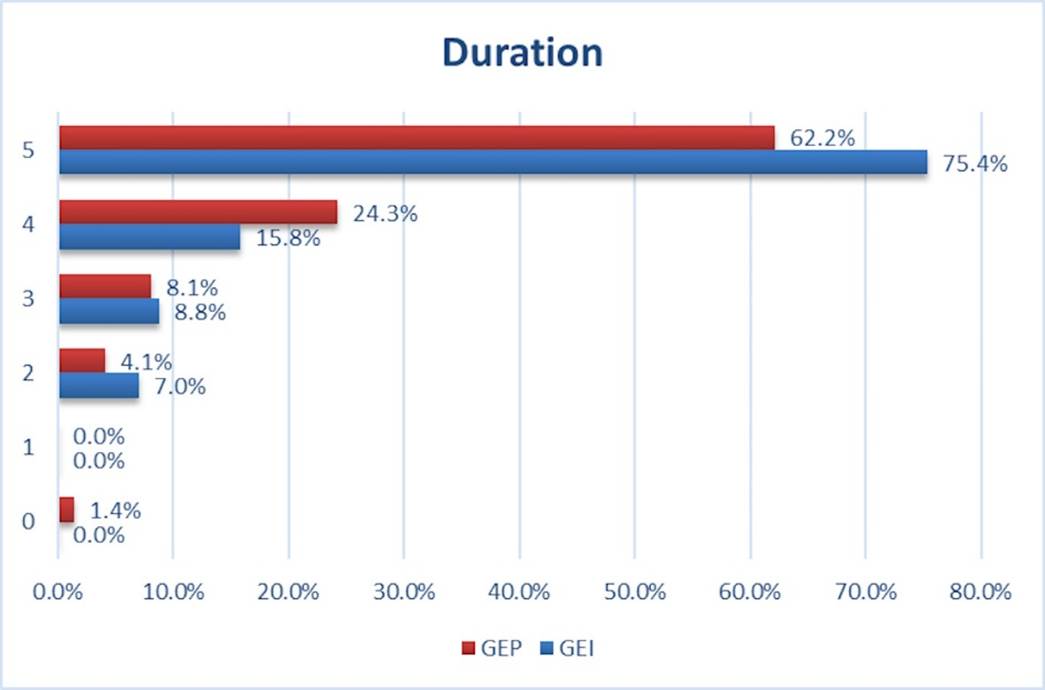
design-related items reveals that the duration of the activity (Figure 3) was
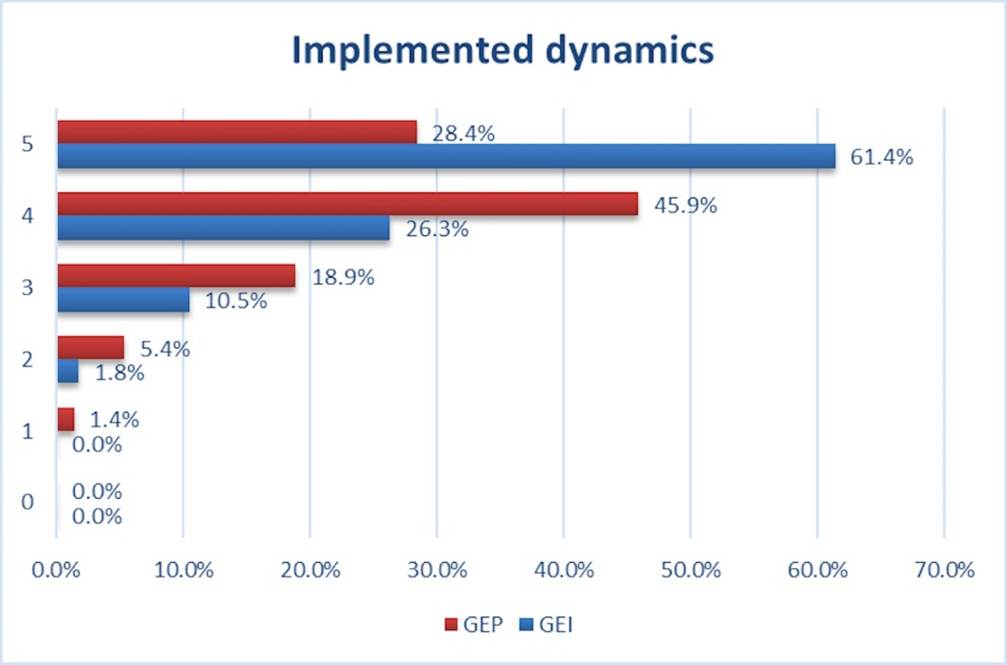
particularly well rated by both groups (GEI: 91.2%; GEP: 86.5%). With regard to the implemented dynamics (Figure 4), GEI
students rated this aspect considerably higher than GEP students (87.7%
compared to 74.3%). In terms of structure, 80.7% of GEI students rated the
activity in the two highest categories, compared to 73% of GEP students.
Finally, content received a moderately high evaluation among GEI students
(78.9%), whereas it reached only 51.3% of the most favourable ratings among GEP
students.
Figure 3
Comparison of activity
duration ratings by degree programme (GEI and GEP)
Source:
own elaboration.
Figure 4
Comparison of
implemented dynamics ratings by degree programme (GEI and GEP)
Source:
own elaboration.
When applying the Mann-Whitney U test, statistically significant
associations were found between degree programme and all four items used to
evaluate the activity design. To determine the direction of these differences,
mean ranks were examined, revealing that values for the GEI group were
consistently higher. This suggests that GEI students evaluated all aspects
related to the activity design more positively than GEP students, a pattern
that is also reflected in the mean scores reported in Table 5.
Table 5
Mean activity design
evaluation scores by degree programme
|
|
Structure |
Dynamics |
Content |
Duration |
|
GEI |
4.23 |
4.47 |
4.23 |
4.46 |
|
GEP |
3.76 |
3.95 |
3.30 |
3.91 |
3.4 Relationship between session and design
evaluations
When Spearman’s correlation test was applied, all correlations were
positive and the obtained p-values were below 0.05. This indicates that
students who rated any aspect of the session positively also tended to evaluate
the activity design favourably. It is also worth noting that several
associations stood out due to their strength, with relatively high rho (ρ) values, such as the relationship between
motivation and implemented dynamics (ρ=0.560), between
learning and dynamics (ρ=0.540), and between
learning and content (ρ=0.599).
4.
Discussion and Conclusions
Overall, the findings indicate that the objectives set out in this study
have been achieved. The most relevant results are outlined below.
The results show that participating students report a high level of
digital competence, in line with findings reported by Salas-Delgado et al.
(2022) across different university degree programmes. This suggests that
students perceive themselves as adequately prepared to work with digital
technologies in educational settings, highlighting the need for higher
education institutions to systematically incorporate these tools into their
curricula.
The evaluation of the gamified session supported by augmented reality
reveals a high level of student satisfaction, with engagement and collaboration
emerging as the most highly valued aspects. These findings are consistent with
those reported by Balbaa and Abdurashidova
(2023) and Li et al. (2023), who emphasise that such approaches promote
collaboration and student engagement. The strong correlation identified in this
study between engagement and collaboration suggests that students who feel more
engaged also tend to collaborate more actively. Similarly, Ramadhan et al.
(2022) note that gamified activities incorporating AR foster participation and
engagement, which aligns with the results obtained in the present study.
Students who reported higher levels of learning also indicated greater
reflection on the content. Lampropoulos and Sidiropoulos (2024) suggest that
the immediate feedback afforded by gamification supports this reflective
process. Other studies (Li et al., 2023; Murillo-Zamorano et al., 2021)
likewise identify gamification as an effective strategy for improving learning
outcomes, while Manzano-León et al. (2021) report a positive effect on academic
performance. Although learning was not the highest-rated item in the present
study, it was nevertheless perceived favourably by the
majority of participants. It is important to note, in line with studies
such as that by Buchner et al. (2022), which highlight the value of
implementing gamified activities after instruction, that the proposed
intervention was designed as a revision strategy and did not introduce new
content. For this reason, students may not have perceived the experience as
involving the acquisition of entirely novel knowledge.
In addition, a significant relationship was observed between the
evaluation of reflection and the route of access to higher education, with
students who entered university through a higher vocational qualification
assigning greater value to this aspect. This finding may be attributable to a
higher level of maturity stemming from their academic and life trajectories.
Motivation was also evaluated positively, reflecting students’ interest
in this type of approach, as evidenced by numerous studies. García-López et al.
(2023) highlight the effectiveness of gamification in enhancing motivation. Smiderle et al. (2020) likewise report positive effects,
while noting that these may vary according to personality traits, a factor not
considered in the present study. Two systematic reviews (Fitria, 2022; Infante-Villagrán et al., 2022) report improvements in motivation
across the majority of studies analysed. Similarly, Erylmaz and Boicu (2023) confirm this effect when examining
different gamification elements, observing increases in enthusiasm, engagement
and interest in the proposed challenges.
With regard to gender differences,
female students reported more positive evaluations in terms of engagement,
collaboration and learning. Sharma et al. (2023) highlight the existence of a
gender gap in the perception and acceptance of gamification and recommend the
inclusion of dynamics and challenges that are equally appealing and relevant to
all genders. Female students may find these activities more motivating, which
is reflected in higher levels of engagement, whereas male students may hold
different expectations shaped by prior experiences.
Focusing on the design of the activity, the overall evaluation was very
positive. The implemented dynamics and the duration of the session received the
highest scores, indicating favourable perceptions of both the way the activity
was conducted and the time allocated to it. Positive evaluations of the session
duration suggest that the time invested was perceived as appropriate,
contributing to an effective and engaging learning experience without
generating undue pressure (García-Iruela & Hijón Neira, 2020). Structure and content were also
positively assessed, albeit with greater variability in responses. This
suggests that students perceived consistency in the activity design, which is
essential for learning and helps to prevent cognitive overload (Romero & Kalmpourtzis, 2020). In this respect, the present study
contributes to the body of knowledge on the effects of gamification design, an
area in which a recent literature review has highlighted a scarcity of
empirical research (Infante-Villagrán et al., 2022).
It may therefore be argued that a well-structured design and appropriate
dynamics are key to the success of such initiatives, in line with the findings
reported by Nava (2024) in a review of educational breakout design.
Furthermore, the study also identified significant differences between
GEI and GEP students in their perceptions of both the session and the activity
design. For instance, GEI students rated the learning experience and reflection
more positively, as well as the overall design of the activity. No comparable
studies were found that would allow these differences to be directly
contrasted; they may therefore be attributable to contextual factors or to
differing expectations across groups. In this regard, the markedly higher
proportion of female students in the GEI group may also have played a role.
Beyond confirming that this type of experience enhances students’
motivation and engagement, the results also indicate that the same educational
breakout activity supported by augmented reality may be perceived differently
depending on the degree programme, particularly in dimensions related to
learning and reflection. These findings reinforce the notion that the impact of
gamified approaches does not depend solely on their design, but also on the
educational context and the learner profile, as noted by various authors
(Deterding et al., 2011; Murillo-Zamorano et al., 2021). Consequently,
particular attention should be paid to the role of the teacher as a key agent
in maximising the educational value of the experience, adapting it to the
specific context in which it is implemented.
Regarding the limitations of the study, it should first be noted that
the data were collected through a self-perception questionnaire, which may
entail response biases. Second, the analysed experience was conducted within a
specific and time-bound context, which prevents the assessment of potential
medium- and long-term effects. Finally, the exclusively quantitative approach
adopted limits an in-depth understanding of certain findings, which could have
been enriched through the inclusion of qualitative data.
With respect to future lines of research, several directions are
proposed. On the one hand, qualitative studies could be conducted to provide a
more detailed and nuanced understanding of the phenomenon. On the other hand,
expanding the sample to include different subjects, fields of knowledge or even
other universities would help to examine the consistency of the results
obtained. It would also be of interest to include actual academic performance
as an additional variable of analysis, in order to
explore its potential relationship with the factors examined.
Author
contributions
Study design, Author1; conceptualisation, Author1, Author2, Author3 and
Author4; methodology and data analysis, Author1; writing, review and editing,
Author1, Author2, Author3 and Author4.
Funding
This study was carried out as part of a teaching innovation project
awarded by the Institute for Educational Research and Innovation (IRIE) at the
University of the Balearic Islands (UIB), reference PID222453, within the
2022-2024 call.
Conflict of
interest
The authors declare no conflicts of interest.
References
Almeida, C., Kalinowski, M., & Feijó, B. (2021, September). A systematic mapping of negative
effects of gamification in education/learning systems. In 47th Euromicro Conference on Software Engineering and Advanced
Applications (SEAA) (pp. 17-24). IEEE.
https://doi.org/10.1109/SEAA53835.2021.00011
Ardila-Muñoz, J. Y. (2019).
Supuestos teóricos para la gamificación de la educación superior. Magis. Revista Internacional de
Investigación en Educación, 12(24), 71-84. https://doi.org/10.11144/Javeriana.m12-24.stge
Balbaa, M. E., & Abdurashidova,
M. (2023). Enhancing student engagement and learning outcomes through gamification
in education. In S. M. Curle y M. T. Hebebci (Eds.) Proceedings
of International Conference on Academic Studies in Technology and Education
2023 (pp. 13-20). Antalya, Turkiye. ARSTE
Organization. https://bit.ly/42TuLxl
Buchner, J., Rüter, M., & Kerres, M. (2022). Learning with a digital escape room
game: before or after instruction?. Research and
Practice in Technology Enhanced Learning, 17, 10 https://doi.org/10.1186/s41039-022-00187-x
Cerezo, L., y Pujolà, J. T.
(2024). Pedagogía lúdica digital (PLD): Videojuegos, minijuegos,
realidades extendidas y robots. En J. Muñoz-Basols, M. Fuertes Gutiérrez, y L.
Cerezo (Eds.), La enseñanza del español mediada por tecnología: De la
justicia social a la inteligencia artificial (IA) (pp. 311-340). Routledge.
https://doi.org/10.4324/9781003146391-16
Chóez Chiliquinga, E. N., y Larreal Bracho, A. J.
(2023). Gamificación y realidad aumentada como herramienta para enseñar y
aprender. Ciencia Latina Revista
Científica Multidisciplinar, 7(2), 1325-1335. https://doi.org/10.37811/cl_rcm.v7i2.5404
Coimbra, T., Cardoso, T., & Mateus, A. (2015). Augmented reality: an
enhancer for higher education students in math's learning?.
Procedia Computer Science, 67,
332-339. https://doi.org/10.1016/j.procs.2015.09.277
Corchuelo, C. (2018). Gamificación en educación superior:
Experiencia innovadora para motivar estudiantes y dinamizar contenidos en el
aula. Edutec, Revista Electrónica de
Tecnología Educativa, (63), 29-41. https://doi.org/10.21556/edutec.2018.63.927
Cuevas Monzonís, N., Cívico
Ariza, A., Gabarda Méndez, V., y Colomo Magaña, E. (2021). Percepción del
alumnado sobre la gamificación en la educación superior. REIDOCREA, 10(16),
1-12. http://dx.doi.org/10.30827/Digibug.66757
Destre, P. C., Barboza, J. R.
R., Garay, J. P., Sánchez, G. A. Á., y Albornoz, V. C. (2022). Gamificación
como técnica de motivación en el nivel superior. Horizontes. Revista de
Investigación en Ciencias de la Educación, 6(23), 484-496. https://doi.org/10.33996/revistahorizontes.v6i23.351
Deterding, S., Dixon, D., Khaled, R., & Nacke, L. (2011). From
Game Design Elements to Gamefulness: Defining
“Gamification”. 15th International Academic MindTrek
Conference: Envisioning Future Media Environments (pp. 9–15). ACM. https://doi.org/10.1145/2181037.2181040
Duterte, J. P. (2024). The Impact of Educational Gamification on Student
Learning Outcomes. International Journal of Research and Innovation in
Social Science, 8(10), 477-487. https://dx.doi.org/10.47772/IJRISS.2024.8100040
Erylmaz, Y., & Boicu, M.
(2023). The Impact of Gamification on Motivation and Engagement in Game-based
Learning Environments-A Literature Review. Journal of Student-Scientists'
Research, 5. https://doi.org/10.13021/jssr2023.3861
Fitria, T. N. (2022). The impact of gamification on students’
motivation: A Systematic Literature Review. Ling Tera,
9(2), 47–61. https://doi.org/10.21831/lt.v9i2.56616
Garcia-Iruela, M., & Hijón-Neira,
R (2020). What Perception Do Students Have About the Gamification Elements? IEEE
Access, 8, 134386-134392. https://doi.org/10.1109/ACCESS.2020.3011222
García-Iruela, M., Hijón-Neira, R., & Connolly,
C. (2022). Can Gamification Help in Increasing Motivation, Engagement, and
Satisfaction? A gamified experience in teaching CS to students from other
disciplines. Education in the Knowledge Society (EKS), 23,
e26932-e26932. https://doi.org/10.14201/eks.26932
García-López, I. M.,
Acosta-Gonzaga, E., & Ruiz-Ledesma, E. F. (2023). Investigating the impact
of gamification on student motivation, engagement, and performance. Education Sciences, 13(8), 813. https://doi.org/10.3390/educsci13080813
Infante-Villagrán, V. A.,
Maluenda-Albornoz, J. I., López-Angulo, Y., y Díaz-Mujica, A. (2022). Revisión
Sistemática acerca del Efecto de la Ludificación de la Enseñanza en la
Motivación de Estudiantes de Educación Superior. Revista Interuniversitaria
De Formación Del Profesorado, 97(36.3). https://doi.org/10.47553/rifop.v97i36.3.92641
Jiménez, J. (2020). La
gamificación en la educación superior: Una revisión bibliográfica actual para
su implantación en el grado de trabajo social. En R. Roig-Vila, (coord.). Redes
de Investigación e Innovación en Docencia Universitaria, 2020 (pp. 85-94).
Universidad de Alicante, Instituto de Ciencias de la Educación (ICE). https://bit.ly/3GPKtAZ
Kalogiannakis, M., Papadakis, S., & Zourmpakis,
A-I. (2021). Gamification in Science Education. A Systematic Review of the
Literature. Education Sciences, 11(1), 22. https://doi.org/10.3390/educsci11010022
Khaldi, A., Bouzidi, R., & Nader, F. (2023). Gamification of
e-learning in higher education: a systematic literature review. Smart
Learning Environments, 10, 10. https://doi.org/10.1186/s40561-023-00227-z
Lampropoulos, G., Keramopoulos, E., Diamantaras K.,
& Evangelidis, G. (2022). Augmented Reality and
Gamification in Education: A Systematic Literature Review of Research,
Applications, and Empirical Studies. Applied Sciences, 12(13), 6809. https://doi.org/10.3390/app12136809
Lampropoulos, G., & Sidiropoulos, A. (2024). Impact of Gamification
on Students’ Learning Outcomes and Academic Performance: A Longitudinal Study
Comparing Online, Traditional, and Gamified Learning. Education Sciences, 14(4),
367. https://doi.org/10.3390/educsci14040367
Li, M., Ma, S., & Shi, Y. (2023). Examining the effectiveness of
gamification as a tool promoting teaching and learning in educational settings:
a meta-analysis. Frontiers in Psychology, 14, 1253549. https://doi.org/10.3389/fpsyg.2023.1253549
Manzano-León, A.,
Camacho-Lazarraga, P., Guerrero, M.A., Guerrero-Puerta, L., Aguilar-Parra, J.
M., Trigueros, R., & Alias, A. (2021). Between Level Up and
Game Over: A Systematic Literature Review of Gamification in Education. Sustainability, 13(4),
2247. https://doi.org/10.3390/su13042247
Moreno Fuentes, E. (2019). El
“Breakout EDU” como herramienta clave para la
gamificación en la formación inicial de maestros/as. Edutec.
Revista Electrónica De Tecnología Educativa, 67. https://doi.org/10.21556/edutec.2018.66.1247
Murillo-Zamorano, L. R.,
López Sánchez, J. Á., Godoy-Caballero, A. L., & Bueno Muñoz, C. (2021). Gamification and active
learning in higher education: is it possible to match digital society, academia
and students' interests? International Journal of Educational Technology in
Higher Education, 18, 1-27. https://doi.org/10.1186/s41239-021-00249-y
Nand, K., Baghaei, N., Casey, J., Barmada, B., Mehdipour, F., &
Liang, H. (2019). Engaging children with educational content via gamification. Smart
Learning Environments, 6, 1-15. https://doi.org/10.1186/s40561-019-0085-2
Peñafiel, W. N. (2021). El enfoque complejo de las estrategias de
gamificación en la educación superior. Revista Eduser,
8(1), 90-103. https://doi.org/10.18050/eduser.v8i1.141
Pujolà, J. T., & Herrera,
F. J. (2020). Gamificación. In J. Muñoz-Basols, E. Gironzetti, & M. Lacorte
(Eds.), The Routledge Handbook of
Spanish Language Teaching:
Metodologías, contextos y recursos para la enseñanza del español L2 (pp.
583-595). Routledge.
Ramadhan, A. D., Permanasari, A. E., & Wibirama, S. (2022, December). Gamification opportunity in
augmented reality-based learning media: A review. En 2nd International
Conference on Intelligent Cybernetics Technology & Applications (ICICyTA) (pp. 117-122). IEEE. https://doi.org/10.1109/ICICyTA57421.2022.10037922
Rodríguez-Cardoso, Ó. I., Ballesteros-Ballesteros, V. A., & Lozano-Forero,
S. (2019). Tecnologías digitales para la innovación en educación: una revisión
teórica de procesos de aprendizaje mediados por dispositivos móviles. Pensamiento
y Acción, 28, 83-103. https://doi.org/10.19053/01201190.n28.2020.11192
Romero, M., & Kalmpourtzis, G. (2020). Constructive Alignment
in Game Design for Learning Activities in Higher Education. Information,
11(3), 126. https://doi.org/10.3390/info11030126
Rouse, W. (2017). Lessons learned while escaping from a zombie:
Designing a Breakout EDU game. The
History Teacher, 50(4), 553–564. https://bit.ly/4jaRKsM
Salas-Delgado, M. V.,
Portilla-Vilca, E., Chara-Barreda, C., & Turpo-Rodríguez, A. M. (2022,
September). Level of the dimensions of the digital competence in university students
from different academic areas. En XII
International Conference on
Virtual Campus (JICV) (pp. 1-4). https://doi.org/10.1109/JICV56113.2022.9934373
Sanz-Prieto, M., & de
Pablo González, G. (2021). Gamify Gamifying: Learning with Breakouts. En L.
Daniela (Ed.) Smart Pedagogy of Game-based Learning. Advances in Game-Based
Learning (pp. 103-118). Springer, Cham. https://doi.org/10.1007/978-3-030-76986-4_7
Serrano, F. J., & Martinez Carmona, M. (2024). La materia a través de un BreakoutEDU:
incorporación de metodologías activas en la formación inicial de docentes en
ciencias. Ápice. Revista de Educación Científica, 8(2). https://doi.org/10.17979/arec.2024.8.2.10670
Sharma, R., Sharma, H., Ali,
A., Sahani, C., & Gupta, P. (2023). An Empirical Study
Gender-Based Perception of Gamification and its Impact on Programming Skill
Enhancement. Journal of Informatics Education and Research, 3(2). https://doi.org/10.52783/jier.v3i2.91
Smiderle, R., Rigo, S. J.,
Marques, L. B., Peçanha de Miranda Coelho, J. A., & Jaques, P. A. (2020). The impact of
gamification on students’ learning, engagement and behavior
based on their personality traits. Smart Learning Environments, 7(1), 3.
https://doi.org/10.1186/s40561-019-0098-x
Suryani, A., Soedarso, S., Muhibbin, Z., Wahyuddin, W., & Saifulloh,
M. (2022). Youth as Educators: Cultivating Youth Digital Contribution to Community
Education. IJECA (International Journal of Education and Curriculum
Application), 5(2), 95-115. https://doi.org/10.31764/ijeca.v5i2.8470
Svanberg, M., & Bergh, D. (2023). Effects of Gamification in a
Teacher Education Program, 2010 to 2020. Sage Open, 13(1).
https://doi.org/10.1177/21582440231160995
Tang, Y., & Hu, J. (2022). The impact of teacher attitude and
teaching approaches on student demotivation: Disappointment as a mediator. Frontiers
in Psychology, 13, 985859. https://doi.org/10.3389/fpsyg.2022.985859
Treiblmaier, H., & Putz, L. M.
(2020). Gamification as a moderator for the impact of intrinsic motivation:
Findings from a multigroup field experiment. Learning and Motivation, 71,
101655. https://doi.org/10.1016/j.lmot.2020.101655
Weng, C., Tran, K. N. P., Yang, C. C., Huang, H. I., & Chen, H.
(2024). Can an augmented reality-integrated gamification approach enhance
vocational high school students' learning outcomes and motivation in an
electronics course? Education and Information Technologies, 29,
4025–4053. https://doi.org/10.1007/s10639-023-11966-4
Yang, S. Z. (2023). Gamification's Effect on Academic Motivation and
Progress. Lecture Notes in Education Psychology and Public Media, 7(1),
43-48. https://doi.org/10.54254/2753-7048/7/20220709